

Key Takeaways
- Home workouts eliminate commute time and membership costs, but require self-discipline and creative programming.
- Gyms offer specialized equipment and structured environments that can accelerate certain fitness goals.
- Neither option is universally superior - consistency in any setting outweighs the setting itself.
- A hybrid approach combining both environments works well for many people long-term.
- Always consult a qualified professional before beginning a new exercise program, especially with existing health conditions.
Our Verdict
Home training and gym training are both legitimate, effective paths to better fitness. The deciding factors are personal: your goals, budget, schedule, available space, and the conditions under which you actually show up and do the work. Neither environment guarantees results - your consistency and programming quality matter far more than the location.
| Best for | Recommended |
|---|---|
| Those with tight schedules or limited budgets | Home Workouts |
| Those pursuing advanced strength or specialized athletic goals | Gym Training |
| Beginners building foundational movement habits | Home Workouts |
| Those who thrive with social accountability and variety | Gym Training |
The Core Question: Environment or Consistency?
The debate between home workouts and gym training tends to generate strong opinions, but the evidence is fairly clear on one point: the environment matters far less than the effort applied within it. Research consistently shows that adherence - simply continuing to exercise over time - is the single greatest predictor of fitness outcomes. That makes choosing the setting where you're most likely to show up regularly the most important decision you can make.
Still, each environment has real, structural advantages and disadvantages worth understanding. This isn't about which is objectively better - it's about which fits your life more honestly. For a broader look at how fitness misconceptions shape these decisions, see our piece on common fitness myths that often steer people in the wrong direction.
Home Workouts: Genuine Strengths and Real Limitations
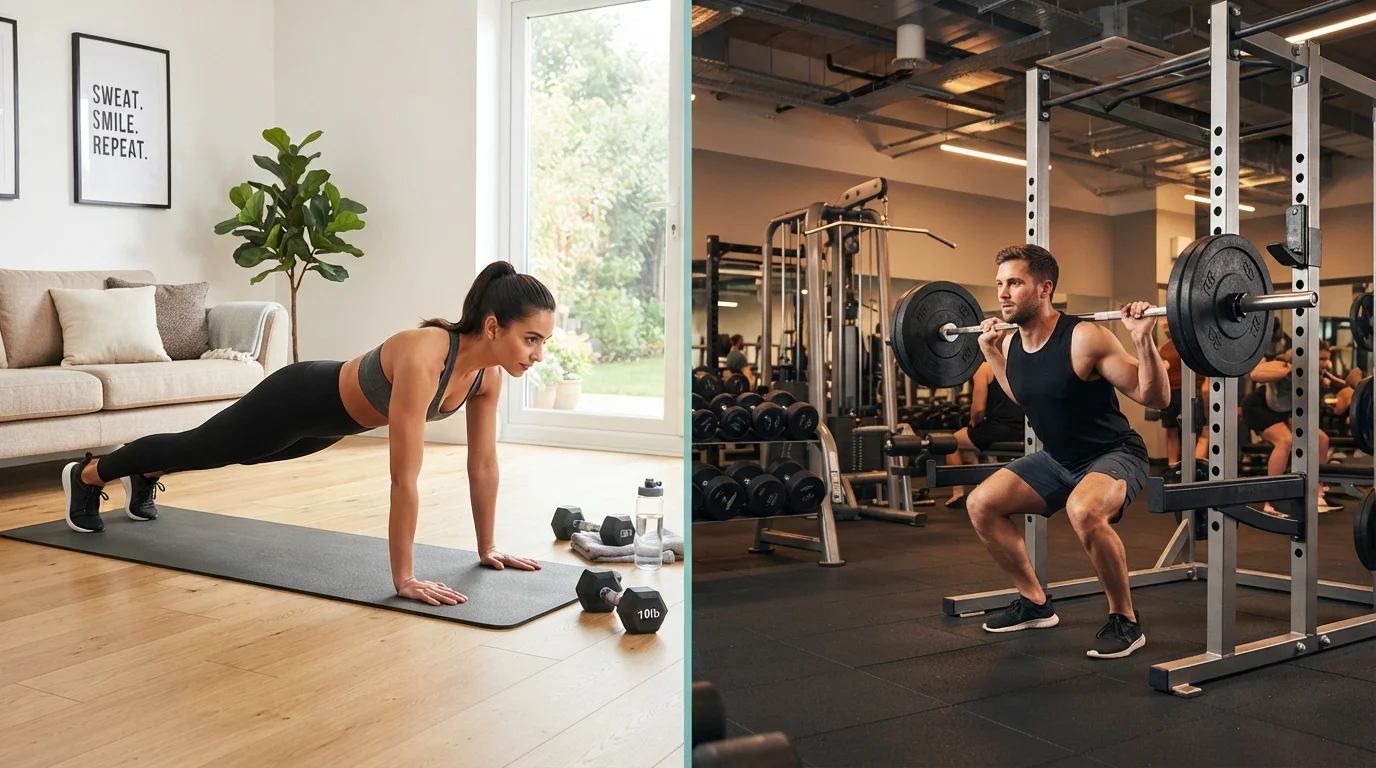
Training at home removes several practical barriers. There's no commute, no membership fee, no waiting for equipment, and no social anxiety about being observed. For many people - especially those with demanding schedules, caregiving responsibilities, or limited transportation - these aren't small conveniences. They're the difference between exercising and not exercising.
Bodyweight training, resistance bands, and a modest set of dumbbells or kettlebells can support substantial fitness gains, particularly for cardiovascular health, muscular endurance, and foundational strength. If your goals include general fitness, weight management, or building consistent movement habits, a home setup can serve you well.
The limitations become meaningful as goals advance. Progressive overload - systematically increasing the challenge your muscles face over time - is central to strength development. Our strength training fundamentals guide explains why this concept is non-negotiable for long-term progress. At home, programming progressive overload requires creativity and, eventually, investment in additional equipment. Space constraints and noise considerations (particularly in apartments) add further friction.
Start Simple, Then Build
If you're new to home training, resist the urge to invest heavily in equipment before establishing a consistent routine. Bodyweight movements - squats, push-ups, lunges, planks - build a strong foundation and require no equipment at all. Once you've maintained a regular habit for several weeks, you'll have a much clearer sense of which tools are actually worth the investment for your goals.
Gym Training: What It Actually Offers
A well-equipped gym provides access to a range of tools that are impractical to replicate at home: barbells with heavy plate stacks, cable machines, squat racks, rowing ergometers, and more. For people pursuing specific strength benchmarks, athletic performance, or rehabilitation-adjacent work, this equipment access is genuinely significant rather than merely convenient.
The social environment also plays a real role for many exercisers. The presence of others working hard, the availability of coaching staff, and the psychological separation of a dedicated fitness space can all support motivation and habit formation. Group fitness classes add structured variety that solo home programming sometimes lacks.
The trade-offs are equally real. Monthly membership costs accumulate. Commute time - even 15 minutes each way - adds friction that compounds over weeks and months, and research on exercise behavior suggests that perceived inconvenience is a leading reason people discontinue gym memberships. Peak-hour crowding limits equipment access, and for those with social anxiety, the gym environment itself can be a deterrent rather than a motivator.
| Home Workouts | Gym Training | |
|---|---|---|
| Upfront & ongoing cost | Low to moderate (equipment only) | Ongoing membership fees |
| Time investment (inc. travel) | Minimal - no commute | Higher - commute adds time |
| Equipment variety | Limited by space and budget | Extensive, regularly maintained |
| Progressive overload potential | Requires creative programming | Straightforward with available weights |
| Social accountability | Self-directed only | Peers, classes, and staff available |
| Accessibility (weather, hours) | Always available, weather-proof | Subject to hours and commute |
| Privacy and comfort | High - no social anxiety | Variable - public environment |
Matching Your Choice to Your Goals and Lifestyle
If your primary goals are cardiovascular health and general movement, home-based approaches - including bodyweight circuits, yoga, and low-intensity steady-state cardio - can get you there effectively. Our overview of Zone 2 training illustrates how impactful lower-intensity, accessible workouts can be for long-term health. Similarly, understanding the differences between HIIT and steady-state cardio can help you structure effective home sessions without specialized equipment.
If you're working toward significant strength gains, sport-specific performance, or you simply know from experience that you train harder and more consistently in a structured external environment, a gym membership is likely worth the cost and time investment. A hybrid approach - maintaining minimal home equipment for high-frequency, lower-intensity sessions while using gym access for heavier or more specialized work - is a practical middle path that many people find sustainable.
The parallel here to other self-directed lifestyle decisions is worth noting. Much like the trade-offs of studying entirely online, choosing a home fitness environment offers flexibility at the cost of structure - and thriving in it demands self-direction.
This article is for general informational and educational purposes only and is not a substitute for professional medical or fitness advice. Consult a qualified healthcare provider or certified fitness professional before beginning a new exercise program, particularly if you have existing health conditions or injuries.