

Key Takeaways
- Stress is typically tied to an identifiable external stressor and tends to resolve when that stressor is removed.
- Anxiety involves persistent worry or apprehension that continues even without a clear, present threat.
- Both activate the body's fight-or-flight system, but their coping strategies differ meaningfully.
- Chronic, high-intensity anxiety that interferes with daily life warrants evaluation by a qualified mental health professional.
- Correctly identifying which experience you're having helps you choose more effective coping strategies.
Option A
Stress
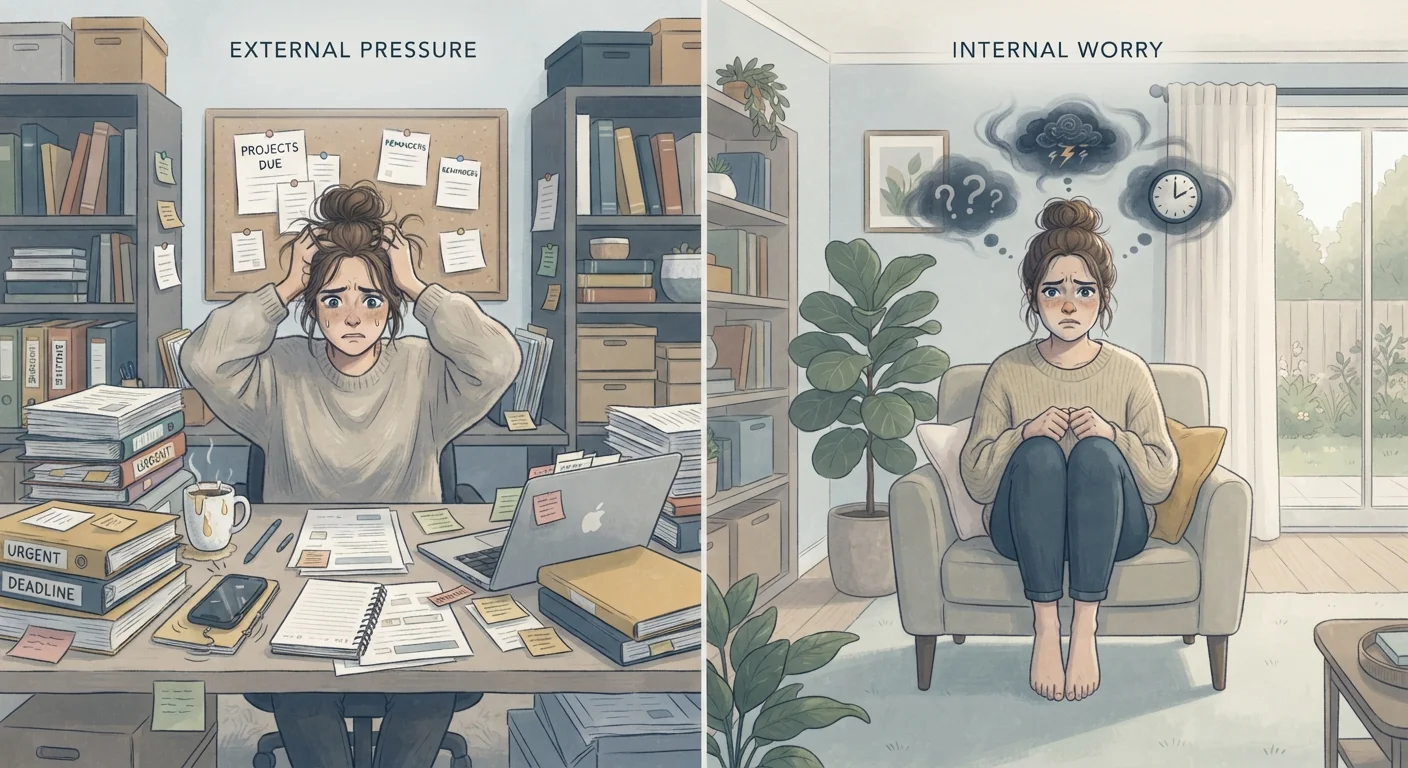
The external-pressure response with an identifiable cause.
Best for: Understanding when a real-world demand is driving your tension and needs a practical solution.
Option B
Anxiety
The internal worry loop that persists beyond the trigger.
Best for: Recognizing when worry has taken on a life of its own, unconnected to an immediate threat.
If your tension is tied to a specific deadline, conflict, or demand
Address Stress
Problem-focused strategies - time management, boundary-setting, delegating - directly reduce the external load driving your symptoms.
If worry persists after the situation resolves or has no clear trigger
Address Anxiety
Anxiety responds better to techniques that shift internal thought patterns, such as cognitive restructuring, mindfulness, or professional support.
If symptoms are frequent, intense, or interfering with relationships or work
Consult a Mental Health Professional
Both chronic stress and anxiety disorders benefit from clinical evaluation; self-help strategies have limits and a professional can tailor a plan.
Same Feelings, Different Sources
A racing heart, tight shoulders, difficulty concentrating - stress and anxiety share a remarkably similar physical signature. Both activate the autonomic nervous system's fight-or-flight response, flooding the body with stress hormones such as cortisol and adrenaline. That overlap is exactly why the two are so routinely conflated.
The meaningful distinction lies in origin. Stress is a response to an identifiable external demand: a looming work deadline, a difficult conversation, a financial shortfall. It is, in a real sense, appropriate - the brain and body mobilizing to meet a perceived challenge. When the stressor resolves, the physical symptoms typically fade with it.
Anxiety, by contrast, involves worry or apprehension that doesn't neatly track an external trigger. It can arise in anticipation of something that may never happen, persist long after a stressor has passed, or appear with no discernible cause at all. The distress feels real and urgent, but the threat driving it is often internal and speculative rather than concrete and present.
This is not a trivial semantic difference. Understanding which experience is dominant shapes which coping tools are likely to help - and which might inadvertently make things worse.
Stress vs. Anxiety: A Closer Look
To make this practical, consider a useful frame: stress asks "What do I need to do?" while anxiety asks "What if something goes wrong?" The first is oriented toward a real problem; the second is oriented toward an uncertain future.
| Criterion | Stress | Anxiety |
|---|---|---|
| Primary driver | Identifiable external stressor | Internal worry, often no clear trigger |
| Duration | Typically resolves with stressor | Persists beyond or independent of triggers |
| Core question | "What do I need to do?" | "What if something goes wrong?" |
| Body's response | Fight-or-flight activation | Fight-or-flight activation (same) |
| Best coping approach | Problem-focused action, rest | Thought reframing, mindfulness, professional support |
| When to seek help | If chronic or physically harmful | If frequent, intense, or impairing daily life |
It's also worth noting that chronic stress and anxiety can influence each other. Sustained, unresolved stress can lower the threshold at which anxiety emerges. Conversely, anxiety about potential stressors can amplify physiological stress responses even before a challenge materializes. The two often coexist, which is another reason careful self-observation matters.
Coping Strategies That Actually Match the Problem
For stress, the most effective approaches are generally problem-focused. Breaking a large task into smaller steps, negotiating a deadline, having a difficult conversation you've been avoiding - these tackle the external source directly. Rest and recovery also matter: the body needs time to return to baseline after sustained activation. See our guide to genuine psychological recovery for an important distinction between passive rest and the kind that actually restores capacity.
For anxiety, problem-solving the imagined threat rarely helps and can reinforce the worry loop. More useful approaches involve shifting how you relate to the anxious thought - observing it without accepting it as fact, gently redirecting attention, and building tolerance for uncertainty. Mindfulness and meditation are two overlapping but distinct tools in this space, each with its own applications.
When anxiety is frequent, intense, or disrupting daily functioning - sleep, relationships, work - it crosses a threshold that self-help strategies may not adequately address. Anxiety disorders are among the most common and most treatable mental health conditions, and professional evaluation is the appropriate next step. If you're unsure what kind of support fits your situation, understanding the differences between therapy, coaching, and self-guided approaches is a practical place to start.
When the Line Becomes Harder to See
In practice, stress and anxiety frequently overlap, especially when stress is prolonged. Sustained high stress can sensitize the nervous system, making anxiety responses more likely over time. If you notice worry intensifying even as external pressures decrease, that shift is worth paying attention to. A mental health professional can help clarify what's driving your experience and recommend an approach suited to it.
This article is for general informational purposes only and is not a substitute for professional mental health advice, diagnosis, or treatment. If you are experiencing significant distress, please consult a qualified healthcare or mental health professional.