

Key Takeaways
- Daily mood tracking can strengthen self-awareness and help identify emotional patterns over time.
- Consistent tracking may support more productive conversations with therapists or healthcare providers.
- Over-monitoring can increase anxiety or shift attention away from living in the present moment.
- The method you choose - app, journal, or simple scale - significantly affects sustainability.
- Mood data is most useful when paired with context, not treated as a standalone score.
Reveals emotional patterns invisible day to day
A single day's mood is easy to dismiss or forget. A week or month of logged data can surface consistent patterns - such as mood dips on Sunday evenings or energy lifts after exercise - that would otherwise go unnoticed.
Helps identify personal triggers
When mood ratings are paired with contextual notes (sleep, diet, social interactions, stress), it becomes easier to correlate specific circumstances with emotional shifts, giving users more agency over their environment.
Improves communication with mental health providers
Many therapists and psychiatrists find mood logs clinically useful, as they provide a more accurate picture of a client's experience between sessions than memory alone typically allows.
Builds emotional vocabulary over time
The practice of labeling emotions precisely - distinguishing anxious from irritable, for example - can gradually expand emotional literacy, which is associated with better regulation and interpersonal communication.
Creates a low-effort mindfulness pause
Taking 30-60 seconds to check in with your emotional state requires intentional self-awareness, which can serve as a micro-mindfulness practice even for people who don't meditate formally.
Can trigger rumination and self-focus
Reviewing negative emotional states repeatedly - especially without a constructive framework - can intensify them rather than build perspective. This risk is higher for people already prone to anxious or depressive thinking.
Data may feel discouraging rather than empowering
Seeing a string of low-mood entries can demoralize rather than motivate, particularly if the tracker lacks tools to contextualize what the pattern means or how to respond.
Mood scores oversimplify emotional complexity
Reducing a day's emotional experience to a number or emoji inevitably loses nuance. Mixed emotions, ambivalence, and context-dependent states don't translate cleanly to a simple scale.
Habit can become obsessive or anxiety-producing
For some individuals, especially those with health anxiety or OCD traits, frequent self-monitoring can amplify rather than reduce distress by creating excessive preoccupation with emotional fluctuation.
Inconsistency limits the data's usefulness
Mood tracking only yields meaningful patterns with consistent input. Sporadic logging creates incomplete records that can mislead rather than illuminate, and the pressure to be consistent can itself become a stressor.
Our Verdict
Daily mood tracking is a genuinely useful self-awareness tool for many people, but it works best when kept simple and used as a guide rather than a judgment. The practice carries real benefits for pattern recognition and clinical communication, while also carrying real risks of over-monitoring and emotional rumination. Like most wellness habits, the value depends heavily on how it's done and whether it fits naturally into daily life.
People who want to build emotional self-awareness, support mental health care, or identify lifestyle triggers will likely benefit most - provided they approach tracking with curiosity rather than self-criticism.
What Daily Mood Tracking Actually Involves
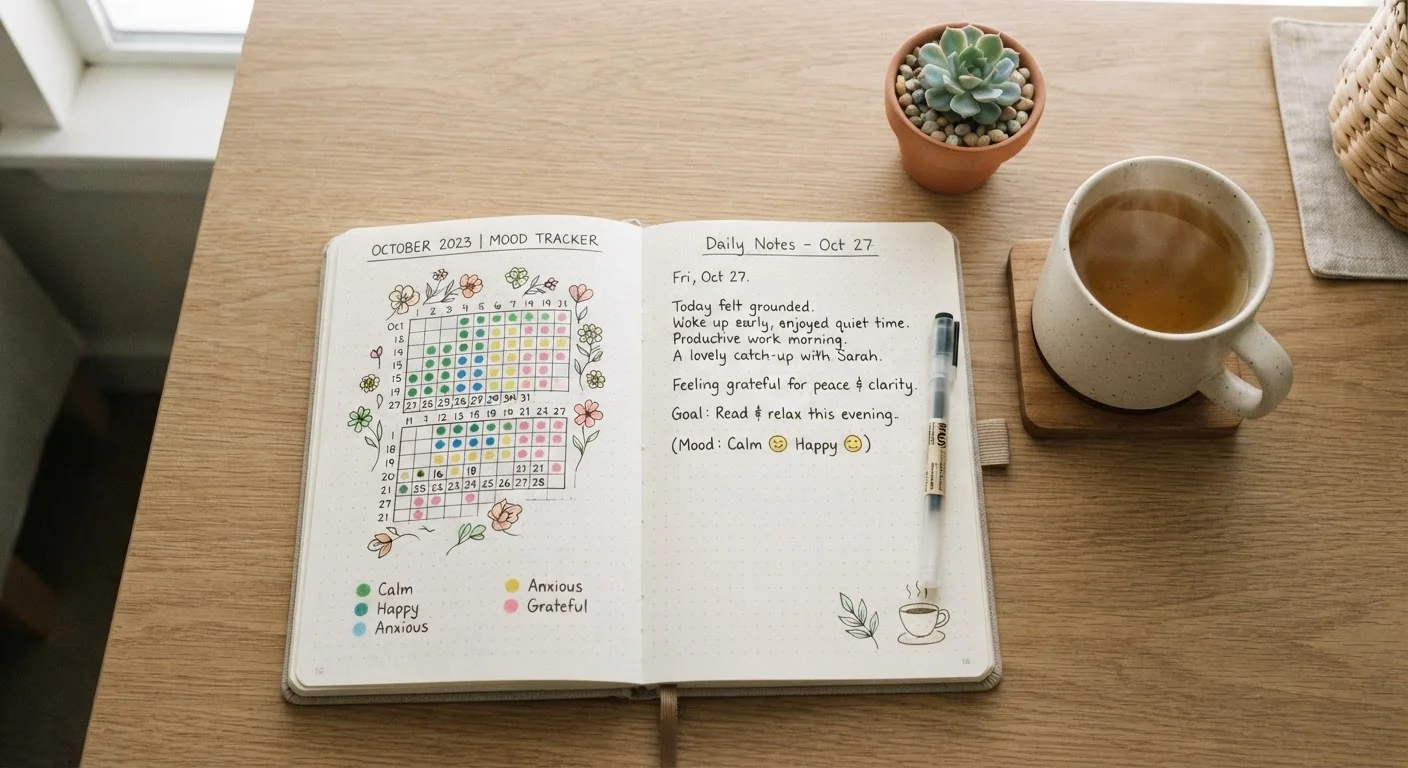
Mood tracking is the practice of regularly recording your emotional state - typically once or more per day - using a structured format. That format might be a numbered scale, a color-coded app, a few written sentences in a journal, or a simple emoji check-in. The goal is to build a consistent record of how you feel across time, so that patterns and triggers become easier to recognize.
Unlike journaling in a freeform, narrative style, mood tracking tends to be brief and structured. Many people combine both: logging a quick emotional rating digitally and expanding on the context in a written entry. If you're exploring that combination, our guide to structured journaling techniques covers approaches that pair well with numeric tracking.
Before weighing the pros and cons, it's worth noting that mood tracking is a self-monitoring tool - not a diagnostic one. It doesn't replace professional mental health assessment, and any patterns you notice should be discussed with a qualified healthcare provider rather than self-interpreted as a diagnosis.
The Advantages of Tracking Your Mood Daily
For many people, the benefits of consistent mood tracking are both immediate and cumulative.
Reveals emotional patterns invisible day to day
A single day's mood is easy to dismiss or forget. A week or month of logged data can surface consistent patterns - such as mood dips on Sunday evenings or energy lifts after exercise - that would otherwise go unnoticed.
Helps identify personal triggers
When mood ratings are paired with contextual notes (sleep, diet, social interactions, stress), it becomes easier to correlate specific circumstances with emotional shifts, giving users more agency over their environment.
Improves communication with mental health providers
Many therapists and psychiatrists find mood logs clinically useful, as they provide a more accurate picture of a client's experience between sessions than memory alone typically allows.
Builds emotional vocabulary over time
The practice of labeling emotions precisely - distinguishing anxious from irritable, for example - can gradually expand emotional literacy, which is associated with better regulation and interpersonal communication.
Creates a low-effort mindfulness pause
Taking 30-60 seconds to check in with your emotional state requires intentional self-awareness, which can serve as a micro-mindfulness practice even for people who don't meditate formally.
~58%
Adults who report low emotional self-awareness
Research published in the journal Emotion suggests that many adults have difficulty accurately labeling their emotional states, which structured self-monitoring may help address over time.
6-8 weeks
Typical timeframe to surface mood patterns
Mental health clinicians generally suggest that at least four to eight weeks of consistent data are needed before meaningful personal patterns become statistically visible.
Beyond the data itself, the act of pausing to check in emotionally - even for 30 seconds - can function as a brief mindfulness moment. It interrupts automatic-pilot thinking and encourages a small degree of self-reflection that many people find grounding. This connects naturally to broader mental wellness practices; see how mindfulness fits into the picture in our article on mindfulness vs. meditation.
The Disadvantages Worth Taking Seriously
Mood tracking isn't the right fit for everyone, and even people who benefit from it can encounter genuine downsides if the practice isn't approached carefully.
Can trigger rumination and self-focus
Reviewing negative emotional states repeatedly - especially without a constructive framework - can intensify them rather than build perspective. This risk is higher for people already prone to anxious or depressive thinking.
Data may feel discouraging rather than empowering
Seeing a string of low-mood entries can demoralize rather than motivate, particularly if the tracker lacks tools to contextualize what the pattern means or how to respond.
Mood scores oversimplify emotional complexity
Reducing a day's emotional experience to a number or emoji inevitably loses nuance. Mixed emotions, ambivalence, and context-dependent states don't translate cleanly to a simple scale.
Habit can become obsessive or anxiety-producing
For some individuals, especially those with health anxiety or OCD traits, frequent self-monitoring can amplify rather than reduce distress by creating excessive preoccupation with emotional fluctuation.
Inconsistency limits the data's usefulness
Mood tracking only yields meaningful patterns with consistent input. Sporadic logging creates incomplete records that can mislead rather than illuminate, and the pressure to be consistent can itself become a stressor.
When Tracking May Not Be the Right Tool
For individuals currently experiencing major depression, OCD, or severe anxiety, intensive self-monitoring may not be appropriate without professional guidance. If you find that tracking your mood consistently makes you feel worse rather than more informed, that's a meaningful signal worth discussing with a mental health provider. The practice should feel like gathering useful information - not like performing an audit on yourself.
The risk of rumination is particularly worth understanding. Research in clinical psychology distinguishes between reflective self-focus - which tends to be adaptive - and ruminative self-focus, which is associated with worsening depressive symptoms. Mood tracking can tip into the latter if entries become a space for dwelling on negative feelings rather than observing them with some detachment.
How to Track in a Way That Serves You
The method matters as much as the habit itself. A few evidence-informed principles can help make tracking more sustainable and useful:
- Keep it brief. A single rating on a 1-10 scale with one sentence of context is often more sustainable - and less ruminative - than lengthy daily self-assessments.
- Track at a consistent time. End-of-day tracking tends to capture overall tone; mid-day tracking can catch situational influences. Pick one and stick to it.
- Add context, not just scores. A mood score without situational notes (sleep quality, major stressors, social contact) has limited interpretive value.
- Review weekly, not daily. Looking for patterns across a week is usually more informative than scrutinizing individual data points.
- Bring your data to your provider. A mood log can be a genuinely useful clinical communication tool - share it with your therapist or doctor rather than interpreting it alone.
If you're thinking about how mood tracking fits into a broader approach to daily well-being, our article on building a daily mental wellness routine offers a practical framework for layering habits sustainably.
This article is for general informational and educational purposes only. It is not a substitute for professional mental health advice, diagnosis, or treatment. If you are experiencing significant emotional distress, please consult a qualified healthcare professional.