

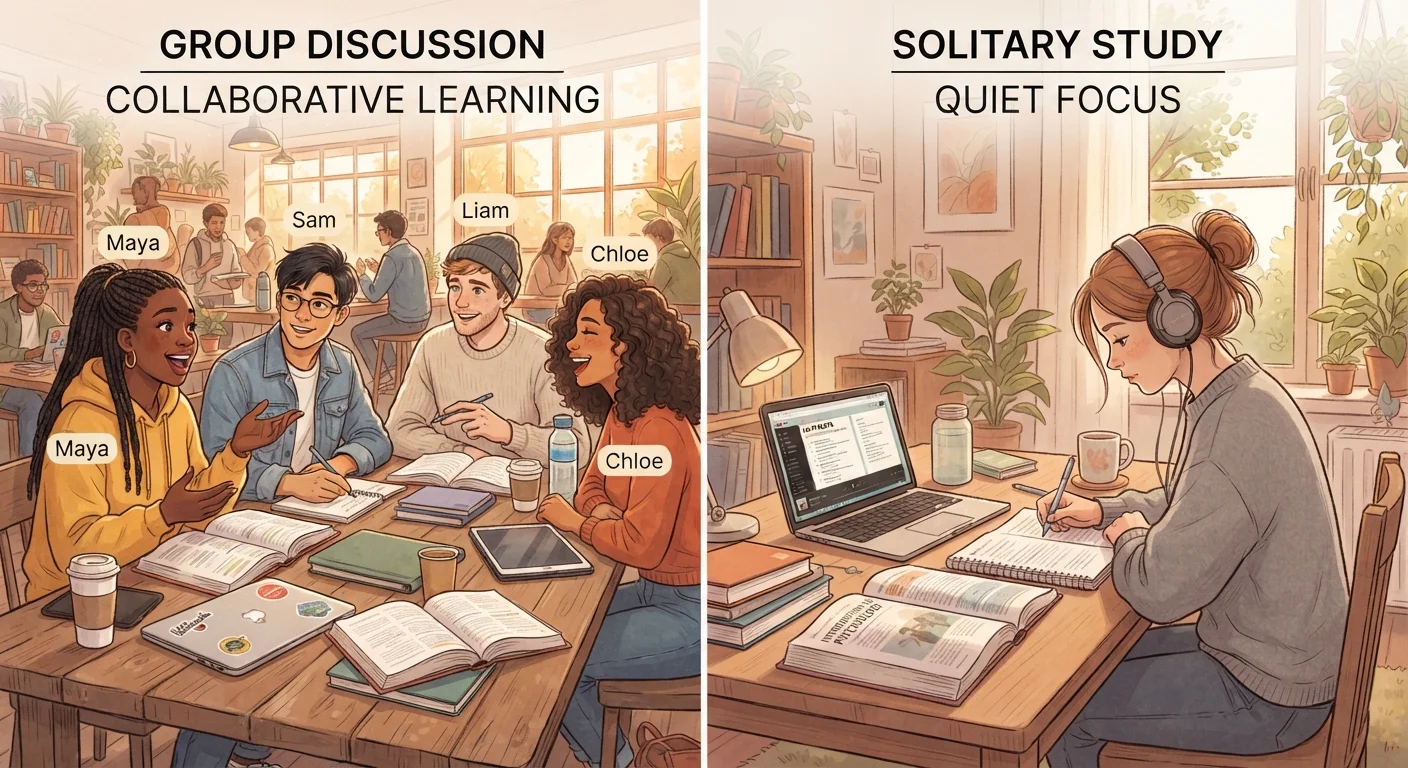
Key Takeaways
- Community learning builds accountability and exposes you to diverse perspectives, which can deepen retention.
- Solo study offers flexible pacing and privacy, making it easier to fit learning into an unpredictable schedule.
- Neither approach is universally superior - your goals, personality, and subject matter all matter.
- Many learners benefit from blending both methods rather than committing exclusively to one.
- Research suggests social learning can improve long-term recall, but only when engagement is genuine and sustained.
Our Verdict
Community learning tends to produce stronger accountability and richer understanding through discussion, making it well-suited for complex or motivation-dependent subjects. Solo study excels when flexibility, privacy, or deep focus are priorities. For most adult learners pursuing personal enrichment, a deliberate combination of the two approaches yields the most durable results.
| Best for | Recommended |
|---|---|
| Those who struggle with motivation or need external structure | Community Learning |
| Learners with irregular schedules or highly personal study goals | Solo Study |
| Anyone tackling complex subjects that benefit from debate and discussion | Community Learning |
| Learners who want maximum control over pace, depth, and direction | Solo Study |
What Each Approach Actually Involves
Community learning encompasses any setting where you study alongside others - cohort-based online courses, book clubs, study groups, discussion forums, or in-person classes. The defining feature is interaction: ideas are tested, challenged, and refined through dialogue. Solo study, by contrast, places you alone with your materials. You set the agenda, control the pace, and choose when to pause or accelerate.
These aren't fixed categories. A learner might follow a self-paced video course (solo) while also posting in a peer forum (community). Understanding the differences between MOOCs, cohort courses, and self-paced programs is a useful starting point, since format often determines how much peer interaction is built in by design.
| Community Learning | Solo Study | |
|---|---|---|
| Accountability | High - peers create social pressure | Low - self-generated only |
| Scheduling flexibility | Limited by group or cohort timing | Fully flexible, learner-controlled |
| Depth of discussion | Rich, multi-perspective dialogue | Depends on learner's initiative |
| Privacy | Lower - ideas shared with others | High - fully private |
| Retention potential | Strong when engagement is active | Strong with active study techniques |
| Cost and access | Varies; cohorts often cost more | Often lower cost or free resources |
| Best subject fit | Complex, interpretive, or social topics | Technical, factual, or niche topics |
How Each Method Affects Retention
Learning science offers some useful guidance here. Social or collaborative learning environments can strengthen retention when learners actively explain concepts to one another - a phenomenon sometimes called the protégé effect. Teaching or discussing material forces you to organize and articulate knowledge, which tends to embed it more deeply than passive review.
Solo study, however, is not inherently shallower. Techniques like spaced repetition, retrieval practice, and interleaving are highly effective and work well in private, self-directed settings. The key variable isn't whether you're alone or with others - it's whether you're actively engaging with the material or passively consuming it.
~90%
Retention rate from teaching others
The National Training Laboratories' Learning Pyramid model (widely cited, though debated in peer-reviewed literature) suggests teaching others yields the highest average retention - reinforcing why community discussion may deepen recall.
40-60%
Online self-paced course completion rate gap
Research consistently finds that self-paced MOOCs have significantly lower completion rates than cohort-based formats, highlighting accountability as a key differentiator.
For learners pursuing career skill development, the retention question has practical stakes: skills that don't stick don't transfer to the workplace, regardless of how the course was delivered.
The Accountability Factor
One of the clearest advantages of community learning is built-in accountability. When peers expect your participation - whether in a live session, a group project, or a shared discussion thread - the social cost of disengaging is real. This external pressure can be especially useful for learners who find self-motivation difficult over weeks or months.
Solo learners must manufacture their own accountability structures: calendar blocks, personal deadlines, or progress tracking. This is achievable but requires deliberate effort. Our related piece on habits of successful online learners identifies consistent scheduling as one of the most reliable differentiators between those who complete self-directed courses and those who drop off.
Try a Hybrid Approach First
Before committing fully to solo or community study, experiment with a blended model for four to six weeks. Join one community forum or study group while keeping the bulk of your study time self-directed. Track your motivation and comprehension week by week - most learners find a natural ratio that works for their lifestyle and subject matter.
If you lean toward solo study, consider adding a single lightweight community touchpoint - even a weekly check-in with one other learner - to replicate some of the accountability benefits without sacrificing flexibility.
Flexibility, Privacy, and Personal Fit
Solo study wins clearly on flexibility. You can learn at midnight, skip a chapter, revisit a confusing section, or abandon a topic that turns out to be irrelevant - without negotiating with anyone. For adults balancing work, caregiving, or irregular schedules, this autonomy is often non-negotiable.
Privacy is an underrated factor too. Some learners feel more comfortable exploring unfamiliar or sensitive subjects without an audience. Others find that group dynamics introduce social anxiety that competes with genuine learning.
Community learning, meanwhile, exposes you to perspectives and interpretations you wouldn't generate alone. This is particularly valuable in subjects involving judgment, ethics, history, or strategy - areas where a single viewpoint is inherently limited. The comparison of formal courses versus self-directed study explores how structure and freedom each serve different learner types in more depth.
Ultimately, neither approach is inherently superior. Your subject matter, personality, schedule, and specific goals all influence which environment allows you to do your most genuine, lasting learning. Many adults pursuing lifelong enrichment find that intentionally alternating between both modes keeps engagement high while covering the weaknesses each method carries alone.