

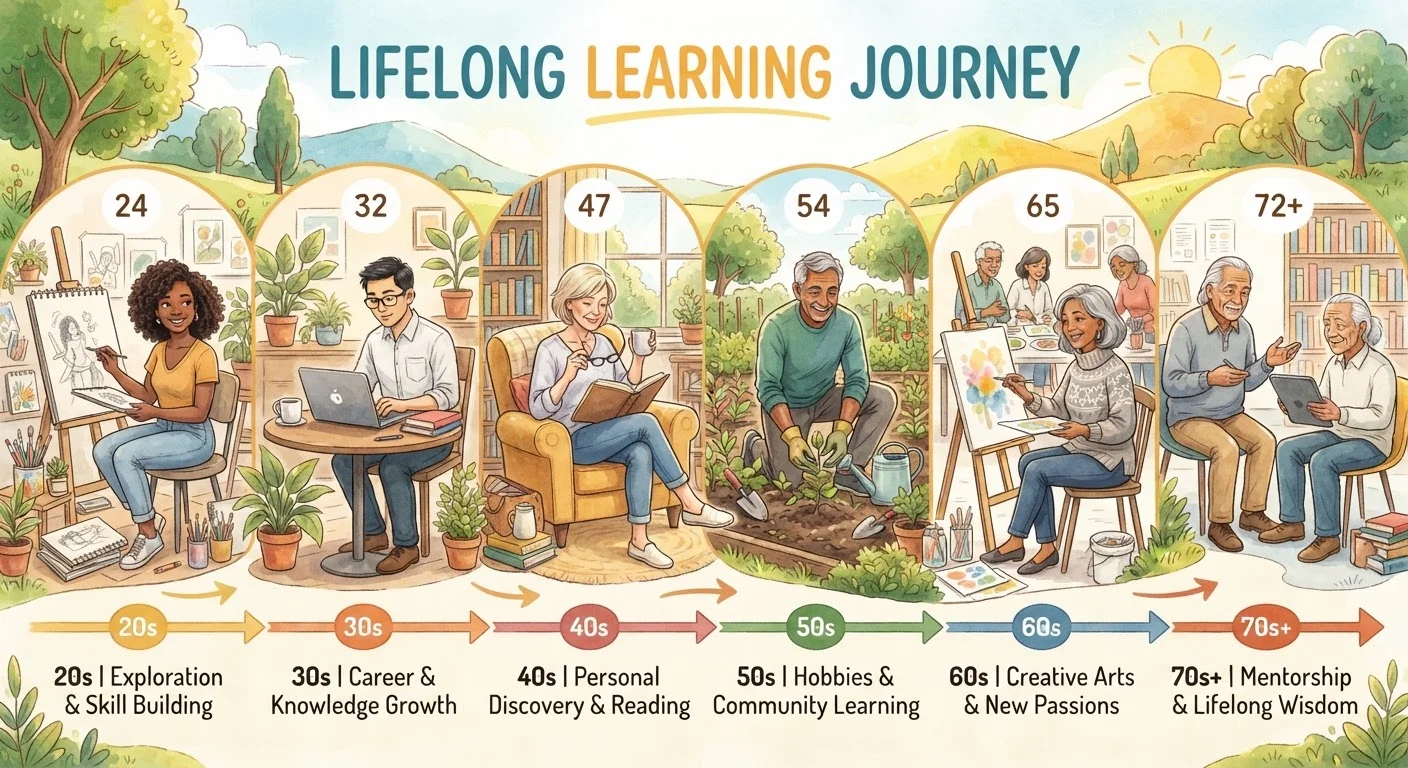
Key Takeaways
- Learning priorities shift meaningfully across each decade of adult life, reflecting changing goals and circumstances.
- Formal education is just one pathway - skills, creativity, and self-knowledge grow through many channels.
- Adults who stay curious across decades report stronger cognitive resilience and greater life satisfaction.
- Even modest, consistent learning habits compound into significant personal and professional growth over time.
- It's never too early - or too late - to pursue a meaningful learning goal.
Why Each Decade Deserves Its Own Learning Agenda
Lifelong learning isn't a single, unchanging practice - it's a series of evolving priorities shaped by where you are in life. The skills that serve a 25-year-old building a career differ sharply from those that enrich a 65-year-old stepping into retirement. Recognising that shift is one of the most useful things an adult learner can do.
Research in adult development consistently shows that motivation to learn changes with life stage. Early adulthood tends to emphasise external goals - credentials, competence, income. Midlife often pivots toward meaning, identity, and contribution. Later decades frequently bring a renewed appetite for curiosity-driven learning untethered from professional obligation. None of these phases is more valuable than another; they're simply different.
If you're not sure where your current habits stand, a personal learning audit can help you spot gaps and opportunities. And if the whole idea of structuring a learning life feels unfamiliar, getting started with lifelong learning offers a practical foundation regardless of your background.
The decade-by-decade goals below aren't rigid prescriptions - they're starting points for reflection.
Your Twenties: Build Transferable Skills and Financial Literacy
The twenties are often consumed by professional credentialing, but the most durable investments of this decade go beyond any single job title. Developing transferable skills - clear writing, data interpretation, project management, public speaking - pays dividends across every career shift that follows.
Equally important, and frequently neglected, is foundational financial literacy. Understanding how budgeting, compound interest, tax-advantaged accounts, and basic investing work isn't personalised financial advice - it's the vocabulary needed to make informed decisions with a qualified professional later. Many online learning platforms offer free or low-cost courses covering both professional and personal finance fundamentals. This is general financial education, not a substitute for advice tailored to your situation.
Transferable skills and financial literacy learned in your twenties compound in value for decades.
Your Thirties: Deepen Expertise and Learn to Lead
By the thirties, most adults have enough professional experience to identify what they're genuinely good at - and where the ceiling of their current skill set sits. This is a productive decade to deepen domain expertise rather than collect surface-level competencies.
Leadership is another high-value focus. Whether or not you hold a formal management role, the ability to influence, communicate across differences, give constructive feedback, and navigate ambiguity shapes nearly every career trajectory. Many of these skills are learnable through deliberate practice, mentorship, and targeted study. The career skills hub covers frameworks and resources for exactly this kind of professional development.
The thirties reward depth over breadth - go further in what you already do well.
Your Forties: Pursue a Subject Purely Because It Fascinates You
Midlife often brings the first real opportunity to ask: what would I learn if it had nothing to do with my resume? History, philosophy, a musical instrument, a second language, woodworking, astronomy - the subject matters less than the act of choosing it for its own sake.
Research in adult cognition suggests that engaging with genuinely novel domains - particularly those involving procedural or creative learning - supports cognitive flexibility in ways that routine professional tasks may not. This isn't a medical claim; it's a prompt to take intellectual pleasure seriously as a legitimate goal, not a luxury. Learning for its own sake also tends to renew engagement with career learning, as the two motivations frequently reinforce each other.
Choosing a subject purely for fascination is a legitimate - and cognitively valuable - learning goal.
Your Fifties: Develop Digital Confidence and Plan for Transition
Digital fluency gaps tend to widen in the fifties if not actively addressed. This doesn't mean becoming a software engineer - it means staying comfortable with the evolving tools that shape communication, commerce, and professional life. Spreadsheet skills, data privacy awareness, collaboration software, and an understanding of how AI-assisted tools work are increasingly baseline competencies rather than specialist ones.
The fifties are also a natural decade to begin planning the next chapter. Whether that means developing skills for a career pivot, exploring encore careers, or building knowledge in areas like caregiving, estate planning basics, or retirement transitions, intentional preparation now eases transitions later. Consulting qualified professionals - financial advisers, legal counsel - remains essential for decisions specific to your circumstances.
Digital confidence and transition planning in your fifties reduce friction in every decade that follows.
Your Sixties and Beyond: Embrace Community Learning and Legacy Skills
Post-career decades offer something earlier stages rarely permit: time to learn slowly, deeply, and in community. Audit programs at local colleges, community workshops, book groups, and intergenerational mentoring all provide structured contexts for continued growth without the pressure of grades or credentials.
This is also a meaningful time to develop or document legacy skills - family history research, oral storytelling, craft traditions, or teaching others what decades of experience have taught you. Sharing expertise is itself a form of active learning; the process of articulating what you know deepens understanding and creates lasting value for others. Social connection embedded in shared learning also supports the kind of purposeful engagement that many find sustaining in later life.
Teaching and sharing expertise in later decades is both a contribution and an act of continued learning.
Making Learning a Habit That Lasts Beyond Any Single Decade
The most durable learning lives share one trait: they're built on habit rather than motivation alone. Motivation fluctuates with circumstance, but a practice - even a small one - persists. Whether that means a weekly course session, a monthly book, or a quarterly skill experiment, regularity matters more than intensity.
Start Small, Stay Consistent
You don't need to enrol in a formal program to maintain a meaningful learning practice. Even 20-30 minutes of focused learning a few times per week - reading, watching a lecture, practising a skill - adds up substantially over months and years. The goal is a sustainable rhythm, not an impressive schedule.
It's also worth questioning assumptions that slow you down. Common myths about adult learning - including the persistent idea that cognitive flexibility declines sharply with age - are largely contradicted by current evidence. Meanwhile, understanding why curiosity fades and how to reignite it can make the difference between a learning practice that stalls and one that deepens over decades.
Learning for pleasure and learning for career advancement aren't mutually exclusive, either. The two motivations overlap more than most people expect, and the most satisfying learning often draws from both wells. For a comprehensive view of what a lifelong learning mindset looks like in practice, the complete picture of lifelong learning covers the psychology, tools, and habits that sustain growth over time.
Whatever decade you're in right now, there's a learning goal worth pursuing - one that fits your life as it actually is, not as it once was or may someday be.