

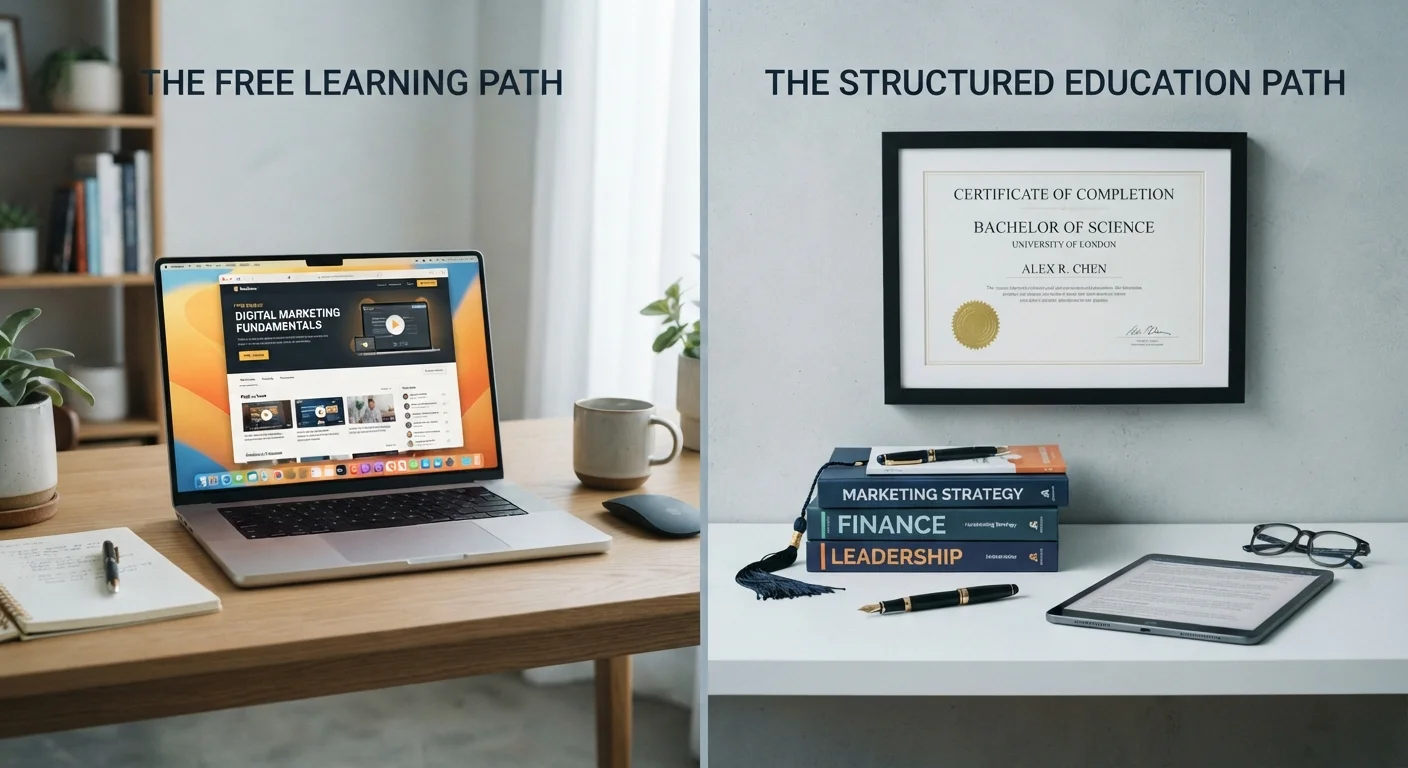
Key Takeaways
- Free courses excel for exploration and foundational learning without financial commitment.
- Paid courses typically offer stronger credentials, instructor access, and structured progression.
- The right choice depends heavily on your learning goal, not just the cost.
- Completion rates and accountability features often differ significantly between free and paid formats.
- Some platforms offer both tiers, allowing learners to audit free before committing financially.
Option A
Free Online Courses
The low-barrier, exploratory learning option.
Best for: Curious learners testing a new subject, building foundational knowledge, or working within a tight budget.
Option B
Paid Online Courses
The structured, credential-driven learning investment.
Best for: Learners pursuing career advancement, verified credentials, or accountability through guided instruction.
If you want to explore a subject before committing time or money
Free Online Courses
Free courses let you sample content, gauge your interest, and build baseline knowledge with zero financial risk.
If you need a verifiable credential for a job application or promotion
Paid Online Courses
Paid programs more commonly issue recognized certificates or badges that employers and institutions can verify.
If you are highly self-motivated and already know your subject area
Free Online Courses
Disciplined learners can extract full educational value from free materials without needing added structure or accountability.
If you want instructor feedback, mentorship, or a learning community
Paid Online Courses
Paid formats more frequently include direct instructor interaction, peer review, and cohort-based accountability features.
If budget is a primary constraint but career growth is your goal
Free Online Courses
Several reputable platforms offer free-to-audit courses from universities; supplementing with a low-cost certificate later remains an option.
What You Actually Get at Each Price Point
The gap between free and paid online courses is not simply about quality - it is about what each format is structurally designed to deliver. Understanding those structural differences helps you match the format to your real need.
Free courses, including open courseware and audited tracks on major platforms, typically provide video lectures, reading materials, and self-graded quizzes. What they usually omit is graded assignments reviewed by instructors, certificates of completion, and consistent access to a learning community. Some platforms archive free content without updates, meaning older courses may contain outdated information.
Paid courses, by contrast, are often built around accountability. They may include deadlines, instructor or teaching assistant feedback, peer-reviewed projects, and verifiable credentials upon completion. Many also provide structured learning paths that reduce the common problem of not knowing what to learn next.
| Criterion | Free Online Courses | Paid Online Courses |
|---|---|---|
| Cost | No financial outlay | Ranges from one-time fee to subscription |
| Certificate / Credential | Rarely included or unverified | Typically included; often verifiable |
| Instructor Feedback | Usually not available | Often included in structured formats |
| Content Updates | Inconsistent; varies by platform | More frequently maintained |
| Accountability Features | Minimal; self-directed | Deadlines, graded work common |
| Best Use Case | Exploration, foundational learning | Career advancement, credential needs |
For a broader look at how platform type shapes these offerings, see our comparison of university-backed programs and independent platforms.
When Free Is Genuinely Enough
Free courses are not a consolation prize. For specific learning goals, they are the objectively appropriate choice.
If your aim is personal curiosity or hobby development - learning music theory, exploring a foreign language, or understanding climate science - a free course from a reputable institution can deliver real, substantive knowledge without any financial outlay. The absence of a certificate is irrelevant when no one needs to verify your learning.
Free courses also work well as a prerequisite audit. Before investing in a paid program, auditing the free version of a course lets you evaluate the instructor's style, the platform's interface, and whether the subject aligns with what you expected. This is a low-risk due diligence step that paid-only learners skip at their own peril.
There is also a strong case for free learning when you already possess the self-discipline to complete unstructured content. Research consistently shows completion rates for free courses are lower overall, but that average masks a subset of motivated learners who finish what they start regardless of financial commitment. If you know you are in that group, you may not need the accountability mechanisms that paid formats sell.
To separate fact from assumption on this point, our article on common online learning myths addresses the misconception that free automatically means low quality.
When Paying Makes a Measurable Difference
Certain goals create conditions where the paid tier genuinely changes outcomes - not just perceived value.
Credential requirements are the clearest case. If a job posting, licensing body, or graduate program asks for documented evidence of competency, a free audit certificate (or no certificate at all) typically does not satisfy that requirement. Paid courses tied to recognized institutions or industry bodies carry weight that free completions usually do not.
Paying also tends to improve follow-through for learners who are honest about their own accountability gaps. When financial investment is on the line, course drop-off rates decrease for many people - not universally, but noticeably enough that some learners deliberately choose paid formats as a behavioral commitment device.
~3-6%
Average MOOC completion rate
Research published in academic journals on massive open online courses consistently finds single-digit average completion rates, though rates vary widely by course type and learner motivation.
40%+
Higher completion with financial stake
Studies on online learning behavior suggest learners who pay for a course or certificate track complete at meaningfully higher rates than those who audit for free.
Instructor access represents another practical differentiator. Many paid formats include the ability to ask questions, receive feedback on assignments, or participate in live sessions. For technical subjects like data science, coding, or accounting, getting timely, specific feedback on your work accelerates skill development in ways that video-only formats cannot replicate.
Before committing to any paid course, evaluate who is teaching it. Our guide on how to evaluate an online instructor outlines what credentials, reviews, and course design signals to examine first.
It is also worth considering the broader trade-offs of online study itself. Our article on the real trade-offs of studying entirely online covers what learners gain - and give up - regardless of price point.