

Key Takeaways
- Payment history is the single largest factor in your credit score, accounting for roughly 35% of a FICO Score.
- Credit utilization - how much of your available credit you're using - is the second biggest driver at about 30%.
- Your score can change month to month as new information is reported to the credit bureaus.
- Checking your own credit score does not hurt it; only certain lender inquiries (hard pulls) can cause a small, temporary dip.
- No single score tells the whole story - lenders may use different models depending on the type of credit you're applying for.
Credit Score
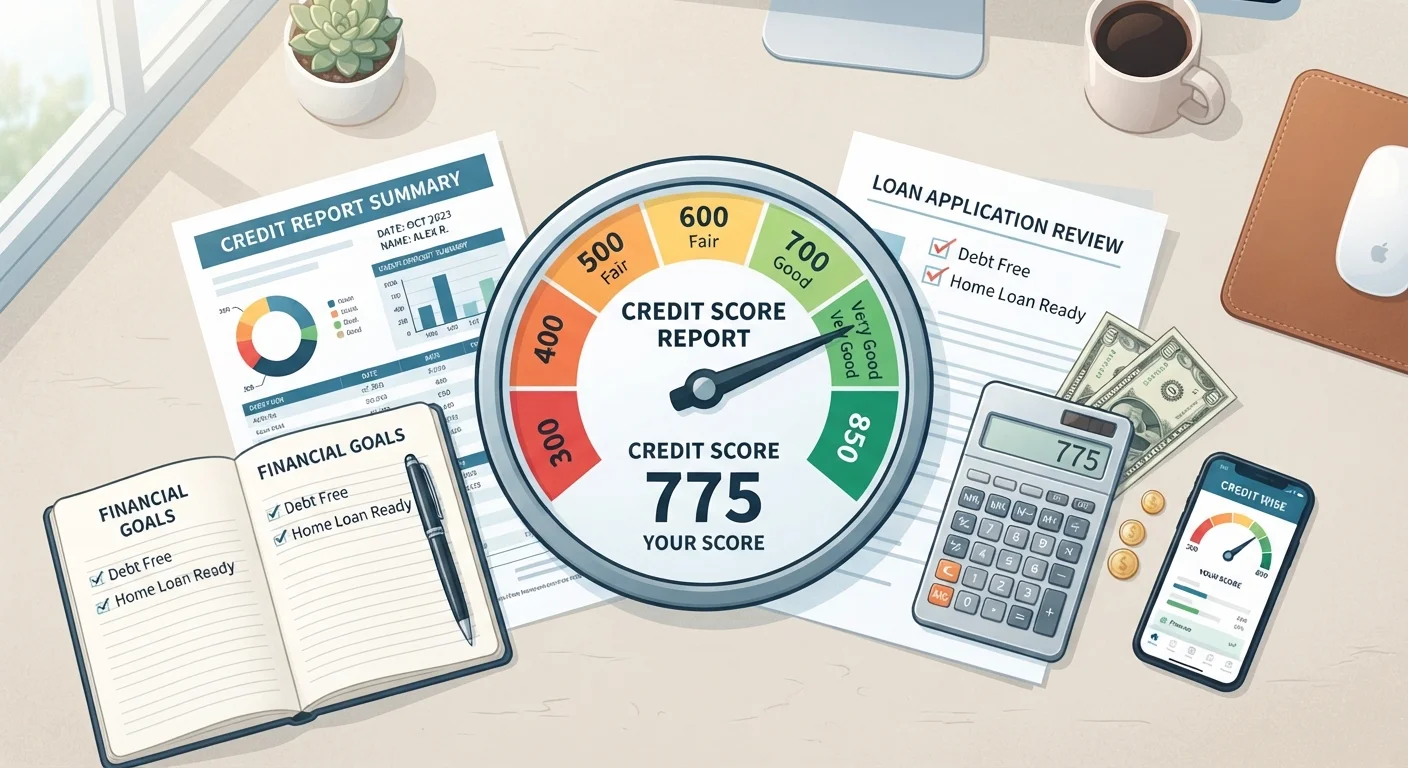
A credit score is a three-digit number, typically ranging from 300 to 850, that summarizes how reliably you've managed borrowed money over time. Lenders use it to quickly assess how likely you are to repay a new loan or credit card. The higher the number, the lower the risk you appear to a lender.
The most widely used scoring model is the FICO Score, developed by Fair Isaac Corporation. VantageScore is another common model. Both use similar inputs but weight them differently, which is why your score can vary slightly across models and bureaus.
The Five Factors Behind the Number
Your credit score isn't a mystery - it's a formula. The FICO Score, used in the vast majority of U.S. lending decisions, is built from five measurable factors, each weighted differently.
- Payment history (35%): Whether you pay your bills on time is the single most influential factor. Even one 30-day late payment can cause a meaningful drop.
- Amounts owed / credit utilization (30%): This measures how much of your available revolving credit you're using. Carrying a balance close to your credit limit signals risk. See our deep dive on credit utilization for strategies to manage this effectively.
- Length of credit history (15%): Older accounts work in your favor. This factor looks at the age of your oldest account, your newest account, and the average age of all accounts.
- Credit mix (10%): Having a variety of account types - credit cards, an auto loan, a mortgage - demonstrates that you can handle different kinds of debt responsibly.
- New credit / recent inquiries (10%): Opening several new accounts in a short window can suggest financial stress, so each hard inquiry carries a small, temporary cost.
35%
Share of FICO Score from payment history
According to Fair Isaac Corporation (FICO), on-time payment behavior is the single largest scoring factor.
716
Average U.S. FICO Score
The Federal Reserve Bank of New York and Experian have reported the national average FICO Score hovering around 716 in recent years.
30%
Share attributed to credit utilization
Amounts owed - primarily revolving credit utilization - is the second most influential factor in a FICO Score calculation.
Why Your Score Moves Month to Month
Many people are surprised to see their score shift even when they haven't done anything dramatic. That's because credit scores are recalculated each time a lender requests them, using whatever data is currently on file at that bureau.
Common causes of month-to-month movement include:
- A credit card balance rising before the statement closes (increasing utilization temporarily)
- A new account being opened or an old one being closed
- A hard inquiry from a recent application
- An account aging another month (gradually improving length of history)
- A late payment being reported or a derogatory mark aging off
Understanding how debt affects your score at each repayment stage can help you anticipate these shifts rather than be rattled by them.
Time Your Payments Strategically
Your credit card issuer typically reports your balance to the bureaus on your statement closing date, not your payment due date. If you pay down your balance before the statement closes, a lower utilization figure gets reported - which can give your score a near-term boost. This is especially useful if you're planning to apply for credit soon.
What Your Score Doesn't Measure
Your credit score captures borrowing behavior - nothing more. Several things that might seem financially relevant are explicitly excluded from FICO and VantageScore calculations:
- Income and net worth: A high earner with poor repayment habits will score lower than a modest earner who pays on time, every time.
- Savings account balances: Your deposit accounts don't appear on credit reports and have no bearing on your score.
- Employment status: Whether you're employed, self-employed, or between jobs does not factor in directly (though lenders may ask separately during underwriting).
- Demographics: Race, gender, religion, marital status, and national origin are legally prohibited from being used in credit scoring models.
This narrow scope means your score is a useful but incomplete picture of your financial health. For a fuller view of what data lenders actually see, our guide to reading your credit report walks through every section in plain language.
Common Misconceptions Worth Clearing Up
Misinformation about credit scores is widespread and can lead people to make decisions that actually hurt their standing. A few persistent myths:
- "Closing old cards improves your score." It often does the opposite - closing a card reduces your available credit, which raises your utilization ratio, and can shorten your average account age.
- "Carrying a balance builds credit." You do not need to carry a balance and pay interest to build a positive history. Paying in full each month demonstrates responsible use without the cost.
- "All inquiries lower your score." Soft inquiries - including checking your own score - have no effect. Rate shopping for mortgages or auto loans within a short window is also typically treated as a single inquiry by scoring models.
For a more thorough look at the evidence behind these and other beliefs, see our article on credit score myths that hold people back.
Your Score Varies by Scoring Model and Bureau
It's normal to see different scores from different sources. A score pulled from Experian using the FICO 8 model may differ from one pulled from TransUnion using VantageScore 3.0. Neither is necessarily more 'real' - lenders choose which model and bureau to use based on the type of credit they're issuing. When you apply for a mortgage, for example, lenders often pull scores from all three bureaus and use specific mortgage-edition FICO models.
This article is for general informational and educational purposes only and does not constitute personalized financial advice. Consult a licensed financial professional for guidance specific to your situation.