

Key Takeaways
- Paying only the minimum on a credit card balance can extend repayment by years and multiply your total interest paid.
- Credit card issuers set minimum payments low by design, which benefits them - not you.
- Even small increases above the minimum payment can dramatically shorten your payoff timeline.
- Understanding how interest compounds daily is essential to grasping the true cost of carrying a balance.
- A structured repayment plan, not just good intentions, is what actually reduces credit card debt.
How Minimum Payments Are Designed - and Why That Matters
Credit card issuers calculate minimum payments using one of two common formulas: a flat dollar amount (often $25-$35) or a small percentage of your outstanding balance, typically 1-3%. Both methods share a key feature - they keep your account current while ensuring that a large portion of each payment goes toward interest rather than principal.
Because the minimum shrinks as your balance shrinks, you pay less and less each month in dollar terms, but the interest meter keeps running. This structure extends repayment and maximises the total interest the issuer collects. It is not designed around your financial wellbeing.
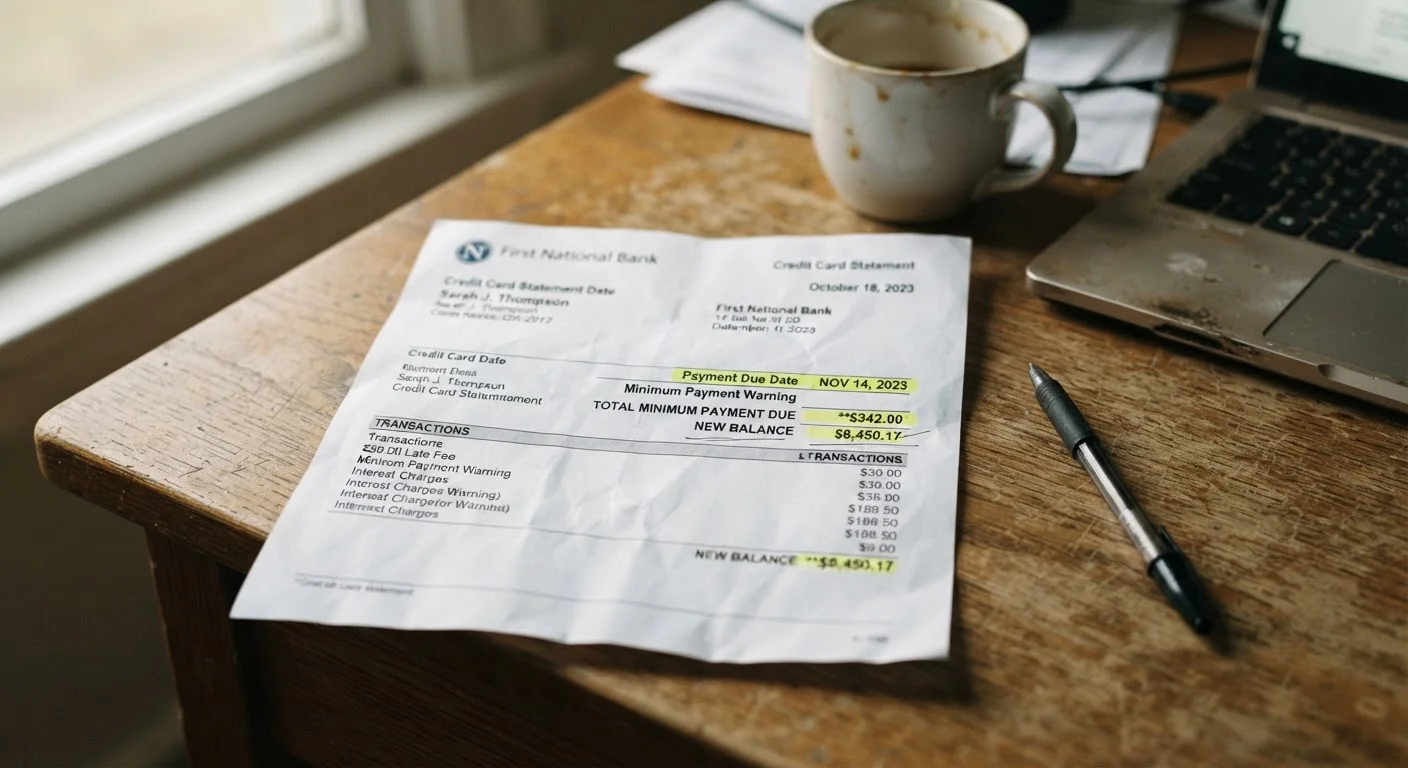
Federal law under the Credit CARD Act of 2009 requires issuers to include a minimum payment warning on every statement, showing how long it will take to pay off the balance at the current minimum and how much interest you'll pay in total. That disclosure is worth reading carefully - the numbers are often sobering. See our credit score myths guide for related misconceptions that affect how people manage their cards.
Assuming the minimum payment is what you're supposed to pay.
Why it happens: Statements prominently display the minimum due, and many cardholders interpret this as the expected or recommended payment rather than the lowest allowable amount.
Underestimating how daily compounding magnifies interest charges.
Why it happens: Most people think of interest as a monthly fee, but credit card interest typically compounds daily based on the average daily balance, meaning every unpaid dollar accumulates cost continuously.
Making extra purchases while paying only the minimum, keeping the balance static.
Why it happens: When minimum payments keep an account current, it's easy to continue spending on the card without recognising that new purchases reset or grow the balance faster than small payments shrink it.
Ignoring the payoff timeline shown on your credit card statement.
Why it happens: Statements include a required disclosure showing how long minimum payments will take to clear the balance, but many cardholders overlook or misunderstand this section.
Confusing 'no late fee' with 'managing debt well.'
Why it happens: Avoiding penalties feels like financial responsibility, and minimum payments do exactly that - making it easy to conflate account compliance with healthy debt management.
The Real Cost: An Illustrative Example
Consider a $3,000 balance on a card charging 20% APR. If your minimum payment starts at 2% of the balance and you make no new purchases, you might expect to pay it off in a few years. In practice, it could take well over five years, and the total interest paid can rival or exceed your original balance - depending on the exact terms.
20%+
Average credit card APR in the U.S.
According to Federal Reserve data, average credit card interest rates have risen significantly in recent years, making minimum-only payments increasingly costly.
~$1,000
Interest paid on a $3,000 balance at minimum payments
Illustrative calculation: a $3,000 balance at 20% APR paid with typical minimum payments can accrue well over $1,000 in interest before the balance is cleared.
5+ years
Time to pay off a modest balance at minimum only
Even a manageable credit card balance can take five or more years to eliminate when only the minimum is paid each month, depending on the card's APR and minimum formula.
The core mechanism is daily compounding. Interest accrues on your average daily balance each day, not just at month's end. Paying more early in the cycle reduces the daily balance that interest is calculated on, which is why timing and amount both matter.
Even raising your payment by $25 or $50 above the minimum each month can cut months or years off your timeline and save a meaningful amount in interest. A balanced approach to debt and saving can help you make headway on both fronts simultaneously.
This Is General Information, Not Financial Advice
The examples in this article use illustrative figures to explain general concepts. Your actual interest costs depend on your specific APR, balance, and payment behaviour. For guidance tailored to your situation, consult a licensed financial professional or a nonprofit credit counselor.
Building a Repayment Strategy That Actually Works
Awareness alone doesn't eliminate debt - a concrete plan does. Start by listing each card's balance, APR, and current minimum payment. Two widely used repayment methods are the avalanche (prioritise the highest-APR card first to minimise total interest) and the snowball (pay off the smallest balance first for psychological momentum). Neither is universally superior; the right choice depends on your temperament and cash flow.
Once you've chosen a method, build the extra payment into your monthly budget as a fixed line item - not a leftover. If budgeting feels unfamiliar, reviewing commonly overlooked budget categories can reveal room you didn't know you had.
Also monitor your credit utilisation as balances fall. Lower utilisation - the share of your available credit you're using - generally has a positive effect on your credit score, as explained in our credit utilisation guide. Progress on debt isn't just a financial win; it often improves your credit profile at the same time.
Low Minimums Are Not a Safety Net
A minimum payment keeps your account in good standing and prevents a late fee, but it does not meaningfully reduce your debt at high interest rates. Treating the minimum as your default payment strategy can trap you in a cycle of debt that lasts a decade or more. Always aim to pay more than the minimum whenever your budget allows.
This article is for general informational and educational purposes only and does not constitute personalised financial or legal advice. Consult a qualified financial professional for guidance specific to your circumstances.