

Key Takeaways
- Dogs pull on the leash because forward movement is self-rewarding, not because they are being defiant.
- A dog's nose processes scent in extraordinary detail, making outdoor environments intensely stimulating.
- Pulling is often unintentionally reinforced by owners who continue walking when the leash goes tight.
- Consistent, calm responses - not punishment - are the foundation of loose-leash walking.
- Understanding the 'why' behind pulling makes training more effective and less frustrating for both parties.
Leash Pulling
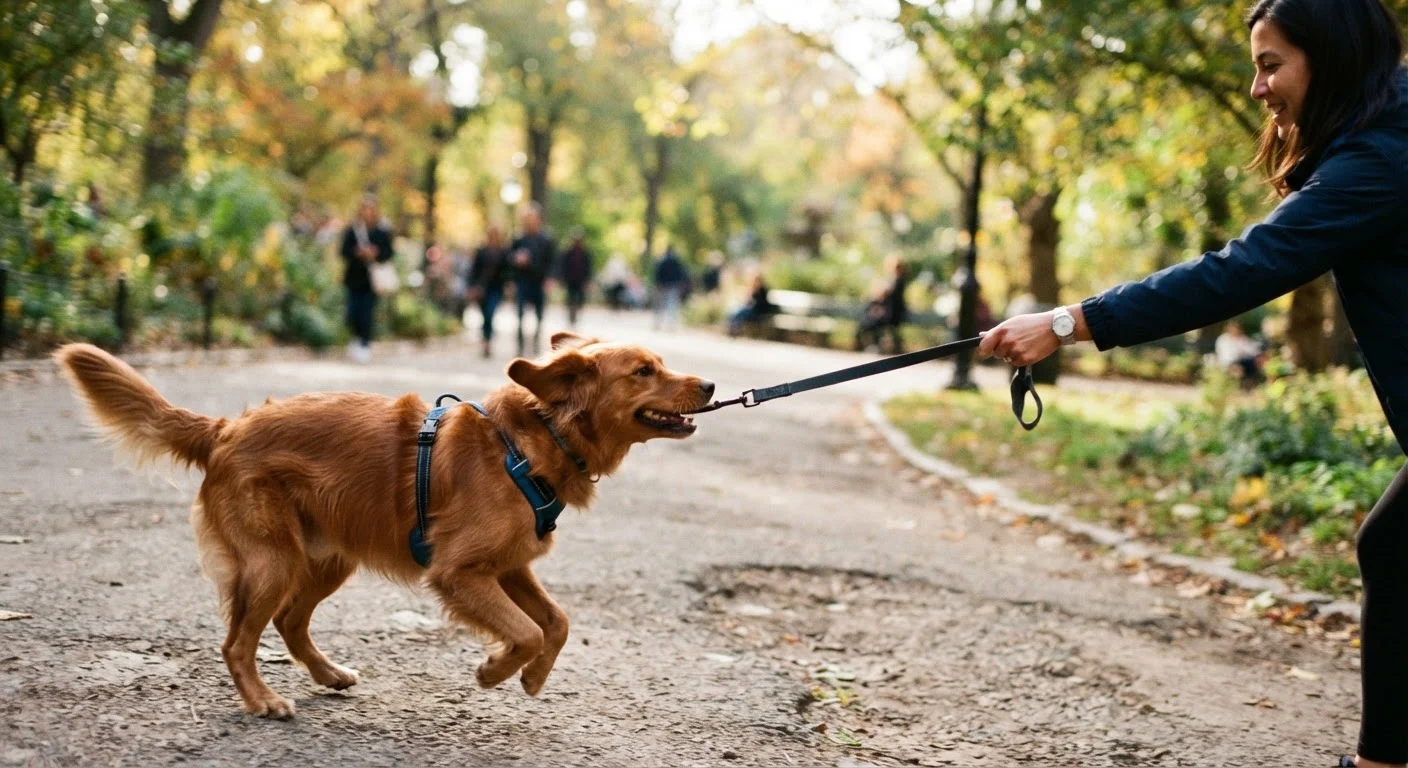
Leash pulling is the natural tendency of dogs to walk faster than their human companions and strain forward against the leash. It is a behaviour rooted in instinct and reinforcement history, not deliberate defiance or a desire to dominate. Dogs pull because moving forward - toward smells, sights, and sounds - is immediately rewarding to them.
In behavioural science terms, pulling is sustained by positive reinforcement: the dog pulls, moves forward, and reaches something interesting. That outcome reinforces the behaviour, making it stronger over time.
The Instinct Behind the Tug
When your dog hits the end of the leash for the fifth time in a block, it is easy to read it as stubbornness. But pulling has nothing to do with attitude. It is the predictable output of a sensory system that is running exactly as it was designed to.
Dogs experience the world primarily through scent. Their olfactory system contains roughly 300 million scent receptors - compared to about 6 million in humans - and the part of the brain dedicated to analysing smell is proportionally about 40 times larger than our own. Every lamppost, patch of grass, and passing pedestrian broadcasts a detailed chemical message. For your dog, a walk is less like a stroll and more like reading an entire newspaper, page by page, at high speed.
Add to that the excitement of movement itself. Dogs are naturally faster-paced walkers than humans. When a dog surges forward and the leash goes tight, they are not making a calculated power play - they are simply trying to reach the next interesting thing before it disappears. That impulse is deeply wired.
“Dogs are not trying to dominate us on walks. They are doing what their biology has prepared them to do - explore, sniff, and move toward interesting things. Our job as trainers is to make the behaviour we want more rewarding than the behaviour we don't.”
— Dr. Karen Overall, Board-certified veterinary behaviourist and author of works on clinical behavioural medicine in animals
How Pulling Gets Reinforced Without You Realising It
Here is where owner behaviour enters the picture. In most households, leash pulling is unintentionally trained into dogs from the very first walk. The sequence goes like this: the dog pulls forward, the owner follows (because stopping completely every time feels impractical), and the dog arrives at the fire hydrant it wanted to sniff. The dog's brain logs a clean lesson - pull equals progress.
Repeated thousands of times across hundreds of walks, this pattern becomes deeply embedded. It is an example of what behaviourists call continuous reinforcement: the behaviour works reliably, so the dog has every reason to keep doing it.
This is also why punishment-based corrections - jerking the leash, shouting - rarely work long-term. They may interrupt the pull in that moment, but they do not teach the dog what to do instead, and they can add anxiety to an already aroused state. As explored in our look at dominance theory, framing dog behaviour as a battle for control leads owners toward techniques that science has largely moved away from.
Start Training in Low-Distraction Settings
Trying to teach loose-leash walking while your dog is already overstimulated is like teaching someone to parallel park in rush-hour traffic. Begin practice sessions in your yard or a quiet street. Once the behaviour is reliable in calm environments, gradually introduce more distractions. Building the skill in layers produces more durable results.
What Is Actually Going on in Your Dog's Mind
Understanding the emotional state behind pulling matters as much as understanding the mechanics. Most dogs that pull are not calm and calculated - they are excited, slightly over-threshold, and operating more on impulse than on reasoned decision-making. Arousal narrows the cognitive window available for learning, which is why trying to train a dog that is already straining at the leash tends to yield poor results.
A dog pulling toward another dog at the park is experiencing something closer to a craving than a choice. Their limbic system - the brain's emotional and motivational engine - is running hot. The prefrontal processing that would allow them to weigh options and respond to cues is temporarily outpaced.
This is not an excuse; it is a roadmap. It tells you that the most productive training happens before arousal peaks - in calmer settings, at greater distances from triggers, and with shorter sessions. Consistency matters enormously here. Everyday habits that undermine training often include allowing pulling in some contexts but not others, which muddies the signal your dog is trying to learn from.
Practical Principles for Responding to Pulling
The core principle of loose-leash training is straightforward: pulling never works, and a loose leash always does. When the leash tightens, forward movement stops. When slack returns, walking resumes. The dog learns that the path to interesting things runs through a loose leash - not through pressure.
This sounds simple, and in principle it is. What makes it challenging is the consistency required. Every household member who walks the dog needs to apply the same rule, every time. One permissive walk can undo a week of careful practice. If you notice progress stalling or reverting, regression in trained behaviours is worth understanding - it is far more common than most owners expect, and usually fixable.
Rewarding the dog when they naturally offer a loose leash - with calm praise, a treat, or simply continuing to walk - accelerates progress. You are not bribing; you are building a new habit loop where the right choice becomes the dog's default.
300M+
Scent receptors in a dog's nose
Compared to roughly 6 million in humans, according to veterinary anatomy research, explaining why outdoor environments are so intensely stimulating for dogs.
~40x
Relative size of dog's olfactory brain region
The olfactory bulb, proportional to overall brain size, is approximately 40 times larger in dogs than in humans, per comparative neuroscience literature.
This article is for general informational and educational purposes only. For personalised guidance on your dog's behaviour or health, consult a qualified veterinary behaviourist or certified professional dog trainer.