

Key Takeaways
- Rewards delivered within one to two seconds of a behavior are most effective at reinforcing it.
- Late or mistimed rewards can accidentally teach unintended behaviors, causing confusion.
- A marker signal - like a clicker or a verbal cue - bridges the gap between behavior and reward.
- Consistent timing across all household members is essential for clear communication with your pet.
- Short, focused training sessions improve timing quality and reduce both human and animal fatigue.
The Science Behind the Window
When your pet performs a desired behavior, a brief biological window opens during which a reward will be strongly associated with that action. Animal learning research consistently points to roughly one to two seconds as the critical interval - beyond that, the connection between behavior and consequence weakens considerably.
This principle stems from classical and operant conditioning, the foundational frameworks that explain how animals learn from their environment. When a reward arrives within the window, the brain links the sensation of the reward to the immediately preceding action. When it arrives late - even by just a few seconds - your pet may associate the reward with whatever they happened to be doing at that moment instead.
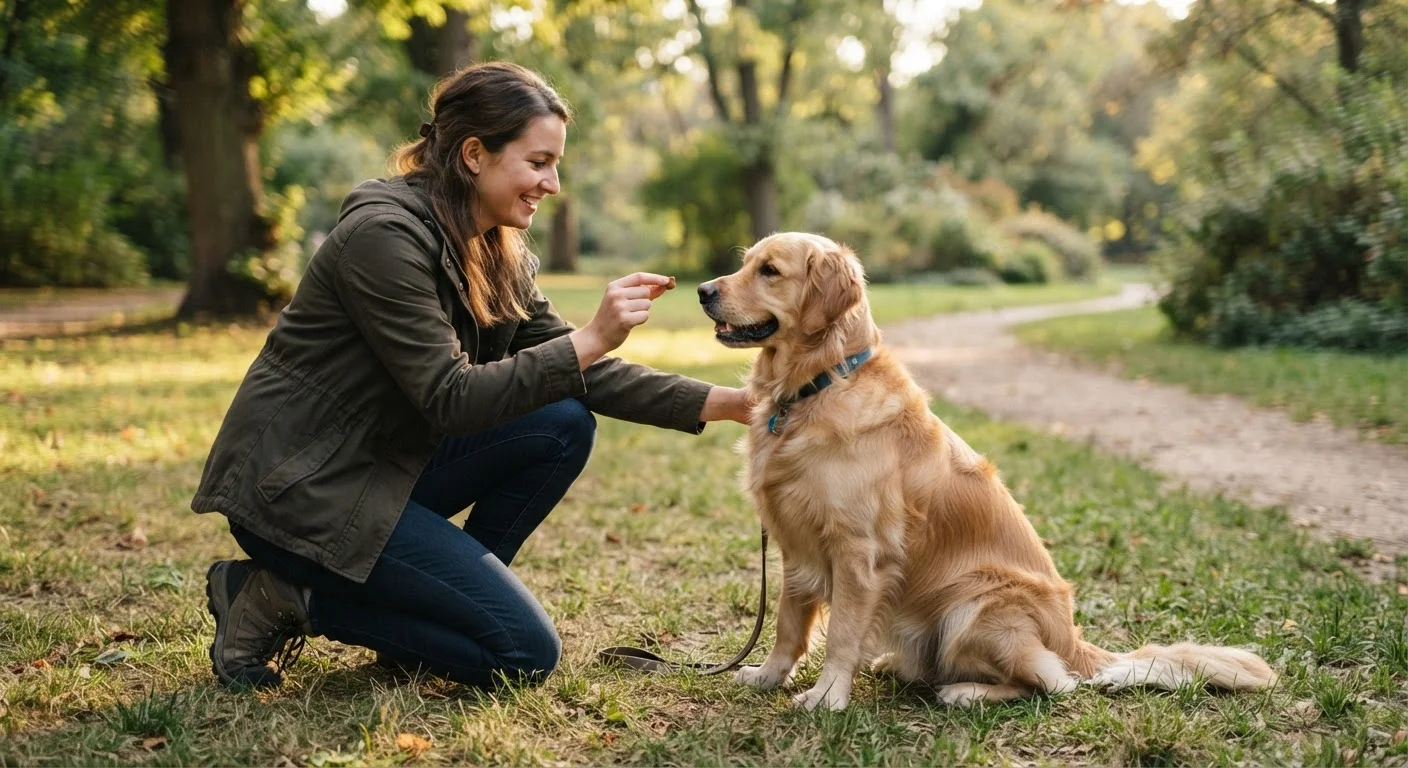
Imagine asking your dog to sit. She sits, you reach for the treat, and by the time she receives it she has stood back up. You have just rewarded standing, not sitting. This is not a training failure - it is a timing failure, and understanding the difference is genuinely empowering. See what the evidence says about reinforcement-based methods for a broader look at why timing is central to the entire positive reinforcement approach.
The Marker Signal: Your Timing Bridge
Because reaching for a treat takes time, experienced trainers use a marker signal - a distinct, consistent sound or word that tells the animal "yes, that exact thing you just did has earned a reward." A training clicker is a common tool, but a crisp verbal cue like "yes!" works just as well when used consistently.
The marker does the heavy lifting in the moment. You click or say "yes" the instant the behavior occurs, then follow with the treat within a few seconds. The animal learns that the marker predicts the reward, so it carries the same informational weight - precision is transferred from the treat to the sound.
Loading Your Marker Signal First
Before applying any marker to specific behaviors, pair it with a reward ten to twenty times in a row without asking for anything. This 'charges' the marker so your pet understands it reliably predicts something good. It only takes a few minutes and dramatically improves training clarity from the first real session onward.
To get the most from a marker signal, it helps to first pair it with a reward several times in a row before applying it to any specific behavior. This process - sometimes called "loading" the marker - establishes its meaning quickly and makes subsequent training much more efficient.
Best Practices for Timing Your Rewards
Mark the behavior the instant it occurs, before reaching for the treat.
The physical act of retrieving a reward introduces a delay that can shift what behavior gets reinforced. A marker signal captures the exact moment, preserving the critical timing window even while your hand is still moving.
Keep training sessions short - five to ten minutes maximum - to maintain sharp attention and timing.
Fatigue degrades timing accuracy in humans and reduces attentiveness in pets. Shorter sessions keep both trainer and animal mentally present, which directly improves the quality of each learning trial.
Pre-load your treat hand before beginning any repetition.
Fumbling for treats after a behavior occurs is one of the most common sources of timing error. Having a treat ready to deliver reduces the gap between marker and reward to a comfortable minimum.
Align timing expectations across every person who interacts with the pet.
Animals generalize what they learn from the environment as a whole, not from one individual. If one family member rewards two seconds late while another is immediate, the pet receives conflicting feedback that slows learning.
Practice your marker timing on a human task before applying it in training.
Timing a click or verbal cue accurately is a motor skill that benefits from rehearsal. Practicing away from the animal - for example, clicking when a bouncing ball hits the floor - removes the cognitive load of the session itself.
Applying these practices consistently will make a noticeable difference in how quickly your pet understands and retains new behaviors. Timing is a skill that improves with deliberate attention, so treat your own consistency as part of the training process.
Inconsistency between family members is one of the quieter barriers to progress - explore everyday habits that quietly undermine your dog's training to see how mixed signals can undo even well-timed work.
Quick Wins to Sharpen Your Timing Today
Good timing is a trainable human skill. Even a few minutes of deliberate practice - without your pet present - can meaningfully improve your accuracy. Before each session, review this preparation checklist for pet owners to set yourself up for success from the first repetition.
If you notice that behaviors your pet once performed reliably have started to slip, timing drift is one of the first things worth examining. When good training stops working walks through the most common reasons for regression and what to do about each one.