

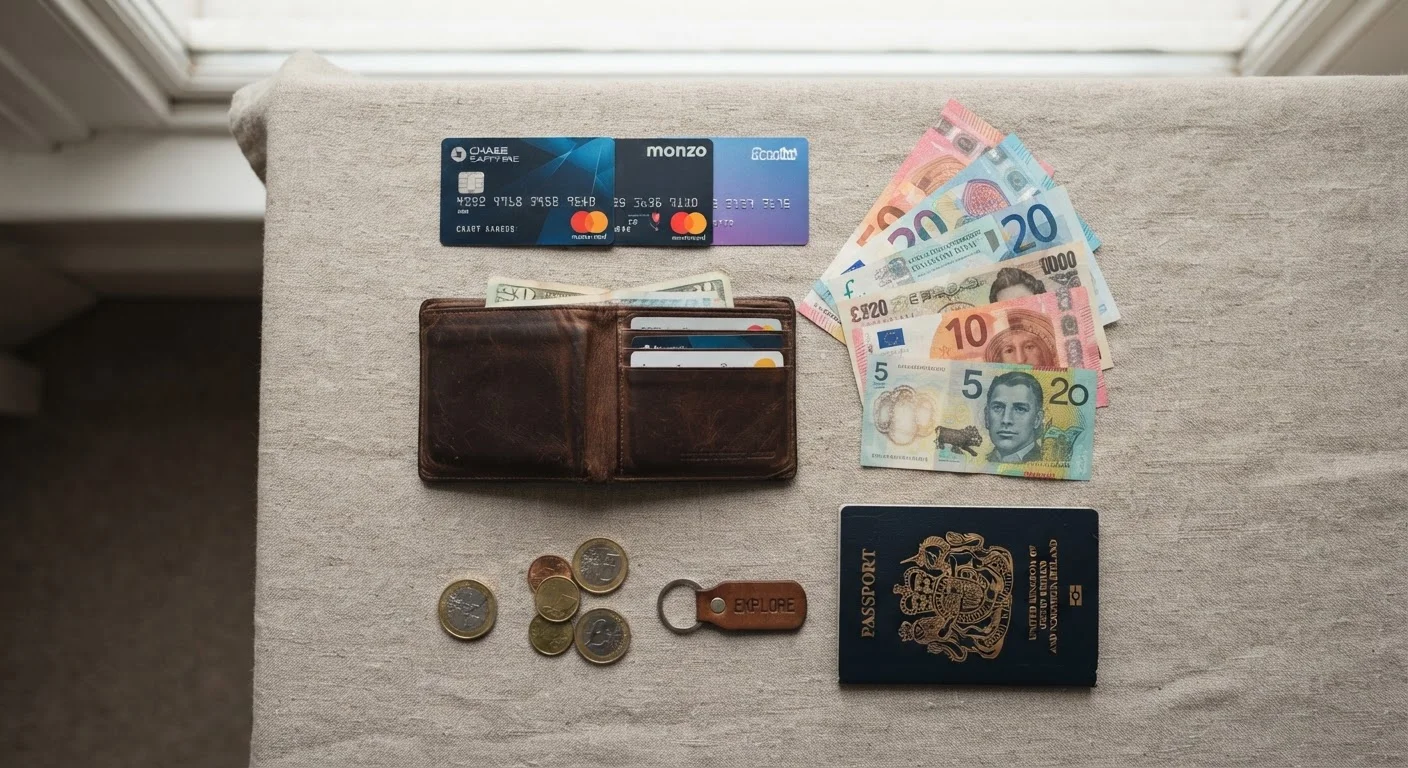
Key Takeaways
- No single payment method works best for every situation - a combination typically serves travelers best.
- Foreign transaction fees and dynamic currency conversion can quietly add 3-5% to every card purchase abroad.
- Local cash remains essential in many destinations, particularly for markets, tips, and rural areas.
- Notify your bank before departure to prevent card freezes due to unexpected foreign transactions.
- ATMs abroad generally offer better exchange rates than airport currency exchange booths.
Universally accepted in cash-dominant destinations
Markets, street vendors, rural guesthouses, and local transit systems in many countries do not accept cards at all. Carrying local currency ensures you can participate fully in the destination.
Prevents overspending through tangible limits
Spending physical notes creates a natural awareness of what you're using. Many travelers find it easier to budget day-to-day when they can see their remaining cash diminishing.
No transaction fees on individual purchases
Once you have local currency in hand, there are no per-purchase fees. Small purchases that would seem inefficient on a card - a $1 coffee, a $2 bus fare - cost nothing extra.
Useful for tipping and gratuities
In many destinations, tipping in local cash is preferred by service workers, as tips added to card transactions may not reach staff directly or may face delays.
No recovery if lost or stolen
Cash has no dispute process or fraud protection. If your wallet is stolen, that money is gone. This risk grows with the amount you carry at any one time.
Exchange rates vary significantly by source
Airport kiosks, hotel desks, and tourist-area exchange counters routinely offer rates 5-10% below the mid-market rate, quietly inflating the effective cost of every transaction.
Logistical burden of carrying and securing bills
Managing cash across money belts, bags, and hotel safes adds daily friction. Keeping track of multiple denominations in an unfamiliar currency also increases the chance of mistakes.
Exchange rate exposure on large lump sums
Exchanging a large amount early in a trip locks you into that day's rate. If the rate shifts unfavorably over a two-week stay, the loss compounds across every transaction.
Our Verdict
There is no universally correct way to carry money abroad - the right strategy depends on your destination, trip length, and spending habits. Most experienced travelers carry a modest amount of local cash for daily small purchases, rely on a low-fee or no-foreign-transaction-fee card for larger expenses, and keep a backup card in a separate bag. Planning this mix before departure, rather than improvising at the airport, consistently produces better outcomes.
Travelers who want to minimize unnecessary fees, avoid running out of usable funds, and feel confident spending in any situation - from a city restaurant to a rural market stall.
Why Your Payment Strategy Matters Before You Leave Home
How you carry and access money abroad has a direct and measurable impact on your travel budget. A careless approach - exchanging dollars at an airport kiosk, using a card that charges foreign transaction fees on every purchase, or carrying too much cash - can add hundreds of dollars in avoidable costs to a two-week trip.
The good news: a little preparation goes a long way. Understanding the trade-offs between foreign cash, travel-oriented cards, and standard debit or credit cards lets you build a payment setup that matches your itinerary. See our pre-departure budget checklist for a full rundown of financial items to confirm before any international trip.
Always Verify Card Acceptance Before You Go
Card network acceptance varies by country and region. Visa and Mastercard have broad global reach, while American Express and Discover have more limited acceptance in some markets. Before relying on any single card abroad, check the network's acceptance map and confirm with your issuer whether the card works on international networks. Carrying cards from two different networks reduces the risk of being unable to pay electronically.
The Case for Carrying Local Cash
In many parts of the world, cash is not optional - it is the only accepted form of payment. Street food stalls, local transit, small guesthouses, rural attractions, and market vendors often operate entirely in cash. Attempting to pay with a card in these settings can leave you stranded or unable to participate in experiences that define a destination.
Universally accepted in cash-dominant destinations
Markets, street vendors, rural guesthouses, and local transit systems in many countries do not accept cards at all. Carrying local currency ensures you can participate fully in the destination.
Prevents overspending through tangible limits
Spending physical notes creates a natural awareness of what you're using. Many travelers find it easier to budget day-to-day when they can see their remaining cash diminishing.
No transaction fees on individual purchases
Once you have local currency in hand, there are no per-purchase fees. Small purchases that would seem inefficient on a card - a $1 coffee, a $2 bus fare - cost nothing extra.
Useful for tipping and gratuities
In many destinations, tipping in local cash is preferred by service workers, as tips added to card transactions may not reach staff directly or may face delays.
Beyond practicality, spending in local currency helps you think in local terms. Paying 50,000 Indonesian rupiah feels more concrete when you know that equals roughly $3, rather than watching a card abstract the transaction entirely.
For sourcing cash, ATMs operated by local banks in-country generally offer rates close to the mid-market rate - significantly better than airport exchange bureaus or hotel desks, which typically build a wide margin into their rates. Withdraw in reasonably sized amounts to minimize the fixed per-transaction ATM fee, but avoid carrying several days' worth of spending money at once.
The Drawbacks of Relying Heavily on Cash
Cash is irreplaceable when lost or stolen. Unlike a blocked card, there is no recovery process for missing banknotes. Carrying large amounts increases risk, and keeping cash secure - across different bags, hotel safes, and money belts - adds friction to daily travel.
No recovery if lost or stolen
Cash has no dispute process or fraud protection. If your wallet is stolen, that money is gone. This risk grows with the amount you carry at any one time.
Exchange rates vary significantly by source
Airport kiosks, hotel desks, and tourist-area exchange counters routinely offer rates 5-10% below the mid-market rate, quietly inflating the effective cost of every transaction.
Logistical burden of carrying and securing bills
Managing cash across money belts, bags, and hotel safes adds daily friction. Keeping track of multiple denominations in an unfamiliar currency also increases the chance of mistakes.
Exchange rate exposure on large lump sums
Exchanging a large amount early in a trip locks you into that day's rate. If the rate shifts unfavorably over a two-week stay, the loss compounds across every transaction.
Exchange rate exposure is another real cost. Rates fluctuate, and if you exchange a large lump sum early in a trip, an unfavorable shift can quietly erode your budget. The myth that cash is always cheaper abroad ignores the spread charged by most exchange services.
Cards Abroad: Fees, Benefits, and Practical Limits
Credit and debit cards offer convenience and security - but not all cards are created equal for international use. A standard card with a 3% foreign transaction fee applied to every purchase represents a meaningful additional cost over a two-week trip. Cards specifically designed for travel typically waive these fees entirely, and some also reimburse international ATM charges.
3%
Typical foreign transaction fee per card purchase
Many standard US credit and debit cards charge a foreign transaction fee of around 3% on every international purchase, which compounds significantly over a multi-week trip.
5-10%
Spread at airport currency exchange counters
Consumer finance researchers and travel advisors consistently note that airport and hotel exchange bureaus build wide margins into their rates compared to mid-market benchmarks.
One significant risk with cards is dynamic currency conversion (DCC) - a practice where a foreign merchant or ATM offers to charge you in US dollars instead of local currency. Always decline and pay in local currency. The conversion rate applied by the merchant is almost always less favorable than your card's rate.
Cards also provide purchase protection and dispute resolution that cash cannot. For larger expenses - hotel pre-authorizations, car rentals, or booking tours - a credit card offers a meaningful layer of consumer protection. Understanding how credit works can help you use a card responsibly rather than carrying a balance home from your trip.
Before departure, notify your card issuers of your travel dates and destinations. Most banks allow this through their app. A card freeze mid-trip due to a suspected fraud flag is a serious inconvenience, especially if it's your only card.
Building a Practical Payment Mix for Your Trip
Rather than committing to one method, most seasoned travelers use a layered approach. Consider this as a starting framework:
- Local cash: Enough for 1-2 days of small purchases at a time, replenished via ATM as needed.
- Primary card: A low-fee or no-foreign-transaction-fee card used for restaurants, accommodation, and larger purchases.
- Backup card: A second card from a different network (e.g., one Visa and one Mastercard), stored separately from your primary card and wallet.
This redundancy matters. Cards are lost, blocked, or occasionally not accepted. Having a functional backup prevents a stressful scramble. Store backup cards and emergency cash in your hotel safe or a separate bag - not in the same wallet you carry daily.
Your destination should also shape your mix. In Scandinavia, cards are accepted almost universally and cash is rarely used. In parts of Southeast Asia or Central America, cash dominates. Research your specific destination before deciding how much to withdraw. The first international trip guide covers destination-specific currency basics worth reviewing before any first-time trip abroad.
Understanding how your spending method interacts with your overall fixed and variable travel expenses can help you decide which costs to put on a card and which to handle in cash, keeping your budget tracking cleaner throughout the trip.