

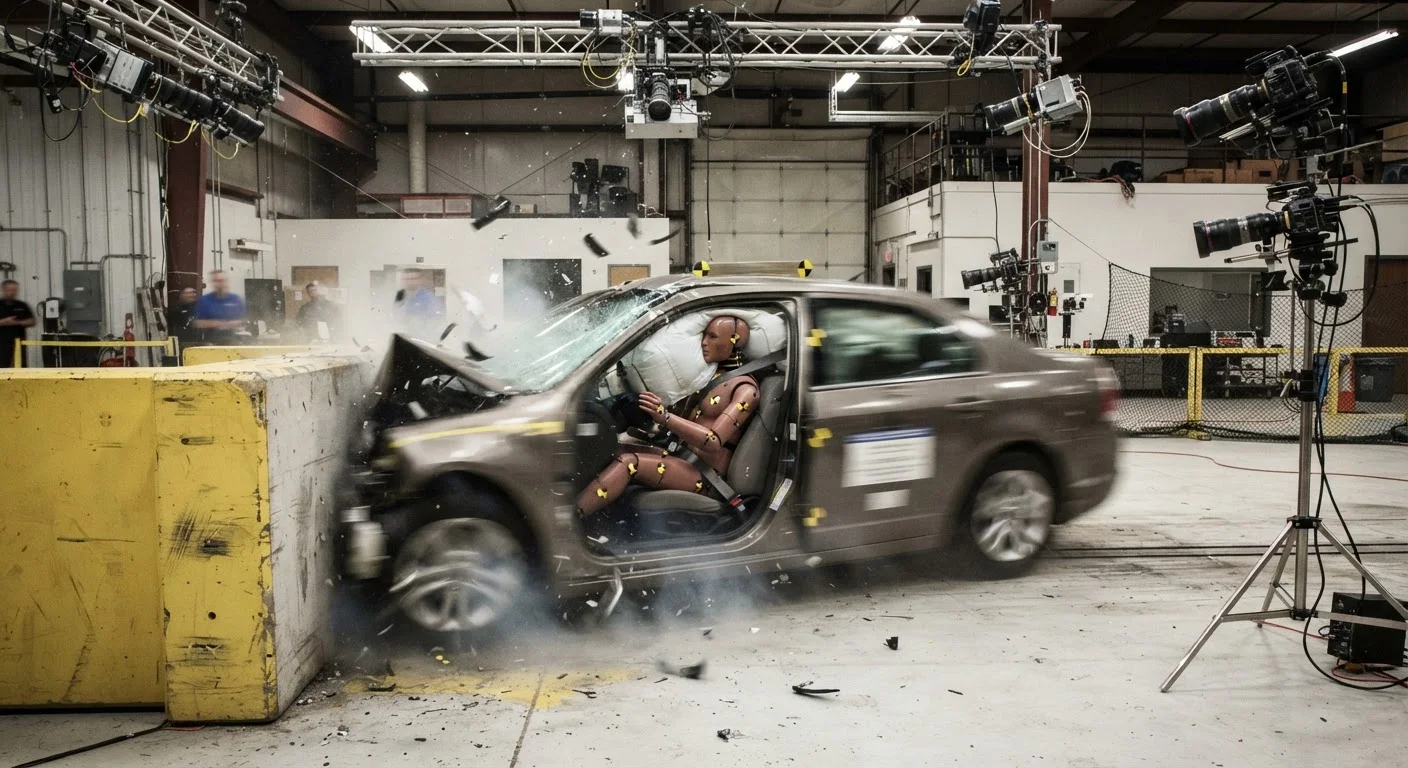
Two Organizations, Two Different Missions
When you see star ratings on a vehicle window sticker or a manufacturer's website, those numbers come from one of two major independent testing programs: NHTSA (the National Highway Traffic Safety Administration) and IIHS (the Insurance Institute for Highway Safety) in the United States, or Euro NCAP (New Car Assessment Programme) in Europe. Each organization runs its own protocol, and the scores are not interchangeable.
NHTSA is a U.S. federal agency. Its New Car Assessment Program assigns one to five stars across three categories: frontal crash, side crash, and rollover resistance. Stars reflect the statistical probability of serious injury in that specific test condition - not an overall verdict on the vehicle's safety. A five-star rollover rating, for instance, says nothing about how the vehicle performs in a small-overlap frontal crash.
Euro NCAP is an independent nonprofit consortium funded primarily by European governments and motoring organizations. Rather than separate category stars, it produces a single overall star rating (zero to five) derived from weighted scores across four areas: Adult Occupant Protection, Child Occupant Protection, Vulnerable Road User protection (pedestrians and cyclists), and Safety Assist (active safety technologies).
Understanding which program rated a vehicle - and under what model year's protocol - is the essential first step before comparing scores across makes or models. See our guide to reading a used car's safety record for a practical walkthrough of how to look up and interpret this data.
What the Tests Actually Measure
Both programs use controlled laboratory crashes to simulate real-world collision scenarios, but the specific tests differ in meaningful ways.
NHTSA Core Tests
- Frontal crash: A full-width barrier impact at 35 mph, measuring forces on a driver and front passenger dummy.
- Side barrier crash: A moving deformable barrier strikes the driver's door at 38.5 mph.
- Pole test: The vehicle slides sideways into a rigid pole, evaluating head protection.
- Rollover resistance: Calculated from a vehicle's track width and center-of-gravity height, supplemented by a dynamic handling test.
Euro NCAP Core Tests
- Frontal offset deformable barrier: Simulates striking another vehicle; only 40% of the vehicle's width contacts the barrier at 40 mph (approximately 64 km/h).
- Full-width rigid barrier: Tests restraint system performance across all seating positions.
- Side movable deformable barrier: Replicates a typical intersection collision.
- Far-side impact: A newer test evaluating occupant movement toward the center of the vehicle when the opposite side is struck.
- Pedestrian and cyclist tests: Evaluate hood and bumper geometry as well as active detection systems.
NHTSA
The National Highway Traffic Safety Administration, a U.S. federal agency responsible for vehicle safety standards and the U.S. New Car Assessment Program. It assigns separate star ratings for frontal crash, side crash, and rollover resistance.
Euro NCAP
The European New Car Assessment Programme, an independent nonprofit that produces a single overall star rating for vehicles sold in Europe, covering adult occupant protection, child protection, vulnerable road users, and safety assist technologies.
Offset Deformable Barrier
A crash test in which only a portion of the vehicle's front end contacts a crushable barrier, replicating a partially overlapping collision with another vehicle. Used by both Euro NCAP and IIHS in different configurations.
Safety Assist
A Euro NCAP scoring category that evaluates the performance of active safety technologies - such as autonomous emergency braking and lane-keep assistance - rather than structural crash protection alone.
Rollover Resistance Rating
An NHTSA metric reflecting the likelihood a vehicle will roll over in a single-vehicle crash, calculated from physical dimensions and confirmed by a dynamic maneuver test.
Far-Side Impact
A crash test scenario where the opposite side of the vehicle from the driver is struck, evaluating how well the occupant is restrained from moving laterally toward the point of impact. Included in Euro NCAP's current protocol.
Euro NCAP's Safety Assist category has grown substantially in recent years, now heavily weighting the presence and performance of technologies such as autonomous emergency braking. This is why a vehicle's rating can shift noticeably between model years even without structural changes. For a deeper look at how one of those technologies works, see our AEB explainer.
How to Read the Ratings Without Being Misled
A few important caveats apply whenever you use crash ratings as a shopping tool.
Ratings Are Protocol-Specific
Both NHTSA and Euro NCAP periodically update their test protocols, raising the bar to reflect new crash scenarios and technologies. A five-star Euro NCAP rating earned under a 2016 protocol is not equivalent to a five-star rating earned under the 2022 or 2023 protocol. Always check the model year and the protocol version alongside the score.
Trim Level Can Affect Scores
Some manufacturers equip only higher trims with the active safety systems required for a strong Safety Assist score. The tested configuration may not match the base model on the lot. Confirm which trim was evaluated before drawing conclusions.
The Tested Trim May Not Be the One You Buy
Manufacturers sometimes submit a higher trim level for crash testing - one equipped with active safety systems that boost the Safety Assist score. If you're comparing ratings, check the test report to confirm which trim and option package was evaluated. NHTSA and Euro NCAP both publish this information in their detailed test reports, which are freely available on their respective websites.
Occupant Size and Position Matter
Standard crash dummies represent a mid-size adult male. Neither NHTSA nor Euro NCAP historically used female-specific dummies in every seating position, though Euro NCAP has been introducing female-proportioned dummies in the far-side test. This is a documented gap in coverage that researchers continue to address.
Crash ratings are a useful filter, not a guarantee. Pair them with real-world reliability data and an understanding of the active systems in your vehicle. This overview of safety features that have the strongest evidence can help you prioritize what matters most.