
Automatic Emergency Braking: How the Technology Works and Where It Falls Short

Key Takeaways
- AEB uses radar, cameras, or a combination of both to detect potential collisions ahead.
- The system can apply full braking force automatically, often faster than a human can react.
- AEB has meaningful limitations in bad weather, at high speeds, and in complex traffic situations.
- NHTSA made AEB a standard requirement on new passenger vehicles starting with model year 2029.
- AEB works best as a backup to attentive driving, not a substitute for it.
Automatic Emergency Braking (AEB)
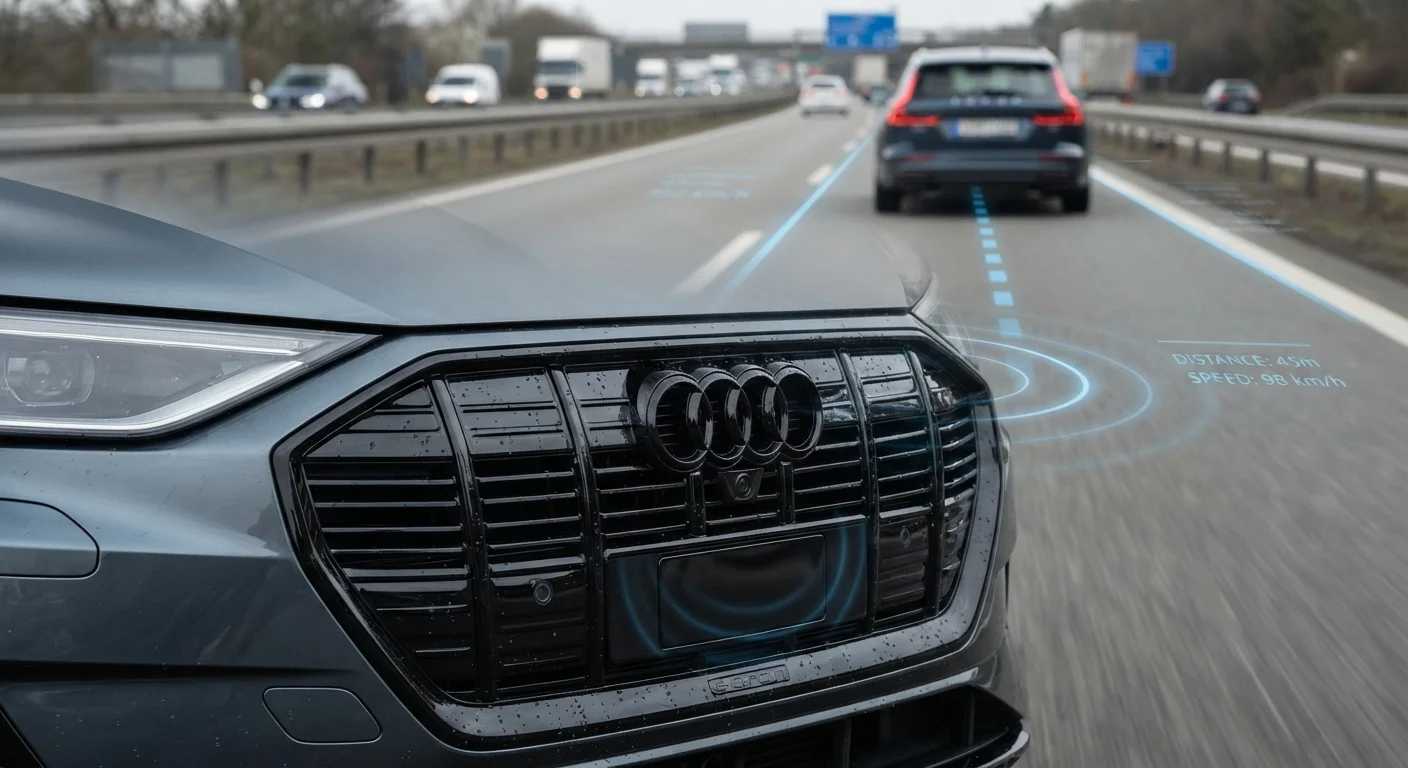
Automatic Emergency Braking is a vehicle safety system that monitors the road ahead using sensors and applies the brakes on its own when it detects an imminent collision the driver hasn't reacted to. It is designed primarily to prevent or reduce the severity of rear-end crashes. AEB does not replace the driver - it acts as a last-resort intervention when a collision appears unavoidable.
AEB systems are classified by the Insurance Institute for Highway Safety (IIHS) and NHTSA into categories based on the speed ranges and object types they address, such as vehicle-to-vehicle (VTV) and vehicle-to-pedestrian (VTP) configurations.
How AEB Detects a Potential Collision
AEB systems rely on a network of sensors - most commonly radar, forward-facing cameras, or both - to continuously scan the road ahead. The sensor data feeds into a processing unit that calculates the distance and closing speed to objects in front of the vehicle. When the system determines that a collision is unavoidable at the current speed and trajectory, it moves through a staged response: first alerting the driver with visual or audible warnings, then pre-charging the brakes to cut response time, and finally applying full braking force if no driver action is taken.
The specific sensors used determine what the system can and can't detect. Radar is strong at measuring distance and speed but can struggle to classify what it's seeing. Cameras provide detailed visual information but are more sensitive to lighting conditions. Most modern systems use sensor fusion - combining radar and camera data - to improve accuracy. For a deeper look at how each sensor technology works, see how radar, lidar, and cameras power modern safety systems.
50%
Reduction in rear-end crashes with AEB
IIHS research has indicated that front-to-rear crashes were reduced by approximately 50% on vehicles equipped with both forward collision warning and automatic emergency braking.
2029
US federal AEB standard deadline
NHTSA finalized a rule in 2024 requiring AEB, including pedestrian detection, as standard equipment on all new light passenger vehicles sold in the US by model year 2029.
~40%
Of new US vehicles with standard AEB
Prior to the federal mandate, industry data suggested roughly 40% of new vehicles sold in the US already included AEB as standard equipment, with higher penetration in newer model years.
What AEB Is Designed to Handle - and What It Isn't
AEB performs most reliably in the scenario it was primarily engineered for: a vehicle closing on a stationary or slow-moving object ahead in clear conditions. This covers a large proportion of real-world rear-end crashes, which is why the safety benefit data is compelling. However, the system has clearly defined boundaries.
Most AEB implementations are calibrated to respond to vehicles and large objects. Pedestrian and cyclist detection - evaluated separately as vehicle-to-pedestrian AEB - requires more sophisticated processing and is not uniformly available across all models or trim levels. Cross-traffic scenarios, vehicles cutting in at close range, and stationary objects off to the side of the lane can all produce inconsistent results. AEB is also generally not designed to manage collision avoidance through steering - it acts on braking only, leaving evasive maneuvers entirely to the driver.
Keep Your Sensors Clean and Clear
AEB performance depends heavily on sensor quality. Regularly clean your front bumper area, windshield, and any visible radar or camera housings - especially after winter driving when salt and debris accumulate. If your vehicle displays a sensor obstruction warning, address it before relying on AEB in traffic.
AEB is one of several driver assistance systems that work within narrowly defined parameters. For context on how it compares to other ADAS features, see our breakdown of common driver-assistance acronyms.
Real-World Limitations Drivers Should Know
AEB systems are not uniformly effective across all vehicles, conditions, or speed ranges. Key limitations include:
- Speed thresholds: Many systems operate fully only below 50 mph. At higher speeds, partial braking may reduce impact force but won't prevent a collision.
- Weather degradation: Heavy rain, snow, and direct sun glare can impair cameras. Mud or ice covering sensors can disable the system entirely.
- False activations: Overhead gantries, roadside signage, and vehicles in adjacent lanes have all been recorded triggering unintended braking in real-world conditions.
- Sensor occlusion: Dirty windshields, aftermarket tinting, or physical damage near sensor locations can reduce detection capability without triggering a warning light.
These limitations don't diminish AEB's overall safety value, but they underline why the system functions best as a supplement to driver attention rather than a replacement for it. Drivers should also be aware that other ADAS features carry similar gaps that aren't always obvious from a spec sheet.
“Automatic emergency braking is one of the most promising crash avoidance technologies we've seen in decades. But drivers need to understand it's a safety net - and safety nets have holes.”
— David Zuby, Former Executive Vice President, Insurance Institute for Highway Safety (IIHS)
Regulatory Status and What It Means for New Vehicle Buyers
AEB has moved from a premium optional feature to a baseline expectation. NHTSA finalized a rule in 2024 requiring AEB - including pedestrian AEB - as standard equipment on all new light passenger vehicles by model year 2029. Separately, IIHS has incorporated AEB performance into its Top Safety Pick criteria, effectively making strong AEB results a prerequisite for top ratings.
For consumers evaluating vehicles today, this means AEB is widely available but not yet universal across all trim levels or older model years. Checking an individual vehicle's IIHS or NHTSA rating - which score AEB performance separately from crash test results - gives a clearer picture than trusting general marketing language. For a plain-language explanation of what those ratings actually test, see how crash-test and safety ratings are scored.
Understanding AEB's real capabilities is part of using your car's full safety suite wisely. For practical guidance on getting the most from driver-assistance features without over-relying on them, that's a useful next step for any driver navigating modern ADAS technology.