

Key Takeaways
- Serving size is the foundation of every number on the label - always check it first.
- The % Daily Value column shows how much a nutrient contributes to a standard 2,000-calorie diet.
- Added sugars, sodium, and saturated fat are three figures most worth watching for everyday health.
- Fiber, vitamins D, calcium, iron, and potassium are nutrients many Americans under-consume.
- Calories alone don't tell the whole nutritional story - nutrient quality matters too.
What you will need
Why the Nutrition Facts Panel Exists
The Nutrition Facts label found on most packaged foods in the U.S. is standardized by the Food and Drug Administration (FDA). Its purpose is straightforward: give consumers a consistent, comparable snapshot of what they're actually eating. Despite that standardization, the label can feel dense and confusing - especially when marketing claims on the front of a package seem to contradict or oversimplify what the panel says on the back.
Understanding the label doesn't require a nutrition degree. It does require knowing which numbers are genuinely useful, which are context-dependent, and which are largely background noise for most shoppers. This guide walks through each section in the order it appears on the standard U.S. label format updated by the FDA in 2016.
For a broader view of why food quality extends beyond any single metric, see our article on why calorie counts tell only part of the story.
What You Need Before You Start
Reading a nutrition label effectively doesn't require tools, but a few mental anchors help.
What you will need
Keep the 5%/20% Rule Handy
The FDA's general benchmark for %DV is simple: 5% or less per serving is low, 20% or more is high. You can apply this to any nutrient on the label - whether you're looking to limit sodium or maximize fiber. It won't answer every nutrition question, but it makes quick shelf comparisons much faster.
Step-by-Step: Reading the Label from Top to Bottom
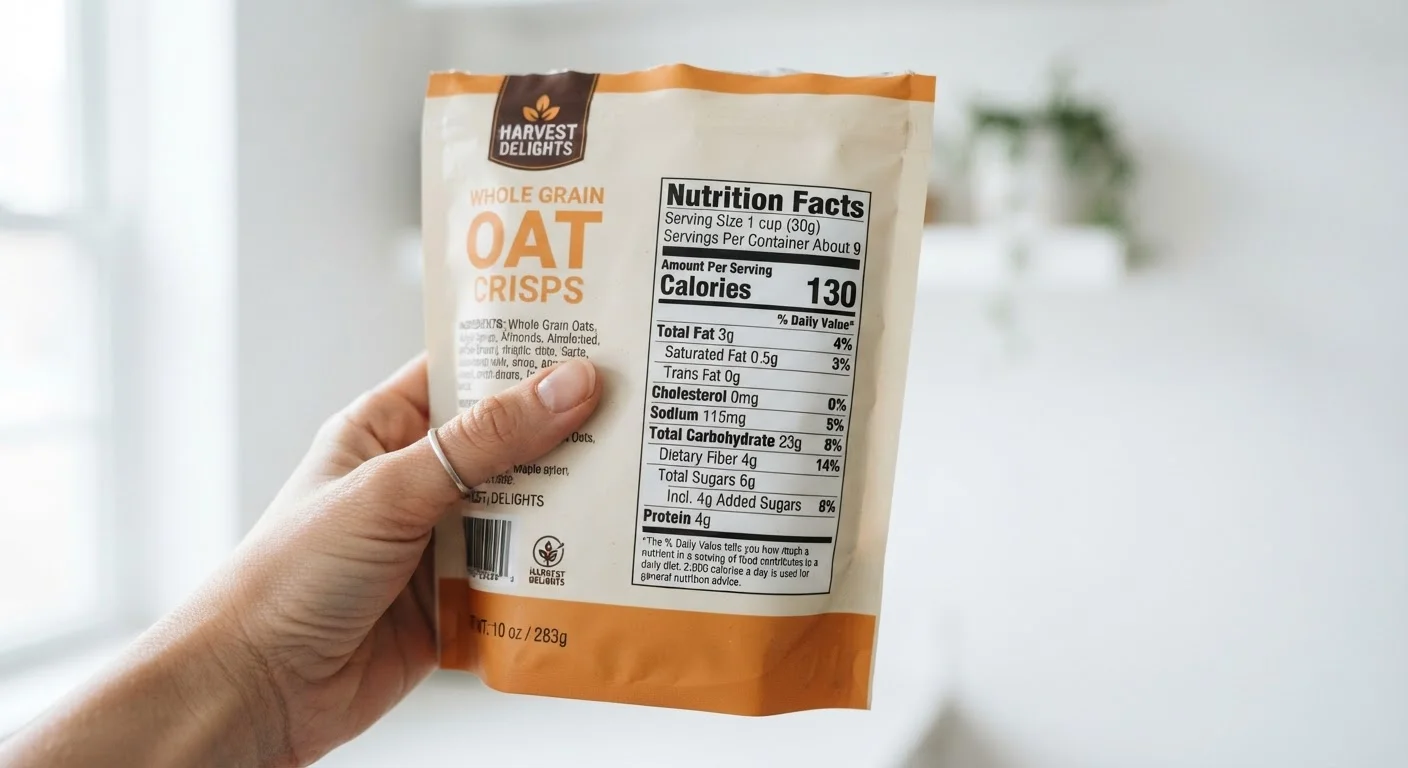
The standard Nutrition Facts panel follows a deliberate top-to-bottom hierarchy. Working through it in order - rather than jumping to individual nutrients - prevents common misreadings.
Find the Serving Size
The serving size sits at the very top of the panel in a larger font for good reason: every single number below it is calculated per that serving. If a bag of chips lists one serving as 28 grams (about 15 chips) but you typically eat twice that, every nutrient figure on the label doubles for your actual intake.
The FDA updated label requirements to make serving sizes reflect amounts people realistically eat, rather than artificially small portions, but it's still worth checking before reading anything else.
Note the Calorie Count
Calories are displayed prominently below the serving size. This number reflects total energy per serving from all macronutrients - carbohydrates, protein, and fat. While useful as a reference point, calories measure energy only, not nutritional quality. A 200-calorie food dense with fiber, vitamins, and minerals is meaningfully different from a 200-calorie food offering little beyond refined carbohydrates.
Scan the 'Limit These' Nutrients
The upper section of the nutrient list covers components that most health guidelines recommend consuming in moderation: saturated fat, trans fat, cholesterol, and sodium. Trans fat in particular should be as close to zero as possible - the FDA has largely phased out artificial trans fats, but trace amounts can still appear.
Sodium is the figure most commonly underestimated. Many packaged and restaurant foods contribute substantially to daily sodium intake, and the label makes it easy to spot high-sodium items: a %DV of 20% or more per serving is considered high.
Check the Carbohydrate Breakdown
Total carbohydrates break down into three sub-entries: dietary fiber, total sugars, and added sugars. Each tells you something different. Dietary fiber supports digestive health and is something many Americans fall short on - a %DV of 20% or more per serving indicates a genuinely high-fiber food. Total sugars combines both naturally occurring sugars (from fruit or dairy, for instance) and added sugars. The added sugars line, introduced in the updated label format, isolates only what was added during processing - this is the figure worth watching most closely for everyday health.
For a deeper look at the distinction, see how natural and added sugars differ on the label.
Review Protein and the 'Get Enough' Nutrients
Protein doesn't carry a %DV on most labels, but the gram amount is listed. Below that, the label lists vitamins and minerals that public health data shows Americans commonly under-consume: vitamin D, calcium, iron, and potassium. Higher %DV values in this section are generally favorable. These micronutrients play important roles in bone health, oxygen transport, and blood pressure regulation, among other functions. For a broader reference on these nutrients, see our guide on vitamins, minerals, and why they matter.
Use the % Daily Value Column as Your Guide
The %DV column runs down the right side of the label and does the math for you, showing each nutrient's contribution toward a standard 2,000-calorie daily diet. This makes it possible to quickly compare foods without doing manual arithmetic. The 5%/20% rule of thumb applies broadly: 5% DV or less signals a low amount of a nutrient per serving, while 20% DV or more signals a high amount. Apply this consistently across both the nutrients to limit and the nutrients to prioritize.
Putting It Together at the Shelf
Once you know how to read the structure, the goal isn't to scrutinize every label for every purchase. It's to build a working mental model so that certain numbers register automatically: a serving size that's smaller than you'd actually eat, a sodium figure that's high relative to the Daily Value, or an added sugars line that seems disproportionate to the product's positioning.
Context always matters. A food with a higher saturated fat number may still fit well within a balanced overall diet, while a food labeled "low fat" may carry significant added sugars. The label gives you data - interpretation depends on your full dietary picture. For guidance on how individual nutrients contribute to overall diet quality, the article on nutrient density offers useful framing, and what a balanced diet actually means puts these numbers in broader context.
For a closer look at one of the label's trickier sections, see our guide on natural versus added sugars and what the label obscures.
This article provides general nutrition education and is not a substitute for personalized dietary advice. Consult a registered dietitian or qualified healthcare professional for guidance specific to your health needs.