

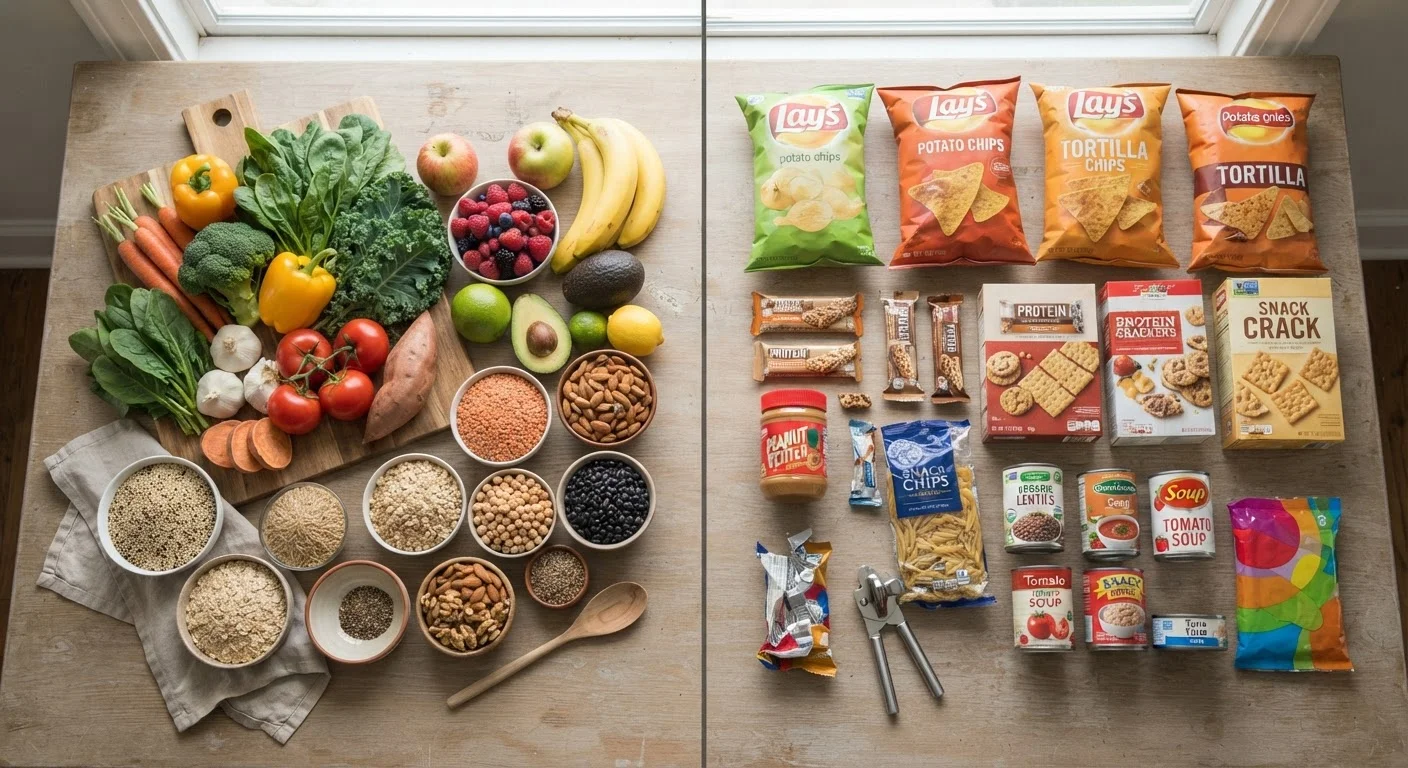
Key Takeaways
- "Processed food" covers a wide spectrum, from frozen vegetables to ultra-processed snack products.
- Whole foods are generally higher in fiber, micronutrients, and beneficial phytochemicals.
- Minimal processing - like canning, freezing, or fermenting - often preserves nutritional value well.
- Ultra-processed foods are associated with higher intakes of added sugar, sodium, and refined fats.
- A practical, balanced diet can include both whole and appropriately processed foods.
- Reading nutrition labels helps you evaluate any food regardless of how it's marketed.
Option A
Whole Foods
The minimally altered, nutrient-dense foundation of most dietary frameworks.
Best for: People prioritizing nutrient density, fiber intake, and minimal additives in their everyday diet.
Option B
Processed Foods
A broad, often misunderstood category spanning minimally altered staples to heavily engineered products.
Best for: Consumers who need convenience, affordability, or shelf stability - depending heavily on processing level.
If you want to maximize fiber and micronutrient intake
Whole Foods
Whole foods consistently deliver the broadest range of vitamins, minerals, and dietary fiber with the fewest trade-offs.
If convenience and affordability are priorities
Processed Foods
Minimally processed options like canned beans, frozen vegetables, and plain oats offer real nutritional value at lower cost and effort.
If you're evaluating packaged foods for your everyday diet
Processed Foods
Not all processed foods are equal - checking the ingredient list and nutrition label lets you make informed choices within this category.
If you're building long-term healthy eating habits
Whole Foods
Centering meals around whole foods provides a reliable nutritional baseline while leaving room for some processed foods without disrupting overall dietary quality.
Defining the Terms: A Spectrum, Not a Binary
The phrase "processed food" tends to conjure images of brightly colored snack bags and fast-food wrappers. But by the technical definition used by food scientists, nearly every food we eat has been processed in some way - washed, milled, pasteurized, cooked, or packaged. The real question isn't whether a food was processed, but how extensively.
Researchers commonly use a classification system called NOVA, developed by Brazilian nutrition researchers, which groups foods into four categories based on the extent and purpose of their processing:
- Group 1 - Unprocessed or minimally processed: fresh fruits, vegetables, plain meats, eggs, legumes, and plain grains. Minimal changes to the original food.
- Group 2 - Processed culinary ingredients: oils, butter, flour, salt, and sugar. These are typically used in cooking rather than eaten alone.
- Group 3 - Processed foods: canned vegetables, fermented foods, cheese, smoked fish, and similar products. Modified for preservation or flavor, but still recognizable.
- Group 4 - Ultra-processed foods: packaged snacks, sugary beverages, reconstituted meat products, and instant noodles. Formulated from industrial ingredients with minimal whole-food content.
"Whole foods," by contrast, typically refers to NOVA Group 1 foods - those eaten close to their natural state with little to no industrial modification. Understanding where a food falls on this spectrum is far more useful than sorting everything into "healthy" or "unhealthy" bins.
| Criterion | Whole Foods | Processed Foods |
|---|---|---|
| Definition | Eaten close to natural state, minimal modification | Altered by industrial or culinary processes |
| Fiber content | Naturally high in dietary fiber | Often reduced or absent in ultra-processed types |
| Micronutrient density | Generally high and varied | Varies widely; may be fortified |
| Added sugars and sodium | Typically absent | Often elevated in ultra-processed products |
| Shelf life and convenience | Often perishable, requires preparation | Longer shelf life, ready or quick to prepare |
| Cost | Can be higher, varies by food | Often lower cost for caloric value |
| Ingredient transparency | Single or few recognizable ingredients | May include additives, emulsifiers, flavorings |
Nutritional Trade-Offs Across the Spectrum
Whole foods tend to have a clear nutritional advantage in several areas. They retain their naturally occurring fiber, phytochemicals, and micronutrient profiles. An apple, for instance, delivers vitamins, antioxidants, and soluble fiber in a form that's difficult to replicate in a supplement or processed product. Fiber in particular matters: it supports digestive health, contributes to satiety, and feeds beneficial gut bacteria.
Minimally processed foods - frozen peas, plain canned tomatoes, full-fat yogurt - often preserve nutritional value quite well. Freezing vegetables shortly after harvest can actually lock in nutrients that degrade during long transport of fresh produce. This means the minimally processed category doesn't deserve the stigma it sometimes gets.
Ultra-processed foods are where the real concerns concentrate. Research published in journals including BMJ and JAMA Internal Medicine has associated high consumption of ultra-processed foods with elevated intakes of added sugars, refined carbohydrates, and sodium - and with lower intakes of fiber and key micronutrients. These associations are meaningful even when accounting for other lifestyle factors, though the relationship between ultra-processed food consumption and specific health outcomes is still an active area of research.
Understanding what's actually in packaged foods requires looking beyond front-of-package claims. Our guide to reading nutrition labels walks through which numbers and sections deserve the most attention.
The NOVA System Has Limitations
While NOVA is a widely cited research tool, it classifies foods by processing type rather than nutritional quality - which means some nutritionally sound foods land in higher processing categories. Plain whole-grain bread, for instance, may be classified as ultra-processed depending on its additives, even if its overall nutritional profile is reasonable. Use processing classification as one lens among several, not a definitive verdict on a food's value.
Fitting Both Into a Realistic Diet
Framing whole foods and processed foods as opposing choices sets up an unrealistic standard. Most people's diets - and most practical, evidence-based dietary guidelines - include both. The goal isn't purity; it's proportion and pattern.
A useful working approach: center meals around whole or minimally processed foods (vegetables, legumes, whole grains, lean proteins, fruit), and treat heavily processed items as occasional additions rather than staples. This aligns with frameworks like the Dietary Guidelines for Americans and the Mediterranean dietary pattern, both of which emphasize food quality and variety rather than strict elimination.
For added sugars specifically - a common marker of ultra-processed food content - understanding the difference between natural and added sugars is a practical starting point. And if you're thinking about overall dietary balance, what a balanced diet actually means offers a grounded explanation of what nutrition frameworks tend to agree on.
Cost and access matter too. Whole foods aren't universally affordable or available, and minimally processed staples - canned beans, frozen vegetables, plain oats - can serve as nutritious, budget-conscious alternatives. A rigid hierarchy that dismisses all processed foods ignores the real constraints many households face.
57%
Share of US calories from ultra-processed foods
A study published in BMJ Open estimated that ultra-processed foods account for roughly 57% of energy intake in the average American diet.
~28g
Daily fiber recommended for most adults
The Dietary Guidelines for Americans recommends approximately 28 grams of dietary fiber per day for a 2,000-calorie diet - a target most Americans fall short of.
This article is for general informational and educational purposes only and does not constitute medical or dietary advice. For personalized guidance about your nutrition or health, consult a qualified healthcare or registered dietitian professional.