

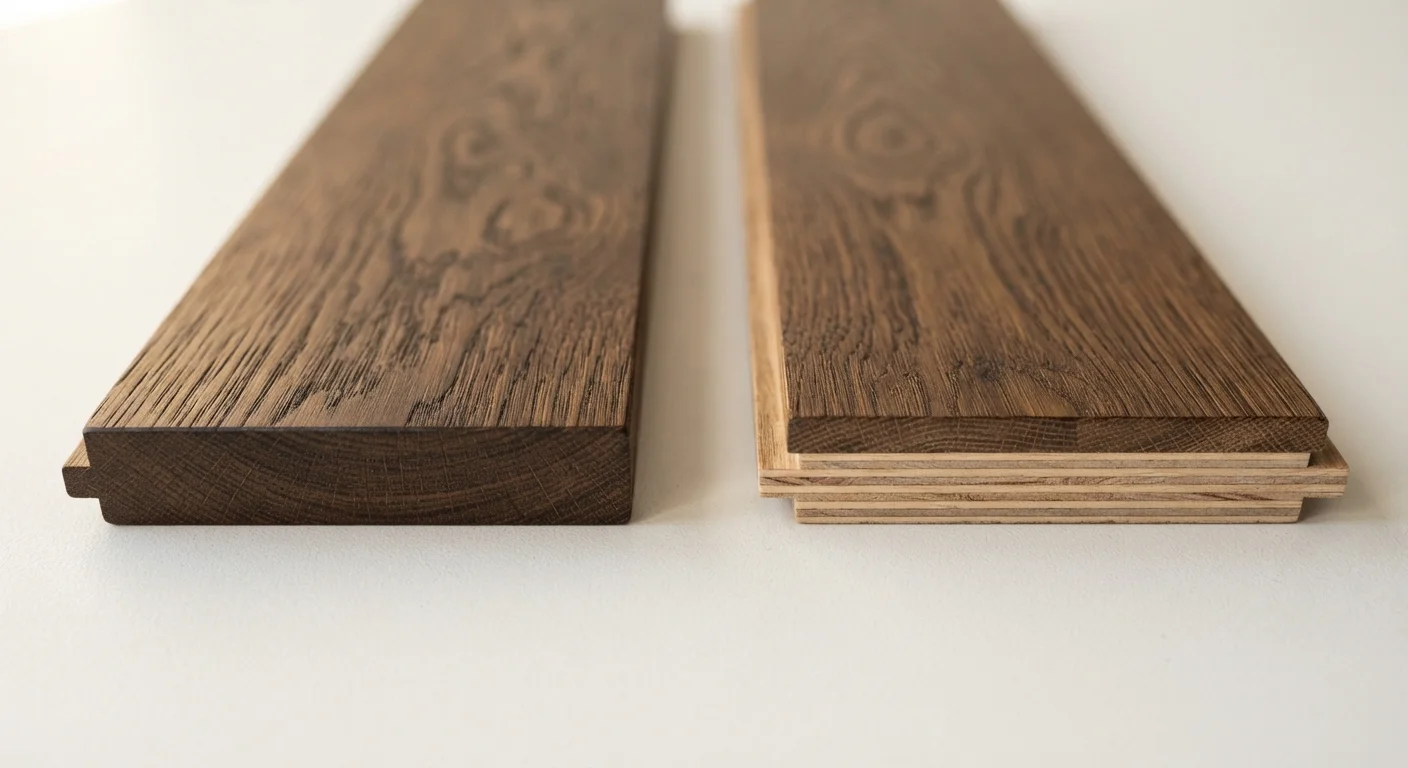
Key Takeaways
- Solid hardwood is milled from a single piece of timber and can be sanded and refinished multiple times.
- Engineered wood uses a real hardwood veneer bonded over a layered core, making it more dimensionally stable.
- Engineered wood is generally suitable for below-grade and high-humidity spaces where solid hardwood is not.
- Both types can look nearly identical on the surface; differences lie in construction and long-term performance.
- Refinishability depends on veneer thickness in engineered boards - thicker veneers allow more sanding cycles.
- Installation method, subfloor type, and room location are the most critical factors when choosing between them.
Option A
Solid Hardwood Flooring
The time-tested, refinishable classic.
Best for: Homeowners in stable, climate-controlled environments who want a long-term floor they can sand and refinish multiple times over decades.
Option B
Engineered Wood Flooring
The dimensionally stable, versatile alternative.
Best for: Homes with variable humidity, basements, or concrete subfloors where solid wood's expansion and contraction would cause problems.
If you want a floor that can be refinished many times over 50+ years
Solid Hardwood Flooring
Solid planks are thick enough to withstand multiple sanding cycles, making them an ideal long-term investment in above-grade, climate-stable rooms.
If you're finishing a basement or installing over concrete
Engineered Wood Flooring
Its cross-ply construction resists moisture-driven movement far better than solid wood, making it appropriate for below-grade and slab installations.
If your home has significant seasonal humidity swings
Engineered Wood Flooring
The layered core minimizes expansion and contraction caused by humidity changes, reducing the risk of cupping, gapping, or buckling.
If authenticity and the highest resale appeal matter most
Solid Hardwood Flooring
Solid hardwood carries a well-established reputation among buyers and appraisers for quality, and its refinishability ensures it can look new again at resale time.
What Each Floor Actually Is
The single most important distinction between these two flooring types is structural, not aesthetic. Solid hardwood is exactly what it sounds like: each plank is cut from a single piece of timber, typically ¾ inch thick. Species like oak, maple, walnut, and hickory are common. That uniform composition is what gives solid hardwood its prized refinishability - there's enough material to sand down surface scratches and worn finishes repeatedly over a floor's lifespan.
Engineered wood flooring, by contrast, is a manufactured product. A real hardwood veneer - anywhere from 1/12 inch to 1/6 inch thick depending on the product - is bonded onto a core of layered plywood or high-density fiberboard (HDF). The layers run in alternating grain directions, a cross-ply structure that dramatically reduces the floor's tendency to expand and contract as humidity changes. Crucially, that top veneer is still genuine wood, so engineered boards can closely mimic the look and feel of solid hardwood.
Veneer Thickness: The Number That Really Matters
When shopping for engineered wood, ask for the wear layer (veneer) thickness in millimeters or fractions of an inch - not just the total plank thickness. A 5/8-inch engineered plank could have a 1mm veneer or a 6mm veneer, and those two products have very different refinishing potential and long-term value. Thicker veneers cost more but behave closer to solid hardwood over time.
Because engineered flooring uses less hardwood per plank, it can make efficient use of premium or slower-growing species - though this alone shouldn't drive your decision. Focus on veneer thickness and core quality when evaluating boards.
Performance, Stability, and Where Each Works
Wood is a hygroscopic material - it absorbs and releases moisture from the air. In solid hardwood, this movement is substantial enough to limit where the floor can be installed. Most manufacturers and flooring professionals advise against using solid hardwood in basements, over radiant heat systems, or directly on concrete slabs. It's also sensitive to climates where humidity swings dramatically between seasons. Inadequate acclimation before installation - letting the planks adjust to the room's temperature and humidity - is one of the most common causes of post-installation problems like gapping in winter or cupping in summer.
Engineered wood's cross-ply core interrupts this movement cycle. It still expands and contracts, but at a fraction of the rate solid wood does. This makes engineered flooring suitable for below-grade rooms, slab subfloors, and areas with radiant heat, provided the specific product is rated for those applications. Always verify manufacturer guidance for the exact product you're considering.
| Criterion | Solid Hardwood | Engineered Wood |
|---|---|---|
| Construction | Single piece of milled timber | Hardwood veneer over layered core |
| Typical thickness | ¾ inch standard | 3/8 inch to ¾ inch |
| Moisture resistance | Low - expands and contracts significantly | Moderate - more dimensionally stable |
| Below-grade suitability | Not recommended | Often suitable (verify product specs) |
| Refinishability | 5-8 times over lifespan | 1-3 times depending on veneer |
| Installation methods | Nail or staple to wood subfloor | Nail, glue, staple, or float |
| Radiant heat compatibility | Limited - check manufacturer | Generally better - check specs |
| Typical lifespan | 50-100+ years with care | 20-50 years depending on veneer |
Choosing between them also depends on your home's layout. If you're weighing broader renovation decisions - like how room configuration affects livability - the guide to open-plan vs. defined rooms covers how flooring continuity factors into those structural choices.
Refinishability, Longevity, and Installation
A solid hardwood floor, properly maintained, can last a century. It can typically be sanded and refinished five to eight times, depending on plank thickness. This is a meaningful advantage in high-traffic homes or properties where owners want to update the floor's color or repair deep scratches years down the road.
Engineered wood's refinishability depends entirely on veneer thickness. A 1/12-inch veneer can usually be lightly sanded once or twice at most. A thicker 1/6-inch veneer may allow two to three cycles. Ask specifically about veneer thickness - not just overall plank thickness - when comparing products.
Installation methods also differ. Solid hardwood is typically nailed or stapled to a wood subfloor. Engineered wood offers more flexibility: it can be glued down, nailed, stapled, or floated (clicked together without adhesive), depending on the product design and subfloor type. That floating method, in particular, simplifies installation in many scenarios and is one reason engineered wood is popular for renovations.
For homeowners planning a larger renovation and weighing how to fund the project, the overview of renovation financing options explains the structures commonly available for home improvement work.
¾ inch
Standard solid hardwood plank thickness
This consistent thickness is what allows solid hardwood to be sanded and refinished multiple times across decades of use.
1mm-6mm
Typical engineered hardwood veneer range
Veneer thickness varies widely across engineered products and directly determines how many times the floor can be refinished.
3-7%
Wood moisture content range for installation
Most flooring professionals target a wood moisture content between 3-7% relative to the subfloor to minimize post-installation movement and gapping.