

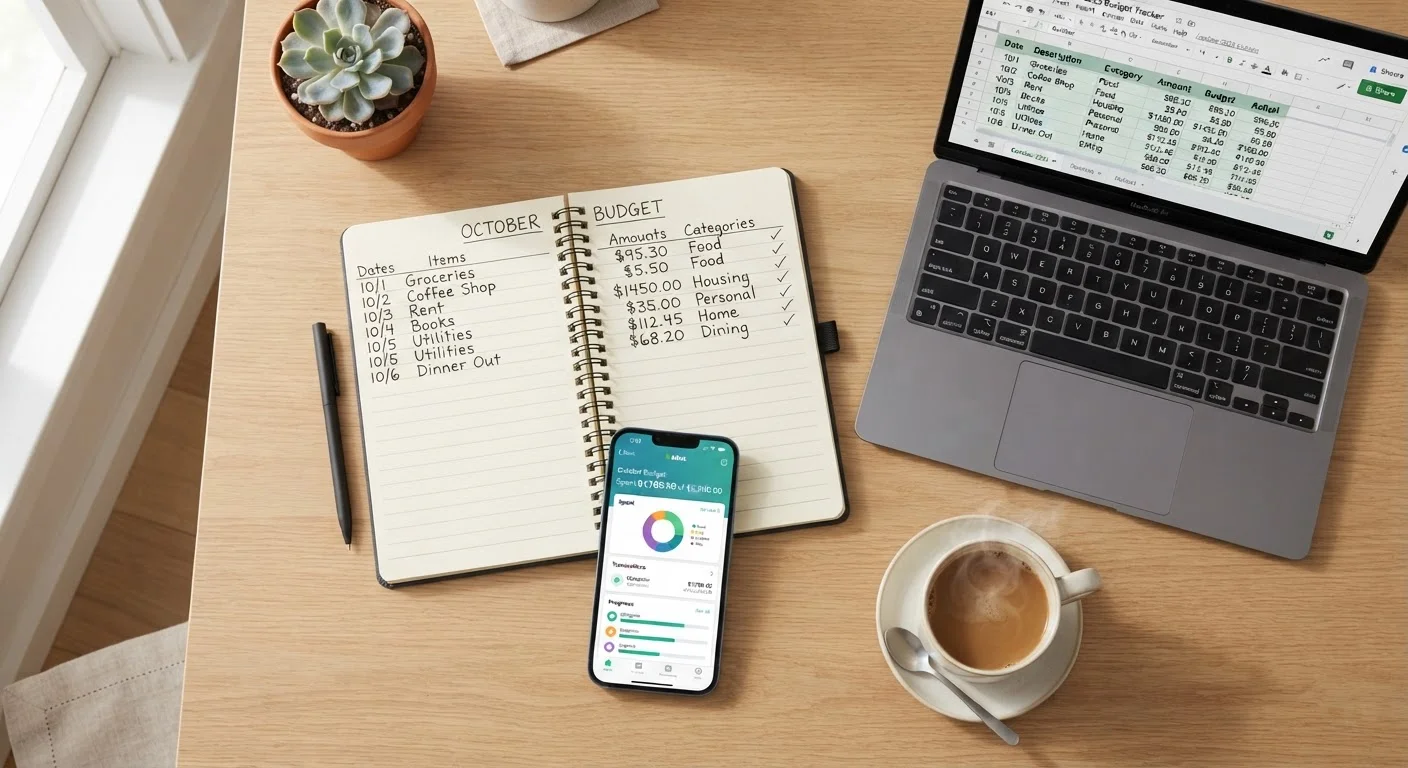
Key Takeaways
- Tracking spending by hand builds awareness but demands consistent daily effort.
- Spreadsheets offer flexibility and control but require some setup and maintenance time.
- Apps automate data entry and categorization but involve data-sharing trade-offs.
- The method you'll actually use consistently matters more than which is theoretically superior.
- Your lifestyle, tech comfort level, and privacy preferences should guide your choice.
Our Verdict
No single tracking method wins outright - effectiveness depends entirely on the habits and preferences of the person using it. Manual tracking suits those who learn through writing; spreadsheets suit detail-oriented people comfortable with basic formulas; apps suit those who want automation and real-time visibility. The most reliable budget tracker is the one you return to every week.
| Best for | Recommended |
|---|---|
| Those who are just starting out or want to build mindful money habits | Hand tracking |
| People who want full customization and don't mind occasional upkeep | Spreadsheet |
| Busy individuals who want automation and fast spending insights | Budgeting app |
| Privacy-conscious users wary of linking financial accounts to third-party services | Spreadsheet or hand tracking |
Why Your Tracking Method Matters
Knowing where your money goes is the foundation of any solid financial plan. Yet research from the Consumer Financial Protection Bureau (CFPB) consistently shows that most people significantly underestimate their discretionary spending - not because they don't care, but because they don't track. Choosing a tracking method that fits your routine is the first step toward changing that.
This comparison covers three common approaches: writing expenses by hand, maintaining a spreadsheet, and using a dedicated budgeting app. Each has genuine advantages and real limitations. For a broader overview of building your full budget, see our complete personal budgeting resource.
| By Hand | Spreadsheet | App | |
|---|---|---|---|
| Setup effort | None | Moderate (initial build) | Low (account linking) |
| Daily time required | High (manual entry) | Moderate (manual entry) | Low (auto-import) |
| Cost | Free | Free or low-cost | Free to ~$15/month |
| Customization | Unlimited | High | Limited by app design |
| Data privacy | Full control | Full control | Third-party access |
| Accuracy of summaries | Manual, error-prone | Formula-driven, reliable | Automated, needs review |
| Best for | Building awareness | Detail-oriented planners | Busy, tech-comfortable users |
Tracking Spending by Hand
Writing down every expense in a notebook or on paper is the oldest and lowest-tech option - and it has a meaningful advantage: the physical act of writing tends to reinforce memory and awareness. Research in cognitive science suggests that handwriting engages the brain differently than typing, which can make the amounts feel more real.
Pros:
- No technology required - works anywhere, anytime
- Zero cost and no data-privacy concerns
- Writing creates a stronger psychological connection to spending decisions
- Useful for people who find screens distracting
Cons:
- Calculating totals and running summaries is manual and error-prone
- Easy to fall behind after a few missed days
- No automatic reminders, charts, or trend analysis
- Difficult to organize across multiple spending categories at a glance
Hand tracking works best as a short-term exercise - even two to four weeks of writing down every purchase can reveal patterns you'd otherwise miss. Many financial educators recommend it as a starting point before migrating to a digital tool.
Start With Just One Week
If you've never tracked spending before, commit to just one week of writing down every transaction by hand. You don't need a perfect system - a pocket notebook or a notes app works fine. Even a single week of manual tracking reveals patterns that months of guessing won't. Once you see where your money actually goes, choosing a longer-term tracking method becomes much easier.
Using a Spreadsheet
A spreadsheet - built in a free tool like Google Sheets or a locally stored program - sits in the middle ground between fully manual and fully automated. You control the structure, the categories, and the formulas. For travel budgeting specifically, a well-built spreadsheet can be especially powerful; our guide to building a travel budget spreadsheet walks through the setup step by step.
Pros:
- Highly customizable - categories, formulas, and views are yours to design
- Calculations are automated once formulas are set up
- No account linking required, keeping banking credentials private
- Free options exist (Google Sheets, LibreOffice Calc)
Cons:
- Initial setup takes time and basic spreadsheet knowledge
- You must still enter transactions manually unless you export bank data as a CSV file
- Can feel overwhelming if you've never used formulas before
- Prone to breakage if formulas are accidentally overwritten
A spreadsheet is a strong long-term tool for people who want to see their full financial picture without linking external accounts. It also scales well - you can add tabs for savings goals, debt payoff timelines, or trip budgets alongside your monthly spending log.
Using a Budgeting App
Dedicated budgeting apps can connect directly to bank and credit card accounts, automatically categorizing transactions as they occur. This eliminates most of the data-entry burden and gives you near real-time visibility into your spending without lifting a finger.
Pros:
- Automated transaction import saves significant time
- Built-in charts, alerts, and spending summaries
- Accessible on your phone at the point of spending
- Some apps support goal tracking and bill reminders
Cons:
- Requires sharing banking credentials or read-only account access with a third party
- Automatic categorization is often inaccurate and needs manual correction
- Some apps carry subscription fees
- If the app changes or shuts down, your data and workflow may be disrupted
Before connecting any financial account to an app, review its privacy policy and data-sharing practices. The Federal Trade Commission (FTC) recommends understanding how your financial data is stored and whether it is sold to third parties. Privacy-conscious users may prefer a spreadsheet or manual log instead.
This article is for general informational and educational purposes only and does not constitute personalized financial advice. For guidance specific to your situation, consult a qualified financial professional.
How to Choose the Right Method for You
The best tracking method is the one you'll actually maintain. Consider these factors when deciding:
- How much time can you realistically commit? Apps require the least daily effort; hand tracking requires the most.
- How comfortable are you with technology? Spreadsheets have a moderate learning curve; apps are generally designed to be intuitive.
- How important is data privacy to you? Hand tracking and spreadsheets keep your data entirely offline or in your own cloud storage.
- Are you trying to build a habit or maintain one? New trackers often benefit from the intentionality of writing; experienced budgeters may prefer automation.
You can also combine methods. Some people use an app for day-to-day awareness and a spreadsheet for monthly review and longer-term planning - including trip budgets. For ideas on applying these principles when you travel, see our travel budget principles guide. And if you're building broader savings habits alongside your tracking practice, the Saving & Emergency Funds hub offers practical next steps.