

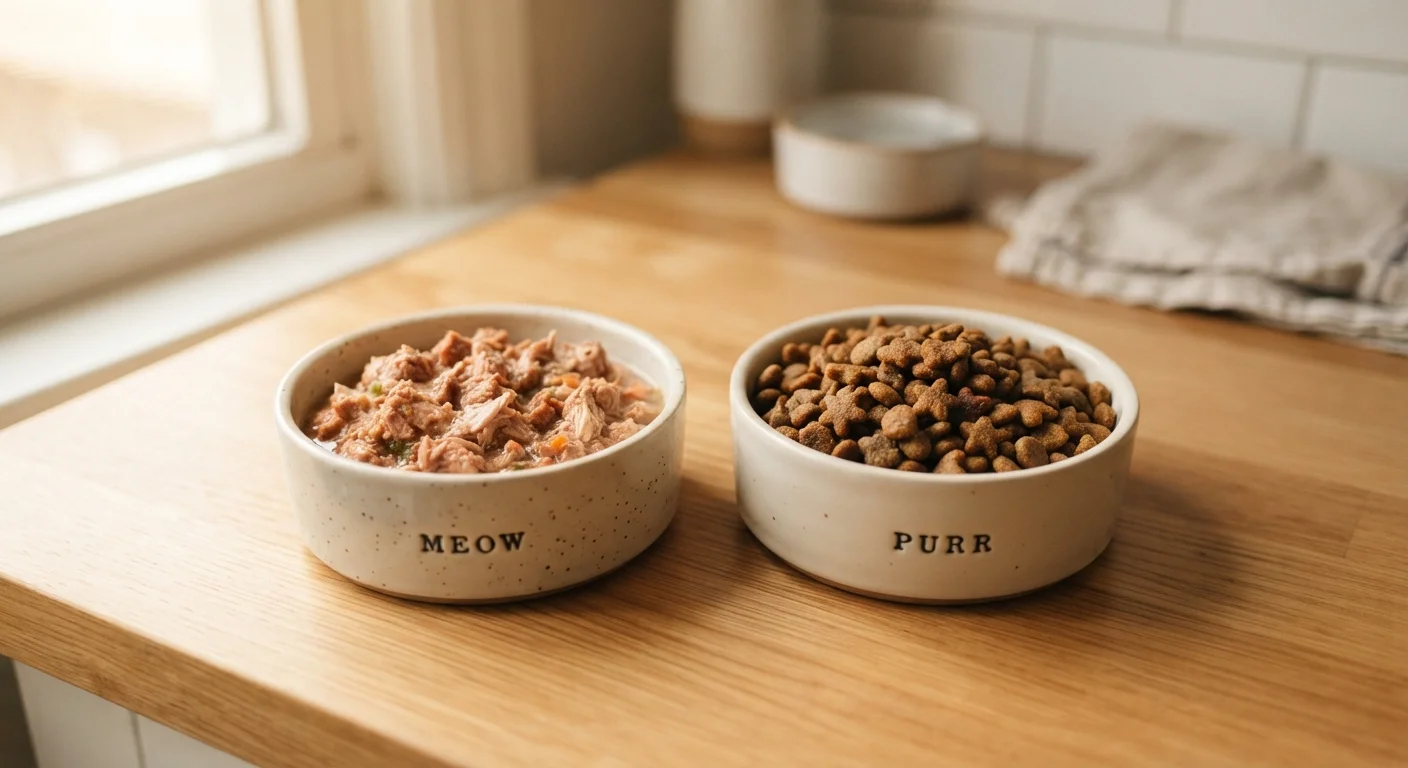
Key Takeaways
- Wet food provides significantly more moisture, which supports urinary and kidney health in cats who drink little water.
- Dry food is more calorie-dense and cost-effective, but cats must drink adequate water alongside it.
- Neither format is universally superior - the best choice depends on your cat's health status, life stage, and preferences.
- Many vets and nutritionists support a mixed feeding approach combining both formats.
- Always choose a food labeled 'complete and balanced' for your cat's specific life stage.
Option A
Wet Cat Food
The high-moisture, palatable option cats often prefer.
Best for: Cats with low water intake, urinary tract concerns, dental sensitivities, or picky eaters needing extra encouragement.
Option B
Dry Cat Food
The convenient, shelf-stable staple for everyday feeding.
Best for: Multi-cat households seeking cost-effective feeding, or owners who need the flexibility of leaving food out for free-feeding.
If your cat has a history of urinary tract issues or kidney disease
Wet Cat Food
The high moisture content in wet food helps increase overall fluid intake, which is widely associated with better urinary tract health. Always discuss dietary changes with your veterinarian.
If budget and convenience are your top priorities
Dry Cat Food
Dry food generally costs less per calorie and can be safely left in the bowl throughout the day, making it easier to manage for busy households.
If your cat is a senior or has reduced appetite
Wet Cat Food
Older cats often find wet food more palatable and easier to chew. Its stronger aroma can also stimulate appetite in cats who have become selective eaters.
If you want a practical, balanced everyday approach
Wet Cat Food
A mixed diet - wet food for moisture and palatability, dry food for convenience - can offer the benefits of both formats when portioned appropriately.
If you're managing a healthy cat at a stable weight
Dry Cat Food
Dry food's predictable calorie density can make portion control more straightforward, helping maintain a healthy body weight with measured daily amounts.
Why the Format of Your Cat's Food Actually Matters
Walk down any pet food aisle and the sheer number of options - pâtés, gravies, kibbles, freeze-dried toppers - can feel overwhelming. But beneath the marketing, the foundational question for most cat owners is simpler: wet or dry? The format of food affects far more than convenience. It shapes how much moisture your cat consumes, how many calories they take in per meal, and even how the food interacts with their digestion.
Cats evolved as desert hunters who derived most of their water needs from the prey they ate. As obligate carnivores, their biology is built around animal-sourced protein - and their ancestral diet was roughly 70% water. That context matters when choosing between a food that is 70-80% moisture (wet) versus one that is roughly 10% moisture (dry).
This isn't about declaring a winner. It's about understanding what each format genuinely offers and where its limitations lie, so you can match the choice to your cat's real-world health needs.
Hydration, Calories, and Palatability: The Core Trade-Offs
The most significant practical difference between wet and dry food is moisture content. Cats with a dry-food-only diet often don't compensate fully by drinking more water - research in feline nutrition has consistently shown that cats on wet diets have substantially higher total daily water intake. This matters most for cats with urinary crystals, kidney disease, or a history of lower urinary tract issues, where dilute urine is genuinely protective.
| Criterion | Wet Cat Food | Dry Cat Food |
|---|---|---|
| Moisture content | ~70-80% | ~8-12% |
| Calorie density (per gram) | Lower - larger portions needed | Higher - smaller portions suffice |
| Palatability | Generally higher; stronger aroma | Variable; texture may appeal to some |
| Cost per day | Higher, especially for larger cats | Lower; more economical at scale |
| Shelf life once opened | 24-48 hours refrigerated | Weeks to months in sealed storage |
| Urinary health support | Favorable - increases fluid intake | Less favorable without ample water |
| Dental cleaning effect | Minimal | Minimal (unless specially formulated) |
| Suitable for free-feeding | No - spoils quickly | Yes - stable at room temperature |
On the calorie side, dry food is considerably more energy-dense per gram. A small volume of kibble can contain a lot of calories, which is useful for underweight cats but makes accidental overfeeding easy in free-fed situations. Wet food's high water content means cats eat a larger physical volume for fewer calories - which can help with satiety and weight management.
Palatability is another area where wet food typically wins. The stronger aroma and softer texture appeal to most cats' natural preferences, making it especially useful for sick, elderly, or picky eaters. That said, some cats develop strong preferences for dry food texture after early habituation, so individual variation is real.
~70%
Moisture in typical wet cat food
Veterinary nutrition references consistently cite wet food moisture content at 70-80%, closely mirroring the water content of whole prey animals.
2-3×
More daily water intake on wet diets
Studies in feline nutrition have found that cats on wet food diets consume significantly more total water per day compared to those eating dry food exclusively.
~10%
Moisture in typical dry kibble
Most standard dry cat foods contain roughly 8-12% moisture, which is far below the water content cats would obtain from a prey-based diet.
Dental Health, Cost, and Practical Considerations
One persistent claim is that dry food cleans cats' teeth through a scrubbing action. The evidence here is mixed at best. Most cats shear kibble rather than chew it, which limits any mechanical cleaning effect. Some dental-specific dry diets are formulated with larger kibble shapes to encourage chewing, but these are specialist products rather than a property of dry food generally. Wet food, by contrast, doesn't contribute to mechanical cleaning - though it also doesn't cause dental disease on its own. Regular dental check-ups and veterinary-recommended dental hygiene practices remain more reliably effective regardless of food format.
Cost is a genuine consideration. Wet food is typically more expensive per calorie than dry food, and it must be refrigerated once opened and used within 24-48 hours. Dry food is shelf-stable, easy to store, and more economical for households with multiple cats. For many families, a combined approach - wet food at mealtimes, dry food available during the day - balances cost against the benefits of increased moisture intake.
Life stage matters too. Kittens have different energy and protein needs than adult or senior cats, and a food's format should be evaluated alongside its nutritional profile for the relevant life stage. For more on this, see our guide on cat nutrition across life stages. If you want a structured way to assess any food you're considering, the pet food evaluation checklist is a useful next step.
This article provides general educational information about cat nutrition and is not a substitute for personalized veterinary advice. Always consult a qualified veterinarian before making significant changes to your cat's diet, especially if your cat has a health condition.