

Key Takeaways
- Dealer financing routes your loan through a third-party lender, often with the dealer earning a markup on your rate.
- Bank or credit union financing lets you know your exact rate before stepping onto the lot.
- Both financing paths use the vehicle as collateral, meaning the structure of a secured auto loan is fundamentally the same.
- Rate promotions from manufacturers through dealers can be genuinely competitive - but only for well-qualified buyers.
- Separating the financing conversation from the vehicle price negotiation typically gives buyers more clarity and control.
- Your credit profile, loan term, and down payment affect your rate regardless of which financing channel you use.
Option A
Dealer Financing
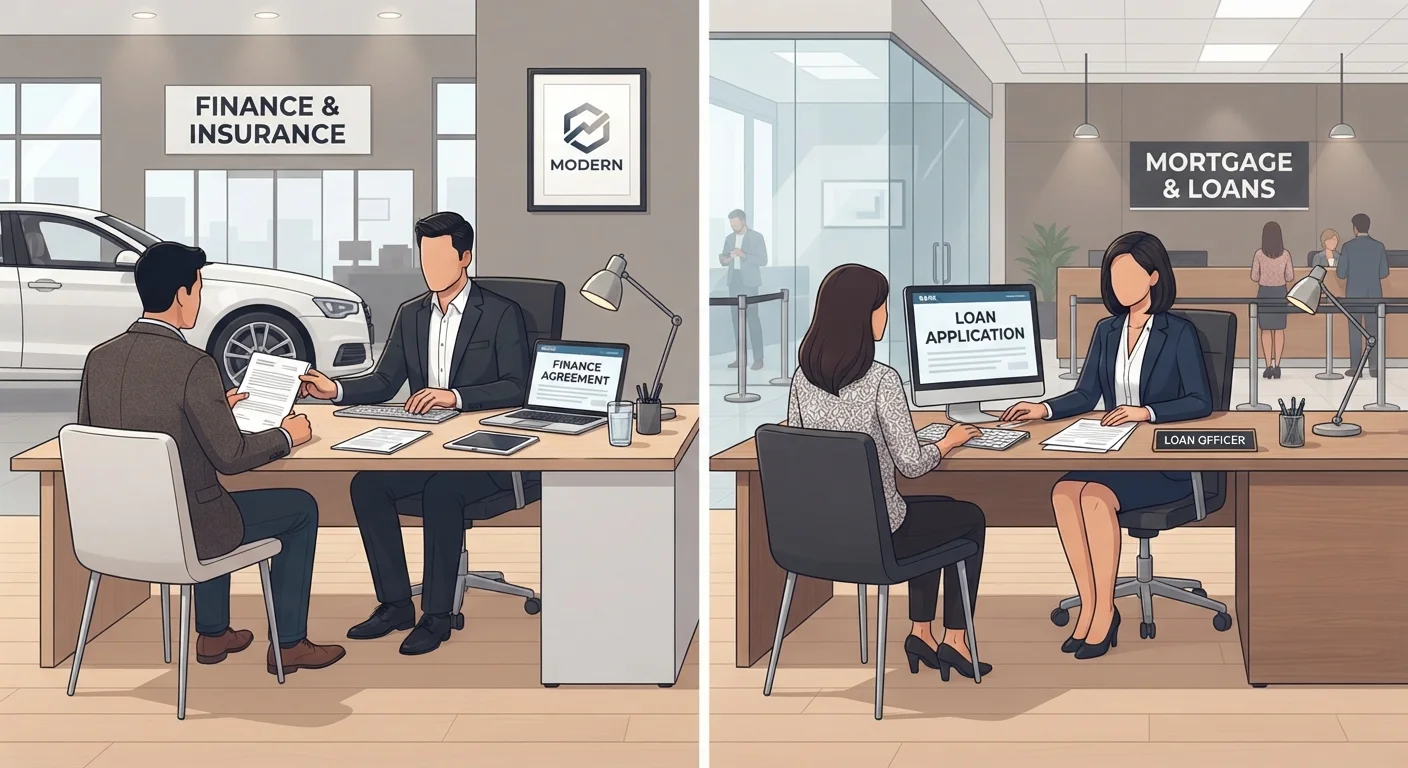
The convenient, one-stop option arranged through the dealership's finance office.
Best for: Buyers who want to handle everything in one visit and may qualify for manufacturer-subsidized rate promotions.
Option B
Bank (Direct) Financing
The independent route secured from a bank or credit union before or after visiting a dealer.
Best for: Buyers who want to negotiate the vehicle price separately from financing and prefer rate transparency upfront.
If you want to lock in a rate before visiting a dealership
Bank (Direct) Financing
Getting pre-approved by a bank or credit union gives you a concrete rate benchmark, strengthening your negotiating position on the lot.
If you qualify for a manufacturer-subsidized low-APR promotion
Dealer Financing
Automaker-backed rate incentives - often 0% to 1.9% APR - can be lower than any independent lender's offer, provided your credit meets eligibility requirements.
If you want to keep the price and financing negotiations separate
Bank (Direct) Financing
Arriving with a pre-approval turns the dealer's finance office into an optional comparison rather than the only option, reducing pressure to bundle deals.
If speed and a single appointment matter most
Dealer Financing
Dealers can often finalize financing the same day you choose a vehicle, coordinating paperwork across multiple lenders through their lending network.
If your credit history is limited or imperfect
Dealer Financing
Some dealerships work with a broad lender network that includes subprime options - though borrowers should review rate and term details carefully in these cases.
How Each Financing Path Actually Works
When you finance a car through a dealership, you're not borrowing directly from the dealer. Instead, the dealership acts as an intermediary - submitting your credit application to one or more wholesale lenders (banks, captive finance arms, or credit unions) and presenting you with an offer. The dealer may add a markup, sometimes called a "dealer reserve," to the interest rate the lender originally approved. That difference is compensation for arranging the loan.
Direct financing - commonly called a bank loan or credit union loan - cuts out the middleman. You apply independently, receive a loan commitment letter or pre-approval, and bring that to the dealership. If the dealer's financing office can beat your rate, you can take that offer; if not, you proceed with the pre-approval. This approach is sometimes called "buying power" because you arrive knowing your ceiling.
In both cases, the underlying loan structure is a secured installment contract: the vehicle serves as collateral, you repay over a fixed term, and the lender holds the title until the loan is paid off. For a plain-language breakdown of what APR, loan term, and amortization actually mean in practice, see our guide to vehicle loan terms.
Where the Rates Come From - and Why They Differ
Interest rates in both channels are driven by the same core factors: your credit score, debt-to-income ratio, loan term, vehicle age, and down payment. What differs is how the final rate is set and who profits from it.
| Criterion | Dealer Financing | Bank / Credit Union Financing |
|---|---|---|
| Who sets your rate | Lender, potentially with dealer markup | Lender directly, no intermediary |
| Rate transparency | Rate revealed at signing | Rate known before dealership visit |
| Promotional low-APR deals | Available via manufacturer captive lenders | Not available through this channel |
| Application process | Handled in-dealership, same day | Applied for independently in advance |
| Negotiation leverage | Price and payment often bundled | Price and financing negotiated separately |
| Lender variety | Multiple lenders via dealer network | Single institution per application |
| Credit impact on shopping | Multiple hard pulls may occur | One hard pull (or soft for pre-approval) |
Manufacturer-captive lenders - the financing arms of automakers - sometimes offer subsidized promotional rates to move inventory. These deals are real, but eligibility is typically limited to buyers with strong credit profiles (often 700+ FICO). If you don't qualify at the promotional tier, the rate adjusts upward, which the dealer's finance office may not flag proactively.
Credit unions, in particular, are worth contacting before any dealership visit. As member-owned institutions, they often return profit to members through lower loan rates. Many credit unions offer pre-approvals with soft credit pulls that don't affect your score.
~80%
New car buyers who finance through dealerships
Industry data from Experian's State of the Automotive Finance Market consistently shows a large majority of financed new-vehicle purchases originate through dealership finance offices.
0.5-2%
Typical dealer rate markup range
The Consumer Financial Protection Bureau has noted that dealer reserve markups commonly range from 0.5 to 2 percentage points above the lender's buy rate, though this varies by lender policy.
The Negotiation Dynamics Each Path Creates
One of the least-discussed differences between dealer and bank financing is how each shapes the negotiation environment. When a dealer controls both the vehicle price and your monthly payment calculation, it becomes easier to obscure the true cost of each. A lower monthly payment achieved by stretching the loan term, for example, may cost more in total interest than a slightly higher payment over a shorter term.
Arriving with a pre-approval separates these conversations cleanly. You negotiate the vehicle's out-the-door price first, then discuss financing. The dealer's finance office may still offer a competitive counter - that's worth evaluating - but you're comparing apples to apples rather than navigating a bundled offer.
For a closer look at how dealership pricing and negotiation tactics work in practice, our dealership negotiation guide walks through the process step by step.
Multiple Credit Inquiries Within a Short Window
When a dealer submits your application to several lenders simultaneously, each may generate a hard credit inquiry. Credit scoring models - including FICO and VantageScore - generally treat multiple auto loan inquiries made within a 14- to 45-day window as a single inquiry for scoring purposes. If you're rate shopping independently at multiple banks, try to complete those applications within the same compressed window for the same benefit.
What Stays the Same Regardless of Path
Despite the channel differences, several realities are consistent across both financing types. First, your credit profile is the primary driver of what rate you'll be offered - a dealer network and a bank are both assessing the same risk. Second, both loans are secured by the vehicle, meaning default can result in repossession. Understanding how secured lending works helps set realistic expectations about what lenders require. Third, loan terms - typically ranging from 36 to 84 months - carry the same trade-off in both settings: longer terms lower monthly payments but increase total interest paid. Finally, gap insurance, extended warranties, and other add-ons may be offered in the finance office regardless of where the loan originated; these are optional products and their costs should be evaluated independently of the loan terms themselves. If you're still weighing whether financing a purchase outright is the right approach, our comparison of buying vs. leasing covers that decision in full.
This article provides general financial information for educational purposes and does not constitute personalized financial or lending advice. Consult a qualified financial professional for guidance specific to your situation.