

Key Takeaways
- Always check tyre pressure when tyres are cold - before driving more than a mile or two.
- Your vehicle's recommended pressure is on the door jamb placard, not on the tyre sidewall.
- Most passenger tyres should be checked at least once a month and before long trips.
- A TPMS warning light is a backup alert, not a substitute for manual checks.
- Even a small pressure deficit can affect handling, tread wear, and fuel efficiency.
What you will need
Why Tyre Pressure Deserves Your Attention
Tyre pressure is one of the simplest maintenance tasks a driver can handle independently, yet it's routinely overlooked until something goes wrong. Running on underinflated tyres increases rolling resistance, which nudges fuel consumption upward, accelerates tread wear on the outer edges, and can compromise how the vehicle responds in an emergency manoeuvre. Overinflation is equally problematic: it reduces the tyre's contact patch with the road, making the ride harsher and increasing susceptibility to impact damage from potholes.
Ambient temperature also plays a direct role. As a general rule, tyre pressure drops roughly 1 PSI (pound per square inch) for every 10°F (about 5.5°C) fall in temperature. This is why tyres that were correctly inflated in late summer may be noticeably low by mid-winter without ever developing a slow leak.
If your dashboard has illuminated a tyre symbol, our guide on what your TPMS warning light is telling you explains what different alerts mean. But remember: the Tyre Pressure Monitoring System (TPMS) fitted to most vehicles sold after 2008 only triggers at a significant threshold - typically 25% below recommended pressure. Regular manual checks catch problems much earlier.
Make It a Monthly Habit
Most tyre and vehicle manufacturers suggest checking pressure at least once a month and before any long journey. Setting a recurring reminder on your phone takes about 10 seconds to set up and removes the 'I'll do it later' barrier entirely. A consistent monthly check gives you a reliable baseline, so an unexpected drop - signalling a slow leak - stands out immediately.
What You Need Before You Start
You don't need specialised tools or a workshop. The following items will cover you for a thorough, accurate check.
What you will need
Tyre pressure gauge
Measures the air pressure inside each tyre in PSI; digital models are easiest to read, stick-type pencil gauges are compact and reliable.
Portable air compressor or tyre inflator
Allows you to add air at home or roadside without needing to drive to a forecourt, keeping tyres in the cold state for accurate adjustment.
Valve stem cap (spare)
Replaces any missing caps to keep dirt and moisture out of the valve core after checking.
Step-by-Step: Checking Your Tyre Pressure
Work through each tyre in sequence - including the spare if your vehicle carries a full-size or compact spare. The process is identical for all four road tyres.
Find your recommended pressure
Open the driver's door and locate the placard on the door jamb or door edge. Note the recommended cold inflation pressure in PSI for both front and rear tyres. If different values are listed for load conditions, use the standard (unloaded) figure for everyday driving unless you're carrying a full load.
Check tyres while cold
Pressure rises as tyres warm up from driving - even a short 10-minute trip can add 4-6 PSI, skewing your reading. Check before the first drive of the day or after the vehicle has sat for at least one hour.
Remove the valve cap and seat the gauge
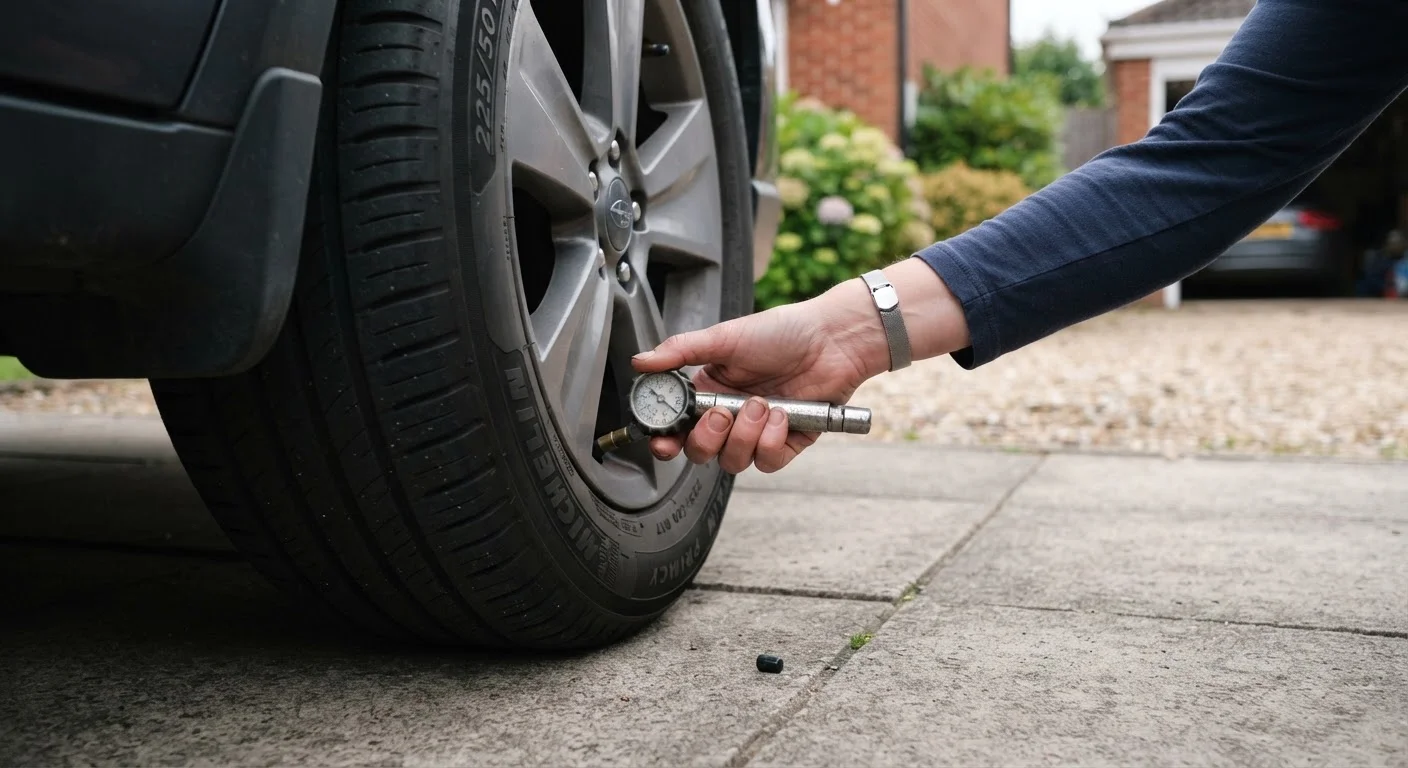
Unscrew the small cap from the valve stem - the short rubber or metal nub protruding from the wheel rim. Place it somewhere you won't lose it. Press the gauge firmly and squarely onto the valve stem. A brief hiss usually means the gauge isn't fully seated; reposition and press again until the hiss stops and you get a stable reading.
Read and record the pressure
Note the PSI reading for each tyre. Work around the vehicle systematically - for example, front-left, front-right, rear-right, rear-left - so you don't skip any. Write the readings down or enter them into your phone.
Add or release air as needed
If a tyre reads low, attach your compressor or the forecourt airline and add air in short bursts, re-checking frequently with the gauge. If a tyre is over-inflated, use the small pin on the back of most gauges - or a pen-style release tool - to press the valve core and release air in brief increments, checking after each release.
Replace valve caps and note the date
Screw valve caps back on finger-tight - they exist to protect the valve core from debris and moisture, not to hold air in. Log the date of your check (a note in your phone or a sticker on your sun visor works well) so you can maintain a monthly checking rhythm.
A Persistent Pressure Drop Needs Professional Attention
If the same tyre reads low week after week even after being corrected, don't just keep inflating it. A slow leak from a puncture, cracked valve stem, or damaged wheel rim requires inspection and repair by a qualified tyre technician. Continuing to drive on a repeatedly underinflated tyre risks tyre failure, especially at highway speeds.
Understanding the Placard and What to Do With the Reading
The sticker on the inside edge of your driver's door (or sometimes the door frame or fuel filler door) is your primary reference. It lists the manufacturer-recommended pressure in PSI for the front tyres, rear tyres, and often a separate value for when the vehicle is fully loaded. This figure is the target cold inflation pressure - the number your gauge reading should match.
Do not use the maximum pressure printed on the tyre sidewall itself. That figure represents the maximum the tyre can hold structurally, not the optimum pressure for your vehicle's weight, geometry, and ride comfort.
If your reading is more than 2-3 PSI off in either direction, adjust accordingly. If a tyre keeps losing pressure between checks, that points to a slow leak - from a nail, a damaged valve stem, or a compromised bead seal - and warrants a professional inspection rather than repeated top-ups.
Tyre pressure is just one piece of the routine maintenance picture. Our pre-long-trip vehicle check walks through tyres, fluids, lights, and more in a structured sequence before any significant journey. And since tyre wear patterns are closely tied to rotation intervals, it's worth reading about why tyre rotation matters to keep wear even across all four corners.