

Key Takeaways
- Blind-spot monitoring detects vehicles alongside you but has real coverage gaps drivers often don't know about.
- The system uses radar sensors that can be fooled by weather, sensor damage, or vehicles moving at very different speeds.
- Overconfidence in BSM is a documented risk - the alert is a prompt to check mirrors, not a lane-change clearance.
- Motorcycles, cyclists, and pedestrians are frequently missed by radar-based blind-spot systems.
- Understanding what your specific vehicle's system covers - and doesn't - is essential for safe use.
What Blind-Spot Monitoring Actually Does
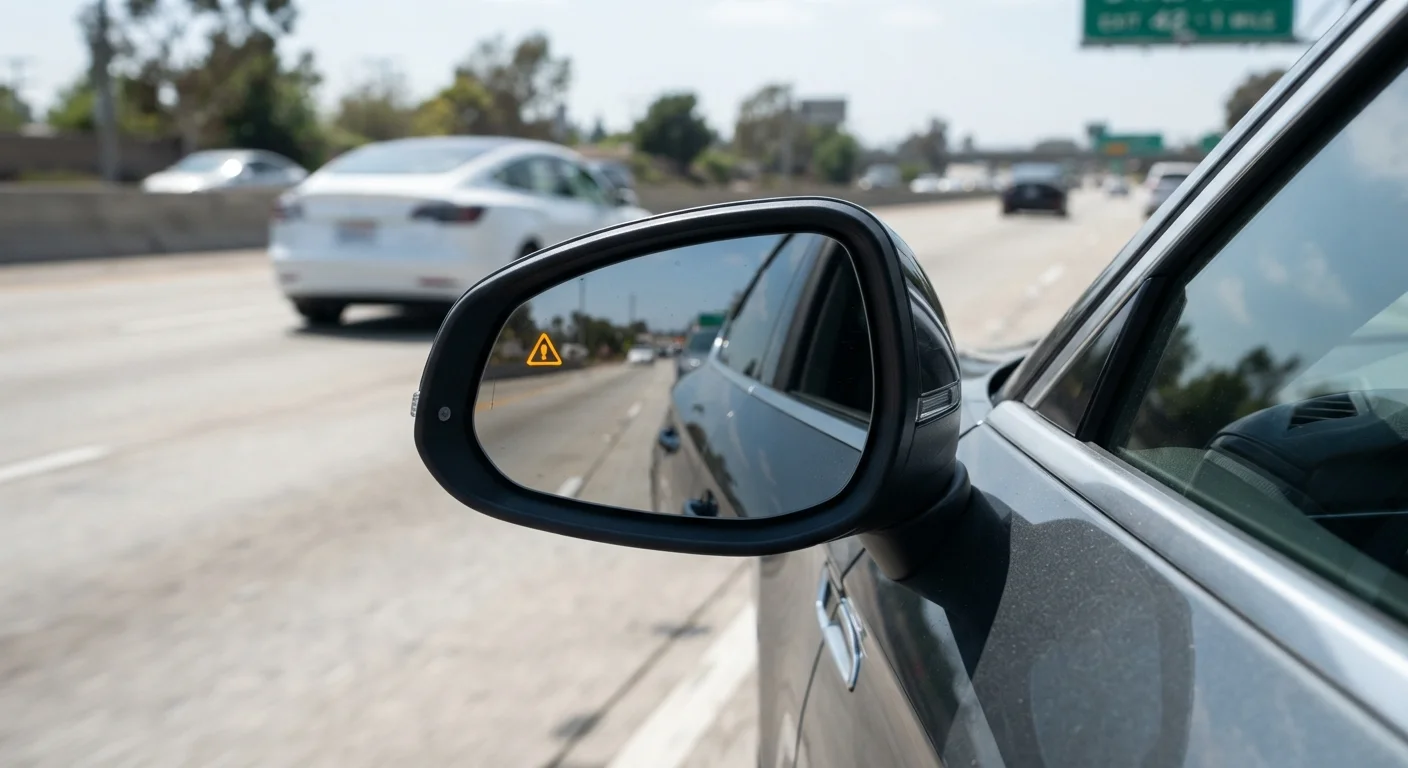
Blind-spot monitoring (BSM) is one of the most widely adopted driver-assistance features on new vehicles. Most systems work by using short-range radar sensors - typically mounted in the rear bumper - to detect vehicles traveling in the zones alongside and slightly behind your car that mirrors don't easily cover. When a vehicle enters that zone, a visual indicator (usually an amber light in or near the side mirror) illuminates, and many systems add an audible or haptic alert if you signal a lane change while the zone is occupied.
That basic description sounds reassuring. But the gap between what the system detects and what drivers assume it detects is where crashes happen. To use BSM safely, you need to know exactly where its coverage ends - and the myths that lead drivers to trust it too completely.
For a broader look at the sensors powering these systems, see how radar, lidar, and cameras compare.
Myth
If the blind-spot warning light isn't on, it's safe to change lanes.
Fact
The absence of a BSM alert means no vehicle was detected in the radar zone - not that the lane is clear of all hazards.
Radar-based BSM only covers a defined detection zone, typically extending from slightly in front of the rear axle to a few car lengths behind. Objects outside that zone - a car approaching fast from further back, a cyclist near the front quarter, or a pedestrian - will not trigger the alert. Always use mirrors and a head-check as primary inputs; BSM is a supplement, not a substitute.
Myth
Blind-spot monitoring detects motorcycles and cyclists just as reliably as cars.
Fact
Motorcycles and cyclists present a much smaller radar cross-section than passenger vehicles, making them significantly harder for BSM radar to detect consistently.
Radar sensors work by bouncing signals off objects and measuring the return. A narrow motorcycle or a bicycle reflects far less signal than a full-size vehicle, which can result in delayed or missed detections - particularly if the rider is traveling quickly or is partially obscured. Extra caution around two-wheeled road users remains essential regardless of what the BSM indicator shows.
Myth
Blind-spot monitoring works the same in all weather conditions.
Fact
Snow, ice, and heavy rain can accumulate on sensor housings and degrade or completely block radar performance.
Radar waves used by BSM systems can be attenuated or scattered by ice build-up on the rear bumper, thick mud, or heavy precipitation. Many vehicles display a sensor-blocked warning in these conditions, but not all drivers recognize or respond to it. Before driving in adverse weather, clear sensor areas (typically marked or indicated in the owner's manual) as part of your standard vehicle preparation.
Myth
Once a car has BSM, you don't need to adjust mirrors properly.
Fact
Correctly adjusted mirrors remain a foundational safety practice that BSM is designed to complement, not replace.
Side mirrors set to eliminate interior door-frame visibility and provide maximum outward coverage - a technique supported by traffic safety research - dramatically reduce the traditional blind spot before BSM even activates. Drivers who rely solely on BSM and skip proper mirror adjustment are compounding risk, not reducing it. The two practices work best together.
Myth
A BSM system that passed its last service check is always reliable.
Fact
BSM sensors require recalibration after any rear-end collision, bumper replacement, or bodywork in the sensor area.
Even a minor impact can shift a sensor's aim angle enough to change its coverage zone without triggering a dashboard fault. A sensor that appears operational may be covering the wrong area or providing incomplete coverage. If your vehicle has had any rear-end work done, confirm with a qualified technician that BSM sensors have been checked and recalibrated to manufacturer specifications.
The Gaps That Create Real Risk
Even a fully functional, properly calibrated BSM system has hard limits. Radar sensors can be degraded by heavy snow, ice build-up, or thick mud on the rear bumper - and most systems will display a warning when sensor performance is reduced, though drivers often dismiss or miss these alerts.
Trailers and Cargo Racks Affect BSM Reliability
Attaching a trailer, hitch-mounted cargo carrier, or bike rack can obstruct rear radar sensors or cause persistent false alerts, leading some drivers to mentally tune out BSM warnings. Many vehicles automatically disable BSM when a trailer is connected via the wiring harness - but not all do. Check your owner's manual to understand how your vehicle behaves when towing or carrying rear-mounted cargo, and never assume BSM is functioning normally without verifying.
Speed differential matters too. BSM systems are designed to detect vehicles traveling at comparable speeds. A motorcycle filtering rapidly through traffic, or a car overtaking at significantly higher speed, may enter and exit the detection zone faster than the system can register and alert. The alert is reactive, not predictive.
Physical obstructions - a trailer, a bike rack, or certain aftermarket accessories attached to your vehicle - can interfere with sensor function or create false readings. If you regularly tow or carry cargo, check your owner's manual for guidance on BSM behavior under those conditions.
For how BSM compares with other safety systems and their respective weaknesses, the overview at which safety features have the strongest real-world evidence provides useful context.
Using BSM the Right Way
The most important mindset shift is treating a BSM alert as a prompt to verify, not a verdict on safety. When the light is off, that means no vehicle has been detected in the radar zone - it does not mean the lane is clear of all hazards. Always cross-check with mirrors and a physical head-check before changing lanes.
Calibration is critical. After any rear-end collision, bumper replacement, or sensor-area bodywork, BSM sensors must be recalibrated by a qualified technician. An out-of-calibration sensor may appear fully functional while delivering unreliable coverage. This is not a DIY task - improper calibration can create a false sense of security that's more dangerous than having no system at all.
~27%
Reduction in lane-change crashes with BSM
Research published by the Insurance Institute for Highway Safety (IIHS) found blind-spot detection systems were associated with a roughly 27% reduction in lane-change crashes compared with vehicles without the technology.
~14%
Reduction in lane-change crash injuries
The same IIHS research indicated injury-producing lane-change crashes dropped by approximately 14% when vehicles were equipped with blind-spot warning systems.
Understanding how to work with - rather than defer to - all your vehicle's driver-assistance features is a skill worth developing. The guidance at getting the most from your car's safety systems without over-relying on them walks through practical habits that apply across ADAS features.
This article is for general informational purposes. Always consult your vehicle's owner's manual and a qualified automotive technician for guidance specific to your vehicle's systems.