

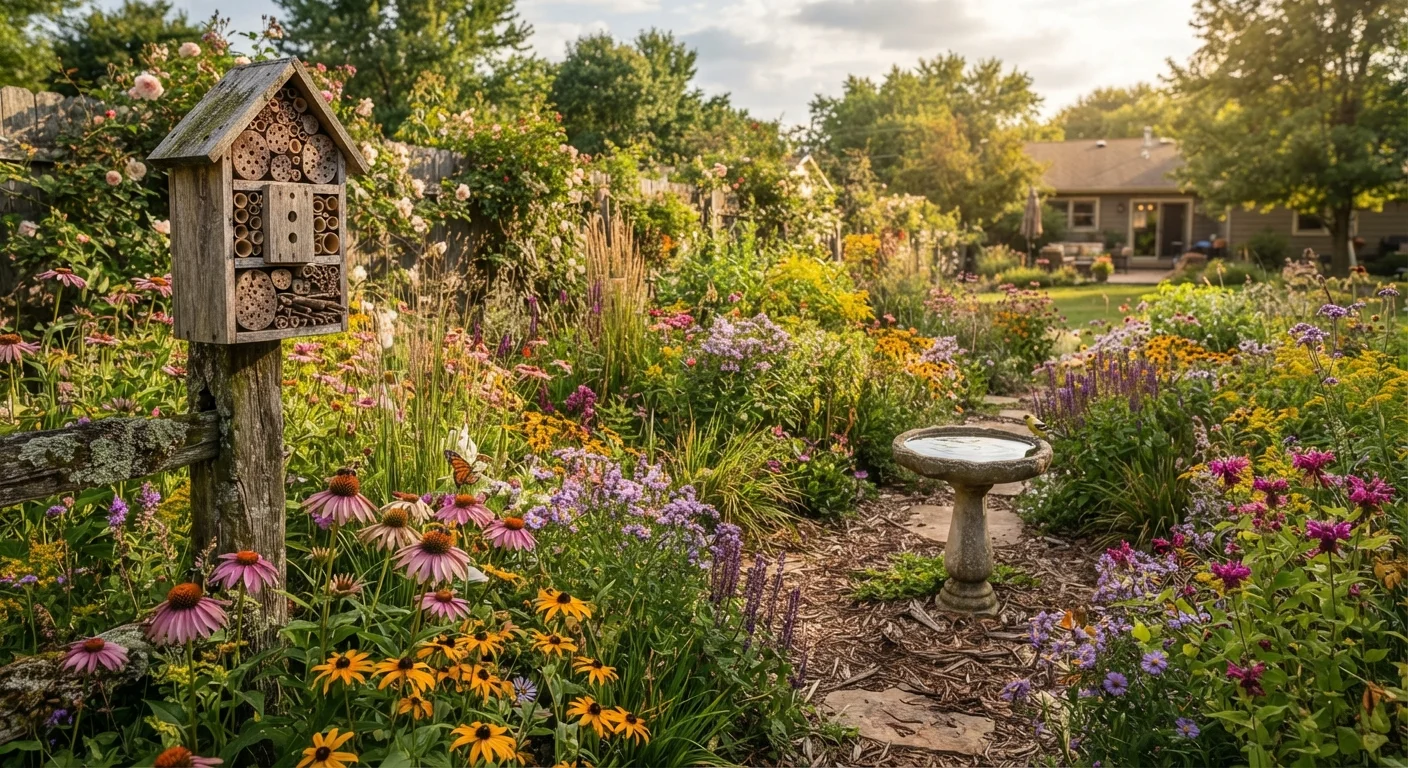
Key Takeaways
- Native plants are the single most effective foundation for a wildlife-friendly garden.
- Reducing chemical inputs - pesticides and synthetic fertilizers - protects insects and soil biology.
- Small structural additions like water sources, log piles, and nest boxes create outsized habitat gains.
- Letting parts of your garden 'go wild' benefits ecosystems without sacrificing the whole yard's appearance.
- Healthy soil underpins all wildlife gardening - invertebrates and fungi form the base of the food web.
Why Wildlife-Friendly Gardening Matters - and Where to Start
Residential gardens collectively cover a significant area of urban and suburban land in the United States. The choices homeowners make - what to plant, how to water, which chemicals to use - ripple outward into local ecosystems in ways that can either fragment habitat or quietly stitch it back together.
Wildlife-friendly gardening doesn't mean surrendering a tidy, functional outdoor space. It means layering intentional decisions into what you're already doing, from the plants you choose to how you manage the margins. The approaches below are practical for homeowners with moderate gardening experience, scalable from a small urban lot to a larger suburban yard, and designed to produce real ecological benefit alongside genuine curb appeal.
Before diving in, it's worth understanding that healthy soil is the invisible foundation of everything. Invertebrates, fungi, and soil bacteria form the base of the food web that every bird and mammal in your yard ultimately depends on. Our guide to soil health explains why structure, pH, and biology matter more than fertilizers alone - and it's an ideal companion to the strategies below.
Prioritize Native Plants as Your Core Palette
Native plants - those that evolved in your specific region - have co-evolved with local insects, birds, and soil organisms over thousands of years. A native oak, for example, supports hundreds of caterpillar species that non-native ornamentals simply cannot. Those caterpillars are critical food for nesting birds, which in turn feed larger predators.
Start by identifying your ecoregion (the USDA Plant Hardiness Zone is a useful starting point, though native plant societies often provide more precise regional lists). Replace even one or two non-native ornamentals per season with locally native alternatives. Prioritize plants with overlapping bloom times so that something is flowering from early spring through late fall, giving pollinators a continuous food source.
This approach pairs well with long-term garden planning. Understanding how annuals and perennials work together helps you layer natives for seasonal interest without sacrificing structure.
Native plants support local insects and birds in ways that most ornamental species cannot match.
Reduce or Eliminate Broad-Spectrum Pesticides
Broad-spectrum insecticides - including many common garden sprays - kill beneficial insects alongside pest species. Bees, lacewings, ground beetles, and parasitic wasps all provide natural pest control and pollination services that are undermined when pesticides are used indiscriminately.
Where pest pressure is genuine, consider an integrated approach: tolerate low-level cosmetic damage, encourage natural predators by providing habitat (see log piles and hedgerows below), and use targeted, least-toxic interventions only when a threshold is crossed. If a plant consistently requires heavy chemical intervention to survive, it may simply be the wrong plant for that location.
Herbicides that reach soil can also disrupt fungal networks and beneficial invertebrates. Hand-weeding, mulching, and ground covers are generally preferable for wildlife-friendly gardens.
Every broad-spectrum spray can set back the insect communities your garden depends on for pollination and pest control.
Add a Water Source - and Keep It Clean
Fresh water is one of the most limiting resources for urban and suburban wildlife. A simple bird bath, a shallow dish sunk flush with the ground, or a small recirculating pond can attract birds, amphibians, beneficial insects, and small mammals - often within days of installation.
Key considerations: keep water shallow (no more than two to three inches in the center for a bird bath), change it every few days to prevent mosquito breeding, place it near cover so animals can retreat quickly, and position it where you can observe it without disturbing visitors. Even a small container garden pond with aquatic plants provides breeding habitat for native dragonflies and serves as a water source for pollinators.
Water features also integrate naturally with garden irrigation planning. If you're thinking about water efficiency more broadly, our comparison of drip irrigation and sprinkler systems covers how different approaches affect both plants and the surrounding environment.
A clean, shallow water source is often the fastest way to attract new wildlife to your garden.
Create Structural Habitat: Log Piles, Hedgerows, and Nest Boxes
Wildlife needs more than food and water - it needs shelter to overwinter, breed, and hide from predators. Several low-cost additions deliver outsized habitat value:
- Log piles and brush piles: Decaying wood harbors beetles, fungi, salamanders, and small mammals. A simple stack of logs or pruned branches in a shaded corner requires no maintenance and provides year-round habitat.
- Hedgerows and dense shrubs: Mixed native shrubs along a fence line or property border provide nesting cover for birds and corridors for small mammals to move safely through the landscape.
- Nest boxes: Cavity-nesting birds (wrens, chickadees, bluebirds) are limited by available nesting sites in managed landscapes. Properly sized and positioned nest boxes - entry hole diameter varies by target species - can meaningfully support local populations.
- Bee hotels: Solitary native bees (mason bees, leafcutter bees) nest in hollow stems and wood tunnels. A simple structure with bundled stems or drilled wood blocks supports them without the management demands of honeybee keeping.
Structural elements like log piles and nest boxes give wildlife the shelter they need to complete their life cycles.
Leave Some Areas Deliberately Undisturbed
The impulse to tidy every corner of a garden works against wildlife. Many insects overwinter as eggs or pupae in leaf litter, hollow stems, and loose soil. Removing all of this material in autumn eliminates the next year's population of beneficial insects before it can establish.
Practical approaches include: delaying cutting back perennial stems until mid-spring when temperatures consistently rise; leaving a section of your lawn unmowed to allow low-growing wildflowers to bloom; and keeping a leaf pile in a corner rather than bagging all fallen leaves. These 'soft edges' between managed and unmanaged zones are often the most biologically productive areas in a garden.
If you're concerned about how this looks, strategic placement matters. Position wilder areas at the back of borders or along boundaries where they read as intentional rather than neglected. This approach contrasts sharply with fully artificial surfaces - our article on artificial turf trade-offs explains why hard surfaces eliminate these habitat opportunities entirely.
Leaving leaf litter and hollow stems in place through winter protects overwintering insects crucial to the following season.
Feed the Soil to Feed the Whole Food Web
Wildlife gardening begins underground. Earthworms, ground beetles, millipedes, and the fungi threading through healthy soil form the foundation of the garden food web. Birds forage for them. Amphibians depend on moist, biology-rich soil. Even plant root health - which drives the quality and quantity of flowers available to pollinators - is tied directly to soil biology.
Composting kitchen and garden waste is one of the most effective ways to build this foundation without synthetic inputs. Adding finished compost feeds soil organisms, improves moisture retention, and reduces the need for fertilizers that can run off and harm nearby waterways. Our composting guide walks through exactly what goes in, what stays out, and how to manage a pile efficiently through different seasons.
Healthy soil biology is the invisible engine that drives every food web relationship in your garden.
Bringing It All Together
Wildlife gardening rewards patience and observation. Start with one or two changes - swapping in a native plant, setting out a water dish, skipping one pesticide application - and watch what arrives. Over a season or two, small decisions compound into a genuinely richer garden ecosystem.
If you're designing or redesigning an outdoor area, the principles of wildlife gardening pair naturally with good spatial planning. See how to balance function and beauty in our article on designing outdoor living spaces that get used. And if year-round consistency is your challenge, a month-by-month garden checklist can help you time wildlife-supportive tasks - from spring planting to leaving autumn seedheads standing for winter birds.
The most meaningful shift is simply reframing what a garden is for. When it supports local ecosystems as well as your own enjoyment, it becomes something more than a yard - it becomes a working piece of the landscape.
Start Small and Build Gradually
You don't need to transform your entire garden at once. Choose one habitat improvement each season - a native plant swap, a water dish, a log pile in a shaded corner - and observe what changes over the following weeks. Incremental additions are easier to maintain and allow you to learn what works in your specific microclimate before committing to larger changes.