

Key Takeaways
- Fibreglass is the most widely available and budget-friendly option, suited to standard wall and attic installations.
- Spray foam delivers the highest air-sealing performance but typically requires professional installation.
- Cellulose is a recycled-content material that performs well in existing walls via blown-in application.
- R-value measures thermal resistance - higher numbers indicate better insulating performance per inch.
- Installation method, project location, and budget should all factor into your insulation decision.
Our Verdict
No single insulation material wins in every scenario. Fibreglass is a reliable, cost-effective choice for straightforward new-construction framing. Spray foam excels where airtightness is the priority, particularly in crawl spaces and rim joists. Cellulose is often the most practical option for retrofitting existing walls without major demolition.
| Best for | Recommended |
|---|---|
| Budget-conscious new construction or attic projects | Fibreglass |
| Maximum air sealing in tight or irregular spaces | Spray Foam |
| Retrofitting insulation into existing finished walls | Cellulose |
| Environmentally focused homeowners seeking recycled content | Cellulose |
Why Insulation Type Matters More Than Most Homeowners Realize
Choosing insulation isn't just about stuffing something into a wall cavity. The material you select affects your home's energy efficiency, moisture management, indoor air quality, and the complexity of installation. With energy costs a persistent concern for most US households, getting this decision right has real long-term impact.
The three materials homeowners encounter most often - fibreglass, spray foam, and cellulose - each have distinct physical properties, performance profiles, and installation requirements. Understanding those differences is the first step toward a confident decision. And since insulation works alongside other air-sealing measures, it's worth also reviewing how caulk and weatherstripping complement insulation for a complete home envelope strategy.
| Fibreglass | Spray Foam | Cellulose | |
|---|---|---|---|
| R-value per inch | R-2.9 to R-3.8 | R-3.5 to R-7 (varies by type) | R-3.2 to R-3.8 |
| Air sealing ability | Low (needs separate barrier) | High (seals and insulates) | Moderate (dense-pack only) |
| Typical relative cost | Lower | Higher | Moderate |
| DIY suitability | Moderate (batts in open bays) | Low (professional recommended) | Low (requires rental/contractor) |
| Best application | New framing, open attics | Crawl spaces, rim joists, new builds | Existing closed walls, attic floors |
| Environmental profile | Partially recycled glass content | Petrochemical-based | High recycled content (~80%) |
| Moisture resistance | Low - must stay dry | High (closed-cell acts as vapor retarder) | Low - absorb moisture if wet |
Fibreglass: The Familiar Standard
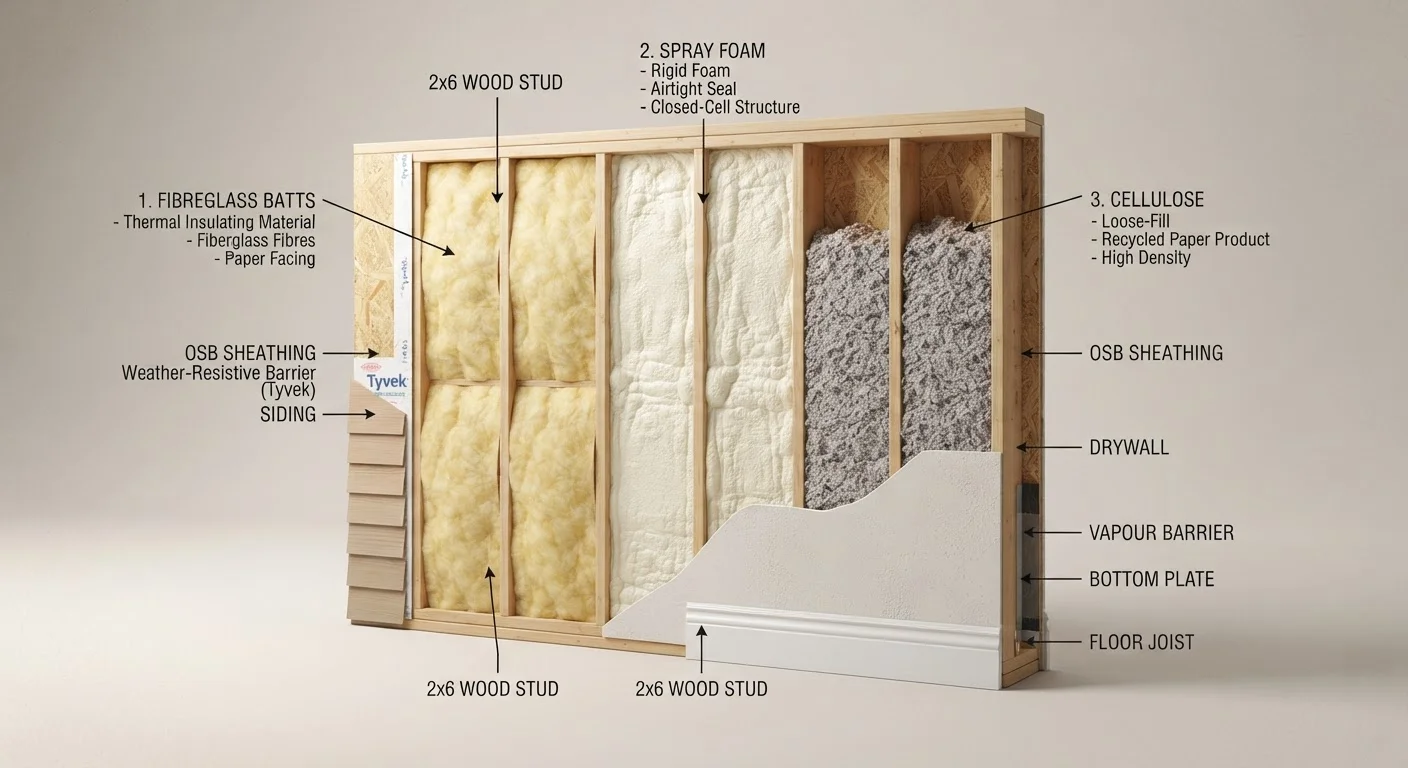
Fibreglass insulation - available as batts, rolls, or loose fill - is the most commonly installed type in American homes. It's made from fine strands of glass and is manufactured in standard widths designed to fit between typical wall studs and attic joists.
Thermal performance: Fibreglass batts typically deliver an R-value of around R-2.9 to R-3.8 per inch, depending on density. This is adequate for most above-grade wall assemblies when properly installed.
Key limitation: Fibreglass insulates by trapping air within its fibers, but it does not block air movement on its own. Gaps, compression, or improper fitting can significantly reduce effective R-value. A separate air barrier - such as house wrap or drywall - is required for a complete system.
Installation: Batt installation is a manageable DIY task in open stud bays, though protective gear (gloves, eye protection, and a dust mask rated for fibrous particles) is essential. Blown-in fibreglass requires rental equipment or professional installation.
Fit Matters as Much as R-Value
Even high-quality fibreglass batts lose significant performance if they're compressed, torn to fit, or leave gaps around electrical boxes and pipes. When installing batts yourself, take time to cut pieces cleanly and fill every gap in the cavity. A well-installed lower-R batt outperforms a carelessly installed higher-R one.
Spray Foam: High Performance With Higher Commitment
Spray polyurethane foam (SPF) comes in two main forms: open-cell and closed-cell. Open-cell foam is softer and more vapor-permeable; closed-cell foam is dense, rigid, and provides both insulation and a vapor retarder in one product.
Thermal performance: Closed-cell foam achieves R-6 to R-7 per inch - the highest of any common insulation material. Open-cell foam runs approximately R-3.5 to R-3.8 per inch.
Key advantage: Spray foam expands to fill irregular cavities and penetrations, making it uniquely effective at both insulating and air sealing simultaneously. This makes it particularly well-suited to crawl spaces, rim joists, and attic roof decks.
Installation: Two-component spray foam systems involve chemical reactions that require proper protective equipment, ventilation, and training. Professional installation is strongly recommended for most applications. DIY canned foam (single-component) is appropriate only for small gaps and cracks - not whole-wall installation.
Cellulose: The Retrofit-Friendly Recycled Option
Cellulose is made primarily from recycled paper products - typically newsprint - treated with fire and pest retardants. It's installed as loose-fill blown in by machine, either into open attic spaces or injected into existing closed wall cavities through small drilled holes.
Thermal performance: Cellulose delivers approximately R-3.2 to R-3.8 per inch. It also performs well at reducing air infiltration when installed at appropriate densities, particularly in dense-pack wall applications.
Key advantage: Dense-pack cellulose is the go-to choice when adding insulation to existing finished walls without full demolition. A contractor drills small access holes, fills the cavity, and patches - a far less disruptive process than opening walls. Its recycled content also appeals to sustainability-minded homeowners.
Moisture considerations: Cellulose can absorb moisture if installation conditions are improper or if a moisture problem already exists. Address any existing water intrusion before insulating. This principle applies across all insulation types - insulation should never be installed over an active moisture problem.
Making Your Decision: Key Factors to Weigh
Once you understand the materials, the decision usually comes down to four practical factors:
- Project location: Open attic or new framing favors fibreglass or blown cellulose. Tight or irregular spaces favor spray foam. Existing closed walls favor dense-pack cellulose.
- Required R-value: Check your local building code or the Department of Energy's climate zone recommendations for your region. Higher-performance requirements may make spray foam more cost-effective over time.
- Budget: Fibreglass batts are generally the most affordable material cost. Spray foam is typically the most expensive per square foot, though its air-sealing benefit can reduce the need for separate air barrier measures.
- DIY vs. professional installation: Fibreglass batts in open cavities are DIY-accessible for prepared homeowners. Spray foam and blown-in applications generally require professional equipment and expertise. Permits and inspections may be required for certain renovation scopes - verify with your local building department before starting.
Insulation decisions also interact with other home improvement choices. Just as material selection matters for flooring - as explored in comparing hardwood and engineered wood options - the right insulation choice depends on your specific structure, climate, and goals.
This article provides general home improvement information only. Building codes, required R-values, and permit requirements vary by location. Consult a licensed insulation contractor or your local building department before beginning insulation work in your home.