
Car Safety Technology from Seatbelts to Autonomous Features: A Complete Timeline

Key Takeaways
- The three-point seatbelt, introduced in 1959, remains one of the single most life-saving automotive inventions.
- Antilock braking systems (ABS) and electronic stability control (ESC) reduced crash fatalities significantly before most drivers noticed they existed.
- Modern Advanced Driver Assistance Systems (ADAS) rely on radar, cameras, and sometimes lidar working together, not any single sensor.
- No current production vehicle meets the SAE Level 4 or 5 autonomy standard - all require an attentive human driver.
- Understanding which safety features are standard vs. optional on a vehicle can materially affect real-world protection.
Why Safety Technology Matters More Than Ever
Motor vehicle crashes remain a leading cause of injury and death in the United States, claiming tens of thousands of lives each year according to federal traffic safety data. Yet the risk of dying in a crash per mile driven has fallen dramatically over the past seven decades - a reduction driven almost entirely by advances in vehicle safety engineering.
Understanding how that engineering evolved helps everyday drivers make smarter decisions: knowing which technologies are proven life-savers, which are genuinely new, and which are still maturing. This timeline traces the full arc from passive restraints to semi-autonomous systems, translating each innovation into what it actually means for the person behind the wheel.
45%
Reduction in front-seat crash fatality risk
NHTSA research attributes this reduction to consistent seatbelt use among front-seat car occupants.
~33%
Drop in single-vehicle fatal crashes
IIHS research estimated this reduction in cars attributable to electronic stability control.
2018
Year rearview cameras became federally mandated
NHTSA's backup camera rule required rearview cameras on all new U.S. passenger vehicles from model year 2018.
The Foundation Era: Seatbelts and Crumple Zones (1950s-1970s)
Before the 1950s, vehicle interiors were genuinely hazardous - dashboards were hard metal, steering columns were rigid spears, and occupant restraints were non-existent in most cars. The safety revolution began with structural thinking.
The Three-Point Seatbelt (1959)
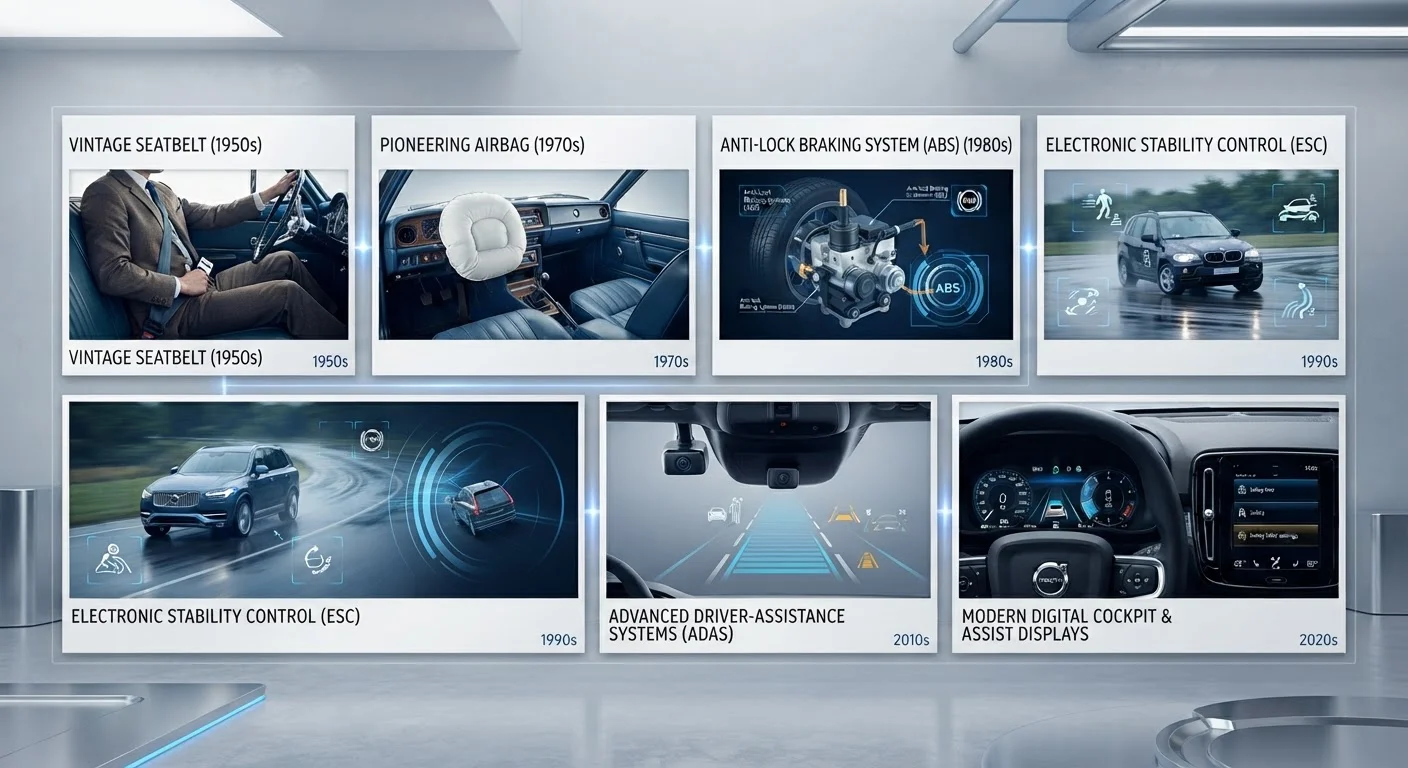
Volvo engineer Nils Bohlin developed the modern three-point lap-and-shoulder belt, and Volvo made the patent freely available to the industry. The National Highway Traffic Safety Administration (NHTSA) later mandated seatbelts in all new U.S. passenger vehicles. Research consistently shows that seatbelts reduce the risk of death in a front-seat crash by around 45 percent for car occupants, making this single invention arguably the most impactful safety technology in automotive history.
Crumple Zones and Collapsible Steering Columns
Mercedes-Benz engineer Béla Barényi pioneered controlled deformation zones in the late 1950s - body sections designed to absorb crash energy before it reached occupants. Collapsible steering columns followed, eliminating the rigid shaft that had caused severe chest injuries in frontal impacts. These passive structural changes saved lives quietly, without any driver action required.
When evaluating an older used vehicle, confirm that its seatbelt pretensioners and airbag system have never been deployed - both are single-use components that require replacement after a crash.
Pretensioners lock belts tight on impact and cannot reset; an unreplaced system provides significantly less protection in a subsequent crash.
Check whether a vehicle's crumple zone or body structure has been updated since its original platform launch - some models carry decade-old structural designs under fresh sheet metal.
IIHS small overlap frontal tests have revealed that vehicles with aging body structures can perform poorly even when their electronic safety features are current.
Electronic Breakthroughs: ABS, Airbags, and Stability Control (1970s-2000s)
The 1970s through the early 2000s introduced electronics to safety engineering. Rather than only managing what happened after a crash began, systems started intervening during the moments leading up to one.
Antilock Braking System (ABS)
ABS, commercialized in passenger cars during the late 1970s and 1980s, prevents wheel lockup during hard braking by rapidly modulating brake pressure. Locked wheels cause loss of steering control; ABS keeps the wheels rolling, allowing the driver to steer around an obstacle while still braking hard. NHTSA mandated ABS on all new passenger vehicles sold in the U.S. starting with the 2013 model year.
Airbags
Supplemental Restraint Systems (SRS airbags) became standard in U.S. vehicles through a phased federal mandate completed in the 1990s. Front airbags deploy in milliseconds during a significant frontal impact, cushioning the head and chest. Side curtain and knee airbags followed as automakers expanded coverage. Critically, airbags work in concert with seatbelts - they are not a substitute for buckled occupants.
Electronic Stability Control (ESC)
ESC detects when a vehicle begins to skid or oversteer by comparing steering input to actual vehicle rotation (yaw rate). It then applies targeted braking to individual wheels to bring the car back on line. NHTSA required ESC on all new light vehicles by 2012. Studies by the Insurance Institute for Highway Safety (IIHS) estimated that ESC reduced single-vehicle fatal crashes in cars by roughly 33 percent.
The ADAS Revolution: Cameras, Radar, and Driver Assistance (2000s-2010s)
Advanced Driver Assistance Systems (ADAS) marked a shift from systems that responded to a crash in progress toward ones that actively monitored the environment and warned - or intervened - before contact. These systems depend on sensors: cameras for lane and object recognition, radar for distance and velocity measurement, and ultrasonic sensors for close-range detection. For a deeper look at how these technologies compare, see our guide to radar, lidar, and camera sensors.
Key ADAS Technologies and Their Approximate Introduction
- Adaptive Cruise Control (ACC): Uses radar to maintain a set following distance, automatically slowing for traffic ahead. First appeared in luxury vehicles in the late 1990s; now common across segments.
- Lane Departure Warning / Lane Keep Assist: Camera systems identify lane markings and alert or gently steer the vehicle back if it drifts without a signal.
- Blind Spot Monitoring: Radar or ultrasonic sensors flag vehicles in adjacent lanes that may be invisible in mirrors.
- Automatic Emergency Braking (AEB): Detects an imminent collision and applies brakes autonomously if the driver doesn't respond. NHTSA and IIHS data show AEB substantially reduces rear-end crash rates. Our AEB explainer covers how it works and where it has limits.
- Rearview Cameras: Federally mandated on all new U.S. vehicles from 2018; significantly reduce backup collisions involving pedestrians.
Semi-Autonomous Features: Where We Are Today
The SAE International autonomy scale runs from Level 0 (no automation) to Level 5 (full self-driving under all conditions). Most vehicles on U.S. roads today with driver assistance packages operate at Level 2 - meaning the system can control both steering and acceleration/braking simultaneously, but a human must remain engaged and ready to take over at any moment.
Level 2 systems - sometimes marketed under names like highway driving assist or traffic jam assist - combine adaptive cruise control with lane centering. They are convenience and fatigue-reduction tools, not autonomous drivers. Misunderstanding this distinction has contributed to high-profile crashes where drivers disengaged from the task of driving.
Level 3 systems, which can handle driving in defined conditions without continuous human monitoring, exist in limited commercial deployment outside the U.S. No consumer vehicle currently sold in the American market is certified for unsupervised Level 3 or above operation as a general rule. For practical guidance on using these systems safely, see our article on getting the most from your car's safety systems without over-relying on them.
Level 2 Automation Is Not Self-Driving
Systems that simultaneously control steering and speed - regardless of what they are called in marketing - require the driver to remain attentive and ready to take control immediately. Treating these systems as hands-free or eyes-free is dangerous and has been a documented factor in serious crashes. Keep both hands accessible to the wheel and your attention on the road at all times when using any driver assistance feature.
What the Timeline Means for Your Next Vehicle
Reading a safety timeline isn't just a history lesson - it shapes smarter purchasing and ownership decisions. A few practical implications stand out:
Not All Safety Features Are Standard
AEB, blind spot monitoring, and rear cross-traffic alert are standard on many new vehicles but remain optional upgrades on others. Checking a specific vehicle's standard equipment list - rather than assuming a badge or trim level includes everything - can make a meaningful difference to real-world protection. Our look at which safety features genuinely matter can help prioritize what to look for.
IIHS and NHTSA Ratings Are Independent
Both the Insurance Institute for Highway Safety and the National Highway Traffic Safety Administration conduct crash tests and issue safety ratings, but their methodologies differ. A vehicle can score well on one program and less well on another. Consulting both sets of results gives a more complete picture.
Older Vehicles Still Benefit from the Basics
Drivers of older vehicles without ADAS shouldn't feel unprotected - seatbelts, ABS, and ESC collectively address the majority of crash scenarios. Maintaining these systems in good working order is more protective than any dashboard display. For broader context on vehicle ownership decisions, the Buying & Ownership hub offers guidance on evaluating vehicles across the full cost and safety spectrum.
The arc of automotive safety technology runs from passive protection to active prevention and is moving toward supervised automation. Each era built on the last, and the safest vehicles today combine decades of accumulated engineering. Knowing where each technology came from helps drivers trust it appropriately - and recognize when it needs their full attention.