
Electronic Stability Control: The Invisible System That Catches Skids Before You Do

Key Takeaways
- ESC operates faster than human reaction time - typically within 20-40 milliseconds of detecting instability.
- The system became a federal requirement for all new passenger vehicles sold in the U.S. beginning with model year 2012.
- ESC uses wheel speed sensors, a yaw rate sensor, and a steering angle sensor to detect and correct skids.
- It does not prevent all crashes - ESC is most effective on curves and slippery surfaces, not during hard straight-line stops.
- A blinking ESC warning light during driving means the system is actively working; a solid light may signal a fault.
Electronic Stability Control (ESC)
Electronic Stability Control is an active safety system that automatically detects when a vehicle begins to skid or deviate from the driver's intended path and applies individual wheel brakes to bring it back on course. It works continuously in the background, requiring no input from the driver. Unlike passive systems such as seatbelts, ESC responds dynamically to what the car is actually doing at any given moment.
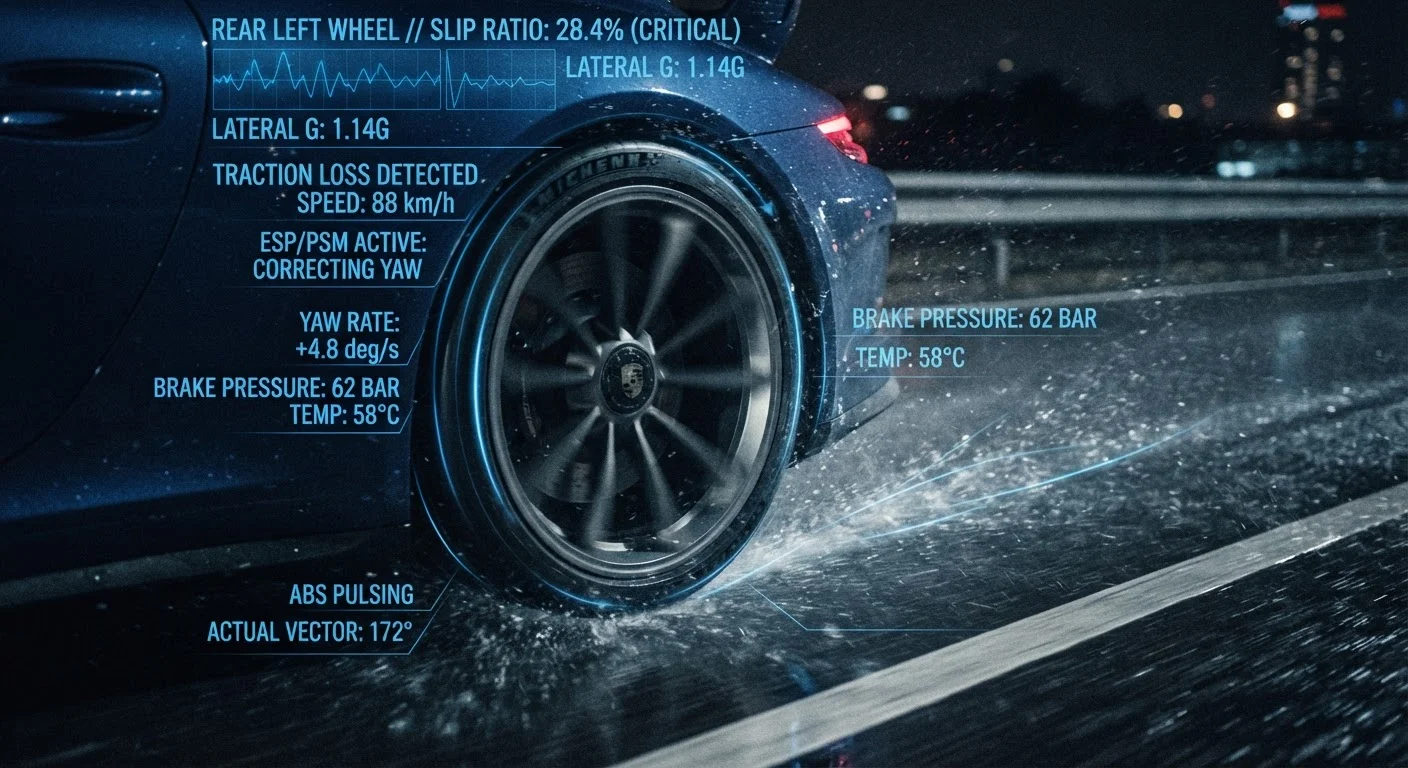
ESC compares the driver's steering angle and throttle inputs against the vehicle's actual yaw rate (rotation around its vertical axis) and lateral acceleration, then selectively brakes individual wheels to counteract understeer or oversteer within milliseconds.
How ESC Detects a Skid You Haven't Noticed Yet
The moment a vehicle begins to lose directional control, several things happen simultaneously - most of them invisible to the driver. ESC monitors a set of sensors dozens of times per second to catch the early signature of a skid before it escalates.
Three core sensors form the foundation of the system:
- Wheel speed sensors - measure how fast each wheel is rotating. If one wheel spins significantly faster or slower than the others, it signals a loss of grip.
- Yaw rate sensor - detects rotation around the vehicle's vertical axis. When the car starts to spin beyond what the steering input calls for, this sensor registers the divergence.
- Steering angle sensor - reads exactly where the driver has pointed the wheel, providing the intended path the vehicle should be following.
The ESC control module compares the intended path (from the steering angle) with the actual path (from the yaw rate and wheel speeds). When the gap between those two values exceeds a threshold, the system determines a skid is underway - often before the driver feels anything unusual.
ESC, VSC, DSC - Different Names, Same Function
Automakers use a variety of proprietary names for their stability control systems - Vehicle Stability Control (VSC), Dynamic Stability Control (DSC), AdvanceTrac, and StabiliTrak are common examples. Despite the different branding, all of these systems meet the same federal standard and perform the same fundamental function. The generic term 'ESC' or 'Electronic Stability Control' applies to all of them.
What ESC Actually Does When It Intervenes
ESC does not simply slam the brakes. Its response is surgical: it applies targeted braking pressure to specific individual wheels to generate a corrective force that rotates the vehicle back into alignment with the driver's intended path.
Two types of instability require opposite corrections:
- Oversteer - the rear of the vehicle swings outward (common in rear-wheel-drive cars). ESC brakes the outside front wheel to pull the nose back in line.
- Understeer - the front wheels lose grip and the car plows straight instead of turning (more common in front-wheel-drive vehicles). ESC brakes one or more rear wheels and may reduce engine torque to slow the vehicle and help front tires regain grip.
The entire sequence - detection, calculation, and brake application - typically takes 20 to 40 milliseconds. The average human reaction time to an unexpected event is roughly 150 to 300 milliseconds. That gap is precisely why ESC saves lives in scenarios where driver reflex simply cannot keep pace.
“Electronic stability control is the most significant automotive safety advance since the seatbelt.”
— Adrian Lund, Former President, Insurance Institute for Highway Safety (IIHS)
For a broader view of how ESC fits among the suite of modern safety technologies, see our guide to driver-assistance systems.
The Safety Record and Legal Mandate Behind ESC
The evidence for ESC's effectiveness is substantial. Research published by NHTSA estimated that widespread ESC adoption could prevent approximately 34% of fatal single-vehicle crashes and up to 59% of fatal rollover crashes among passenger cars. These figures contributed directly to ESC becoming mandatory in the United States for all new passenger vehicles starting with model year 2012.
~34%
Reduction in fatal single-vehicle crashes
NHTSA research estimated this potential reduction attributable to ESC adoption across the passenger vehicle fleet.
~59%
Reduction in fatal rollover crashes
The same NHTSA analysis found ESC could cut fatal rollover crashes among passenger cars by approximately 59%.
2012
Model year ESC became U.S. law
NHTSA's Federal Motor Vehicle Safety Standard 126 required ESC on all new passenger vehicles from model year 2012 onward.
Similar mandates followed in the European Union, Australia, Canada, and other major markets, making ESC one of the most globally adopted active safety technologies in automotive history.
It's worth understanding what ESC does not cover, however. The system cannot override the laws of physics - at very high speeds or in extreme conditions, available traction may simply be insufficient for any correction. ESC also provides minimal benefit during straight-line braking emergencies, where a separate system, anti-lock braking (ABS), takes the lead. For a comparison with another critical active system, see our article on how automatic emergency braking works and where it falls short.
What Drivers Should Know in Practice
Understanding ESC helps you use it wisely rather than treat it as a license for aggressive driving. A few practical points every driver should know:
- Tire condition matters enormously. ESC works within the limits of grip your tires can provide. Worn, underinflated, or mismatched tires reduce that limit significantly.
- Speed remains your responsibility. ESC can correct a developing skid but cannot defy physics at excessive speed. Entering a wet corner too fast will still end badly.
- The blinking dashboard light is informational. When ESC intervenes and the indicator light flashes, that's the system doing its job. Treat it as a signal to ease off and adjust your speed or inputs.
- Disabling ESC has limited legitimate uses. Rocking out of deep snow or mud are the practical exceptions. For everything else, leaving ESC enabled is the right call.
If you want to understand how safety systems work together - and how to rely on them appropriately - our article on getting the most from your car's safety systems offers practical guidance for everyday driving.
Check Your ESC Is Actually Active
On most vehicles, ESC is enabled by default every time you start the car. However, if you or a previous driver pressed the ESC-off button, the system may remain disabled until manually re-enabled or the car is restarted. Check your dashboard for an ESC or stability control indicator light and consult your owner's manual to confirm the default behavior for your specific vehicle.