

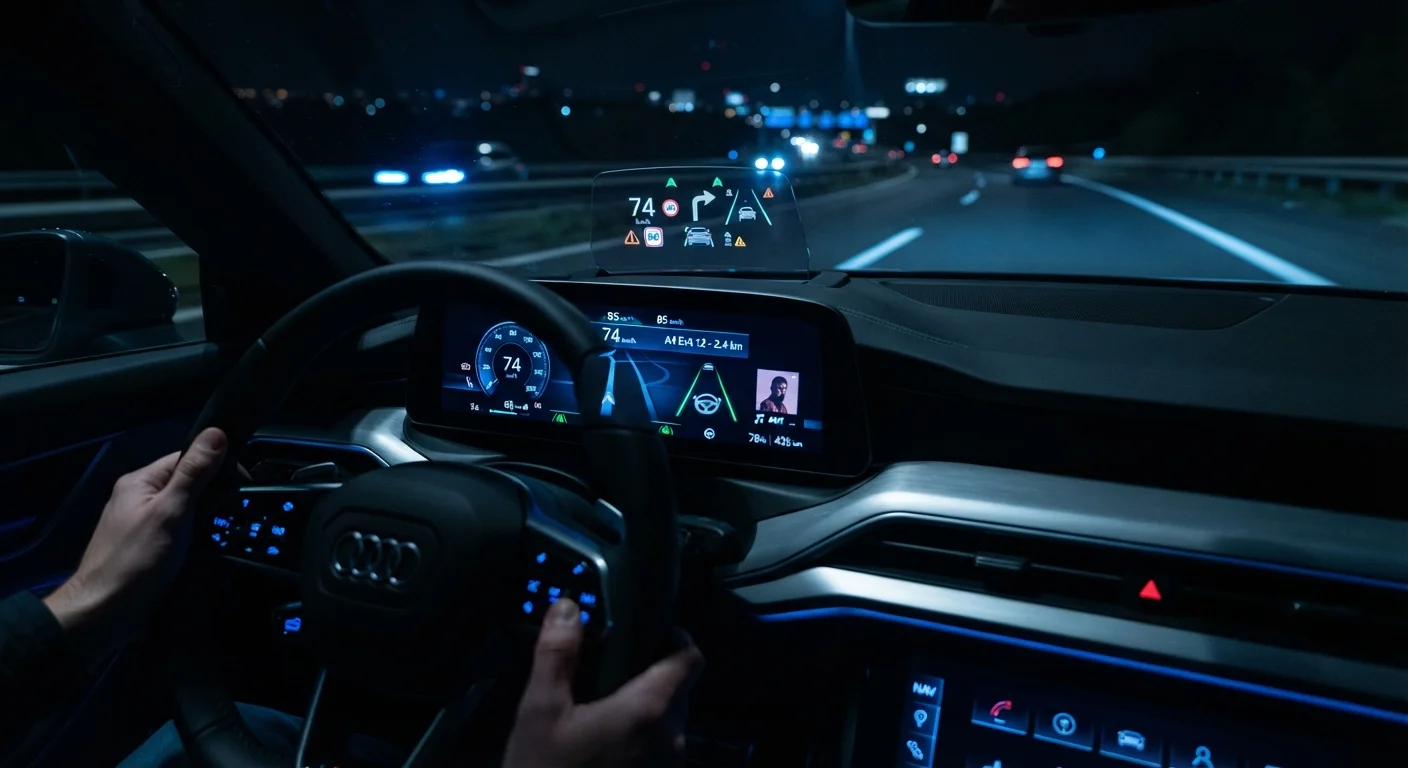
Key Takeaways
- ADAS is an umbrella term covering dozens of distinct driver-assistance features, not a single system.
- Each acronym - LDW, ACC, AEB, BSM - describes a specific function with its own sensors and trigger conditions.
- Most ADAS features warn or assist; they do not replace driver attention or judgment.
- Understanding when a system activates helps you use it correctly and avoid false confidence.
- Sensor limitations mean ADAS performance can degrade in poor weather, heavy traffic, or unusual road conditions.
ADAS (Advanced Driver-Assistance Systems)
ADAS is a broad category of electronic safety and convenience features built into modern vehicles. These systems use sensors, cameras, and software to monitor the road around you and either warn you of hazards or intervene automatically to help prevent collisions. They range from simple alerts - like a beep when you drift out of your lane - to more active responses like automatic emergency braking.
ADAS features are classified under SAE International's automation levels (0-5); most production vehicles today operate at Level 1 or Level 2, meaning the driver must remain fully engaged at all times.
Why So Many Acronyms?
Walk through a new-car brochure and you'll encounter a wall of abbreviations: LDW, LKA, ACC, AEB, BSM, RCTA, FCW. Each one refers to a distinct system with its own sensors, logic, and behavior. Automakers have developed these features largely independently, which is why similar functions sometimes carry different names across brands - one manufacturer's "Lane Departure Warning" is another's "Lane Alert."
Understanding what each acronym does - and when it activates - makes you a safer, more confident driver. It also helps you evaluate what a vehicle actually offers, rather than being swayed by a long feature list you can't interpret. For a deeper look at the sensor technology powering all of these systems, see our guide on radar, lidar, and camera sensors.
~20%
Reduction in rear-end crashes linked to AEB
The Insurance Institute for Highway Safety (IIHS) has reported that vehicles equipped with forward collision warning and AEB show meaningful reductions in rear-end crash rates compared to vehicles without these systems.
Level 2
Highest automation level in most consumer vehicles
SAE International's automation framework places most production vehicles at Level 1 or Level 2, where the driver must remain fully engaged; no consumer vehicle currently on sale achieves full self-driving capability.
40+
Distinct ADAS features available across the industry
The European New Car Assessment Programme (Euro NCAP) tracks over 40 individual driver-assistance technologies across production vehicles, illustrating how broad the category has become.
The Core ADAS Systems, Decoded
Lane Departure Warning (LDW) and Lane Keep Assist (LKA)
LDW monitors painted lane markings using a forward-facing camera. If your vehicle crosses a line without a turn signal, it issues an audible or visual alert. LKA goes further: it applies gentle steering inputs to guide the car back into the lane. LKA does not steer for you - it nudges, and the driver remains responsible for steering.
Forward Collision Warning (FCW) and Automatic Emergency Braking (AEB)
FCW uses radar or cameras to detect a slower or stopped vehicle ahead, alerting the driver before a potential impact. AEB escalates: if the driver doesn't respond to the warning, the system applies the brakes autonomously to reduce collision severity or avoid it entirely. AEB is one of the most consequential safety features in modern vehicles, though it has real-world limitations worth understanding. Our companion article on how AEB works and where it falls short covers those in detail.
Adaptive Cruise Control (ACC)
ACC builds on conventional cruise control by automatically adjusting vehicle speed to maintain a set following distance from the car ahead. When traffic slows, the car slows; when it clears, the car accelerates back to the set speed. Some systems can bring the vehicle to a complete stop and resume - useful in stop-and-go highway traffic.
Blind Spot Monitoring (BSM) and Rear Cross-Traffic Alert (RCTA)
BSM uses rear-facing radar to detect vehicles in adjacent lanes that fall outside your mirrors' field of view, displaying a warning light in or near the mirror housing. RCTA is the parking-lot equivalent: it alerts you to approaching vehicles crossing behind your car as you reverse out of a space.
Read Your Owner's Manual for Activation Conditions
Every ADAS feature has documented operating parameters - minimum speeds, sensor coverage angles, and conditions under which it disengages. These details are in your vehicle's owner's manual and are worth reviewing once so you know exactly what to expect from each system before you need it.
What ADAS Won't Do - And Why That Matters
Every ADAS feature operates within defined boundaries. Sensors can struggle with heavy rain, snow accumulation on camera lenses, faded lane markings, unusual road geometries, or construction zone layouts. A system that performs flawlessly on a dry highway may disengage or misread conditions on a snow-covered two-lane road.
Critically, ADAS features are designed to assist attentive drivers - not replace attention. Over-reliance on these systems is a documented safety concern. If you assume the car is handling the driving, you're more likely to be unprepared when it reaches its limits. Our article on getting the most from your safety systems without over-relying on them offers practical guidance on keeping that balance.
For context on how ADAS compares to the safety features that protect you after a crash, see our explainer on active vs. passive safety. Both layers work together - neither is a substitute for the other.
“Driver assistance technology works best when drivers understand what it can and can't do. The goal is a well-informed driver who uses these tools as intended - not a passenger who's handed off responsibility to the machine.”
— David Zuby, Former Executive Vice President of Vehicle Research, Insurance Institute for Highway Safety (IIHS)