

Key Takeaways
- 'Complete and balanced' is a regulated claim tied to specific nutritional standards, not a marketing phrase.
- Ingredient lists are ordered by weight before processing, which affects how you interpret them.
- The guaranteed analysis panel shows minimum or maximum nutrient levels, not exact amounts.
- Life-stage statements tell you which animals the food was actually formulated for.
- Trendy label claims like 'natural' or 'holistic' have limited or no regulatory definition.
- A veterinarian is the best resource for tailoring food choices to your individual pet's needs.
Pet Food Label
A pet food label is the regulated set of information printed on packaging that tells you what's in the food, who it's made for, and whether it meets established nutritional standards. In the United States, these labels are governed by state regulations that align with guidelines set by the Association of American Feed Control Officials (AAFCO). Every element - from the product name to the guaranteed analysis panel - follows specific rules about what can and cannot be claimed.
AAFCO establishes nutrient profiles for dogs and cats that serve as the baseline for 'complete and balanced' claims; individual states enforce these standards through their own feed laws.
The Five Things Regulators Require on Every Label
Before diving into what labels mean, it helps to know what they're legally required to include. Under AAFCO-aligned state regulations, every commercial pet food sold in the U.S. must display five core elements: the product name, the net quantity, the manufacturer's name and address, the ingredient list, and the guaranteed analysis. A nutritional adequacy statement is also required if a complete diet is claimed.
Each of these elements carries specific rules. The product name alone has an entire naming system - if a food is called 'Beef Dog Food,' it must contain at least 95% beef by weight (excluding water). Drop to 25% and the label must say something like 'Beef Entrée' or 'Beef Dinner.' If beef is merely a flavor, the word 'flavor' must appear. These naming conventions matter because they signal how prominently a named ingredient actually features in the formula.
For a deeper look at how the ingredient list itself is structured, see our guide to reading a pet food ingredient list.
AAFCO Sets Guidelines, States Enforce Them
AAFCO itself is not a government agency and does not directly regulate pet food. It publishes model regulations and nutrient profiles that individual U.S. states adopt into their own feed laws. In practice, this means the standards are broadly consistent nationally, but enforcement is a state-level responsibility. The FDA also has oversight authority, particularly for safety and adulteration issues.
Decoding 'Complete and Balanced'
This phrase is one of the most substantive claims on any pet food label. A food earns it in one of two ways: either it's been formulated to meet AAFCO's published nutrient profiles for a specific life stage, or it has passed a controlled feeding trial. Both pathways represent real standards, though they're not identical - a formulation approach confirms the nutrient math on paper, while a feeding trial tests how pets actually perform on the diet over time.
The life-stage specification attached to this claim matters enormously. A food labeled for 'adult maintenance' has not been validated for puppies or kittens, whose rapidly developing bodies need higher levels of certain nutrients like calcium, phosphorus, and protein. Foods labeled 'for all life stages' must meet the most demanding of the life-stage profiles - typically growth and reproduction - which means they can be fed to any age group.
95%
Minimum named-ingredient content for simple product names
Under AAFCO naming rules, a product called simply 'Beef Dog Food' must contain at least 95% beef by weight, excluding added water.
25%
Threshold triggering 'dinner,' 'entrée,' or 'formula' naming
When a named ingredient makes up 25-94% of the product, AAFCO rules require a qualifying descriptor such as 'dinner,' 'entrée,' or 'formula' to appear in the product name.
2
AAFCO pathways to 'complete and balanced' status
Pet foods can earn the 'complete and balanced' designation either by meeting AAFCO nutrient profiles through formulation or by passing a controlled animal feeding trial.
If no nutritional adequacy statement appears, the food is likely a treat, supplement, or intermittent-feeding product - not suitable as a sole diet.
What Marketing Language Actually Signals
Words like 'holistic,' 'premium,' 'ancestral,' and 'human-grade' appear prominently on many labels - and most carry no regulatory definition in the context of pet food. They are marketing descriptors, not nutritional standards. 'Natural' is a partial exception: AAFCO does define it, restricting the term to ingredients not produced through synthetic chemical processes. But 'natural' doesn't mean nutritionally superior, and it doesn't prohibit the use of synthetic vitamins added to meet nutrient targets (which are usually necessary).
'Grain-free' is another term worth scrutinizing. It describes what's absent, not what's present. Foods marketed as grain-free often substitute legumes or potatoes as carbohydrate sources. The FDA has been investigating a potential association between grain-free diets and dilated cardiomyopathy (DCM) in dogs since 2018, and while a definitive causal link hasn't been confirmed, the conversation among veterinary cardiologists remains active. Our article on grain-free vs. grain-inclusive dog food covers the research in detail.
Trendy claims aside, the most nutritionally meaningful language on a label remains the guaranteed analysis and the AAFCO adequacy statement - neither of which tends to feature on the front of the bag.
Turn the Bag Around First
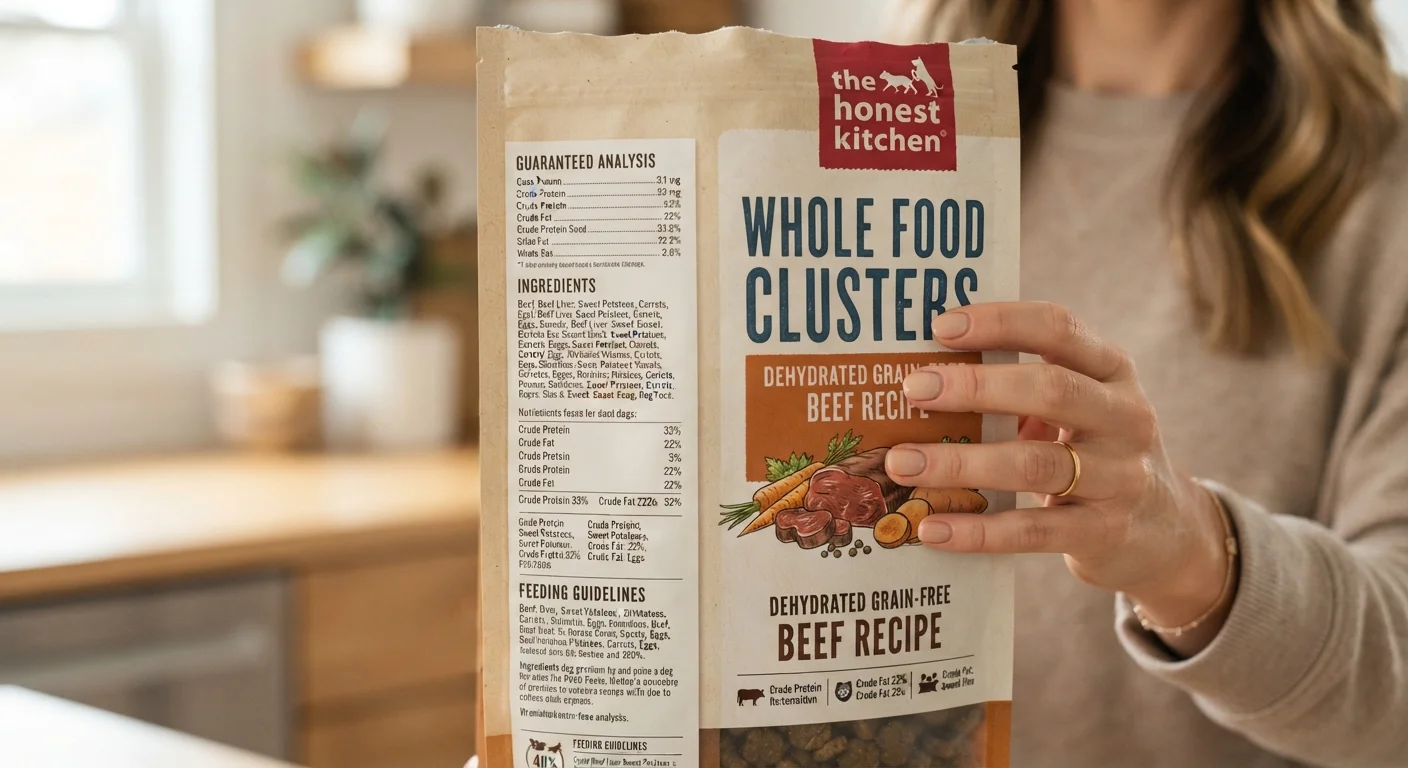
The front panel of a pet food bag is designed to sell; the back panel is designed to inform. Get into the habit of flipping to the AAFCO statement and guaranteed analysis before evaluating any other claim. These regulated sections are where the nutritionally meaningful information lives.
Putting It All Together When You're at the Shelf
Reading a label well means looking past the front panel - the flavor photography, the lifestyle claims, the bold font promising 'real ingredients' - and flipping to the back or side where the regulated information lives. Start with the AAFCO statement to confirm the food is complete and appropriate for your pet's life stage. Then check the guaranteed analysis to understand the broad nutrient ratios. Finally, scan the ingredient list with the understanding that it reflects pre-processing weights, not final nutrient contribution.
Different pets have meaningfully different needs. Cats, as obligate carnivores, require nutrients like taurine and arachidonic acid that dogs can synthesize themselves - our explainer on why cats are obligate carnivores unpacks the biology behind those differences. Dogs have their own nutrient requirements detailed in our guide to canine nutritional needs.
If you want a structured way to apply all of this, our practical pet food evaluation checklist walks through the key criteria step by step. And for any significant dietary change - especially for pets with health conditions, seniors, or very young animals - a conversation with your veterinarian is always the most reliable next step.
This article is for general informational purposes only and does not constitute veterinary or nutritional advice. Always consult a qualified veterinarian for guidance tailored to your individual pet's health and dietary needs.