

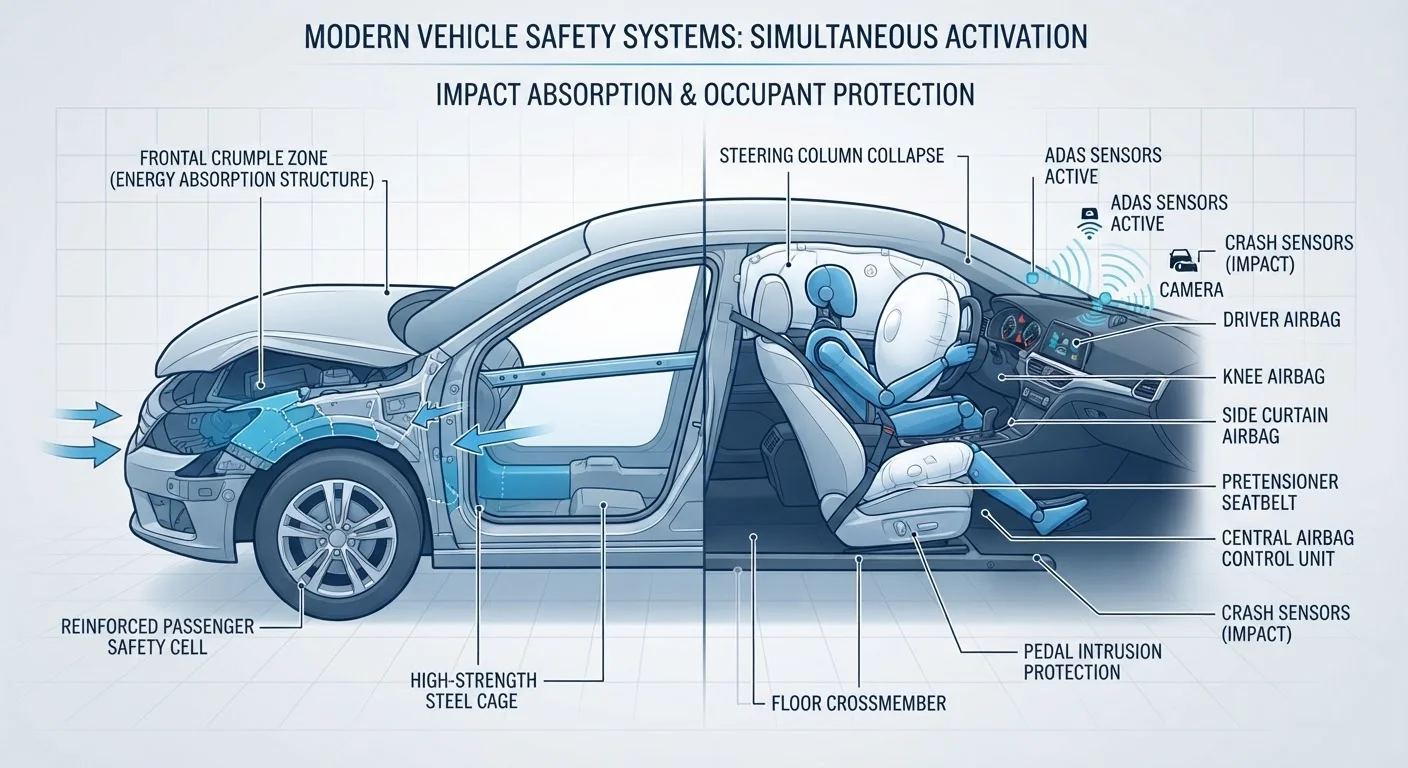
Key Takeaways
- Active safety systems work before a crash by monitoring, warning, and intervening to prevent it.
- Passive safety systems work during and after a crash, absorbing energy and restraining occupants.
- Both layers are complementary - neither alone provides complete protection.
- Modern active systems like AEB and lane-keep assist rely on sensors that can have real-world limitations.
- Seatbelts remain the single most effective passive safety device ever put in a vehicle.
- Understanding both types helps you evaluate vehicles more confidently and drive more responsibly.
Option A
Active Safety
The crash-prevention layer - intervening before impact occurs.
Best for: Drivers who want technology that actively monitors conditions and reduces the risk of a collision happening in the first place.
Option B
Passive Safety
The crash-survival layer - protecting occupants once impact is unavoidable.
Best for: Every driver and passenger - passive systems are always present and require no input to work when a collision occurs.
If you want to understand what tech prevents a crash from starting
Active Safety
Active systems like automatic emergency braking and blind-spot monitoring are designed to intervene before impact. Knowing how they work helps you use them correctly and recognize their limits.
If you want to understand what protects you once impact is unavoidable
Passive Safety
Crumple zones, airbags, and seatbelts work without any driver action, making them your last line of defense in any collision scenario.
If you're evaluating a vehicle's overall safety package
Active Safety
When comparing vehicles, active safety features are increasingly where modern engineering investment is concentrated - and they directly influence crash avoidance ratings from organizations like IIHS and NHTSA.
If you're a parent or caregiver focused on occupant protection
Passive Safety
Proper seatbelt use, appropriate child restraints, and understanding airbag deployment zones are the most consistent and reliable protections for every passenger in every trip.
Two Safety Philosophies, One Vehicle
When automakers and safety engineers talk about keeping you safe, they're really talking about two separate problems: stopping a crash from happening, and limiting the harm when it does. These aren't competing ideas - they're complementary layers that every modern vehicle uses together. Understanding them clearly is the first step to driving smarter.
Active safety describes any system that monitors conditions, detects risk, and takes action - automatically or through alerts - to prevent a collision. Passive safety describes the structural and mechanical systems that protect occupants during an unavoidable impact. One layer works before the crash; the other works during and after it.
For a broader look at how these systems evolved over decades, see how car safety technology developed from seatbelts to semi-autonomous features.
| Criterion | Active Safety | Passive Safety |
|---|---|---|
| Primary goal | Prevent the crash | Protect occupants during a crash |
| When it operates | Before impact - continuously monitoring | During and immediately after impact |
| Requires driver input | Sometimes (alerts) or automatically | Never - fully automatic response |
| Key examples | AEB, lane-keep assist, blind-spot monitoring | Seatbelts, airbags, crumple zones |
| Sensor dependent | Yes - cameras, radar, lidar | No - mechanical and structural |
| Can be degraded by conditions | Yes - weather, obstructions, speed | Rarely - but misuse reduces effectiveness |
| Improves with technology advances | Rapidly - new algorithms and sensors | More slowly - physics-based engineering |
Active Safety: Preventing the Crash
Active safety systems are the vehicle's early-warning and intervention network. They rely on sensors - cameras, radar, and sometimes lidar - to continuously read the environment around the car. When those sensors detect a developing hazard, the system either alerts the driver or takes direct action.
Common active safety technologies include:
- Automatic Emergency Braking (AEB): Detects an imminent forward collision and applies brakes if the driver doesn't respond in time.
- Lane Departure Warning / Lane-Keep Assist: Alerts the driver or gently corrects steering when the vehicle drifts out of its lane unintentionally.
- Blind-Spot Monitoring: Warns when another vehicle occupies the zone beside and behind the car, reducing lane-change risks.
- Adaptive Cruise Control: Maintains a set following distance from the vehicle ahead without requiring constant driver input on speed.
These systems are powerful, but they aren't infallible. Weather, sensor obstructions, and unusual road situations can degrade their performance. Our article on how AEB works and where it falls short covers those real-world limitations in detail. To understand the sensors powering all these features, see radar, lidar, and camera sensor comparison.
~50%
Reduction in rear-end crashes linked to AEB
IIHS research has found that automatic emergency braking systems are associated with substantial reductions in rear-end police-reported crashes compared to vehicles without AEB.
~45%
Lives saved by seatbelts annually in the US
The NHTSA estimates that seatbelts save tens of thousands of lives each year and that correct use dramatically reduces fatality risk in crashes.
30+ ms
Airbag deployment time at impact
Front airbags typically deploy in approximately 30 milliseconds - faster than a human blink - to cushion occupants before their bodies move forward.
Passive Safety: Protecting Occupants at Impact
Once a collision becomes unavoidable, passive safety takes over. These systems require no driver input - they're engineered to respond automatically to the physics of an impact.
Key passive safety components include:
- Seatbelts: The most statistically important passive safety device. Pretensioners tighten the belt at the moment of impact; load limiters then ease pressure to reduce chest injury.
- Airbags: Inflatable cushions that deploy in milliseconds to prevent occupants from striking hard interior surfaces. Modern vehicles deploy front, side, curtain, and sometimes knee airbags depending on collision type.
- Crumple Zones: Engineered sections of the vehicle body - typically front and rear - designed to deform progressively during a crash, absorbing kinetic energy and reducing the force transmitted to the passenger compartment.
- Reinforced Safety Cage: The rigid passenger cell surrounding occupants, designed to maintain structural integrity and prevent intrusion even as outer zones crumple.
Passive systems operate regardless of driver awareness, making them the unconditional baseline of vehicle safety. However, their effectiveness depends heavily on proper use - an unbuckled seatbelt, for example, renders much of the passive system less effective and can make airbag deployment dangerous.
How They Work Together - and Why Both Matter
Neither layer is sufficient on its own. Active systems reduce crash frequency, but no technology eliminates risk entirely. Passive systems are essential precisely because crashes still happen despite the best prevention technology available.
Think of it this way: active safety narrows the window in which a collision can occur; passive safety ensures that if you pass through that window anyway, you're as protected as possible. The two are designed to complement each other, and automakers increasingly engineer them as integrated systems rather than independent add-ons.
Driver behavior still plays a central role. Active systems can be misunderstood or over-relied upon, which introduces its own risks. Using your car's safety systems without over-relying on them offers practical guidance on maintaining good driving habits alongside modern assistance features.
When evaluating any vehicle, it's worth asking how well both layers are represented - not just which acronyms appear on the spec sheet. For a grounded look at which features carry the strongest real-world safety evidence, see car safety features that genuinely matter.
Active Safety Acronyms Can Be Confusing
Automakers use different brand names for similar technologies - what one calls "Pre-Collision Assist" another calls "Forward Collision Warning with Auto Brake." If you're comparing vehicles, decoding ADAS acronyms can help you compare like for like rather than trusting marketing labels. Always check what the system actually does, not just what it's called.