
Semi-Autonomous Driving: What Level 2 and Level 3 Systems Can and Cannot Do

Key Takeaways
- SAE Level 2 automates steering and speed simultaneously but requires the driver to remain fully engaged at all times.
- SAE Level 3 allows the driver to disengage attention in specific conditions, but the driver must be ready to take over on request.
- Neither Level 2 nor Level 3 constitutes self-driving - the driver retains ultimate legal responsibility in nearly all U.S. jurisdictions.
- Over-reliance on Level 2 systems is a documented safety concern linked to driver inattention incidents.
- Level 3 systems are rare in consumer vehicles and typically operate only within tightly defined conditions such as low-speed highway driving.
Reduces driver fatigue on long highway stretches
Adaptive cruise control and lane-centering working together ease the physical and mental load of sustained highway driving, particularly in stop-and-go congestion.
Faster reaction to sudden speed changes ahead
Automated braking responses within Level 2 systems can act in milliseconds - significantly faster than the average human reaction time of around 1.5 seconds.
Maintains more consistent following distance
Adaptive cruise control holds a driver-set gap from the vehicle ahead, reducing the risk of rear-end collisions caused by distracted or inconsistent manual throttle control.
Level 3 permits genuine secondary task engagement
Within its certified operational conditions, a Level 3 system legally allows the driver to read, use a device, or otherwise disengage - a meaningful quality-of-life difference from Level 2.
Driver disengagement is a documented safety risk
Multiple studies and incident investigations have found that drivers using Level 2 systems often become less attentive over time - a phenomenon sometimes called automation complacency - despite the system requiring continuous supervision.
Systems disengage without guaranteed warning time
Environmental conditions such as faded lane markings, heavy rain, or sensor obstruction can cause Level 2 systems to hand control back abruptly, leaving little time for drivers to re-engage.
Level 3 takeover demands can be sudden and stressful
When a Level 3 system reaches its operational limit, it requires the driver to reassume control within a short window - a cognitively demanding transition, especially if the driver has been deeply engaged in another task.
Legal liability remains with the driver in most U.S. states
With narrow exceptions, U.S. law treats the licensed driver as responsible for the vehicle's operation regardless of what automation is active, meaning any collision is legally attributed to the human operator.
Performance degrades in adverse weather and complex environments
Rain, snow, glare, and unusual road markings can reduce sensor reliability significantly, and neither Level 2 nor Level 3 systems are designed to handle complex urban intersections or uncontrolled scenarios.
Our Verdict
Level 2 and Level 3 semi-autonomous systems offer genuine safety and convenience benefits, but both demand a well-informed driver who understands exactly where automation ends and human responsibility begins. The technology reduces fatigue and can intervene faster than a human in certain scenarios, yet it is not a substitute for attentive driving. Misunderstanding what these systems do - and don't do - is itself a safety risk.
Drivers who have taken the time to read their vehicle's owner manual, understand the specific conditions under which their system operates, and treat automation as a tool rather than a replacement for attention.
The SAE Scale: A Quick Orientation
The Society of Automotive Engineers (SAE) defines six levels of driving automation, from Level 0 (no automation) to Level 5 (full self-driving with no human needed). Most vehicles on U.S. roads today sit at Level 1 or Level 2. A handful of production vehicles have begun incorporating Level 3 capability under specific conditions. Understanding the difference between these two levels matters because it directly determines who is responsible for the vehicle at any given moment.
For broader context on the individual systems that power these levels, see our guide to driver-assistance acronyms. For the sensors that make them possible, the radar, lidar, and camera explainer covers the hardware layer in detail.
Level 2: Hands on Wheel, Mind on Road
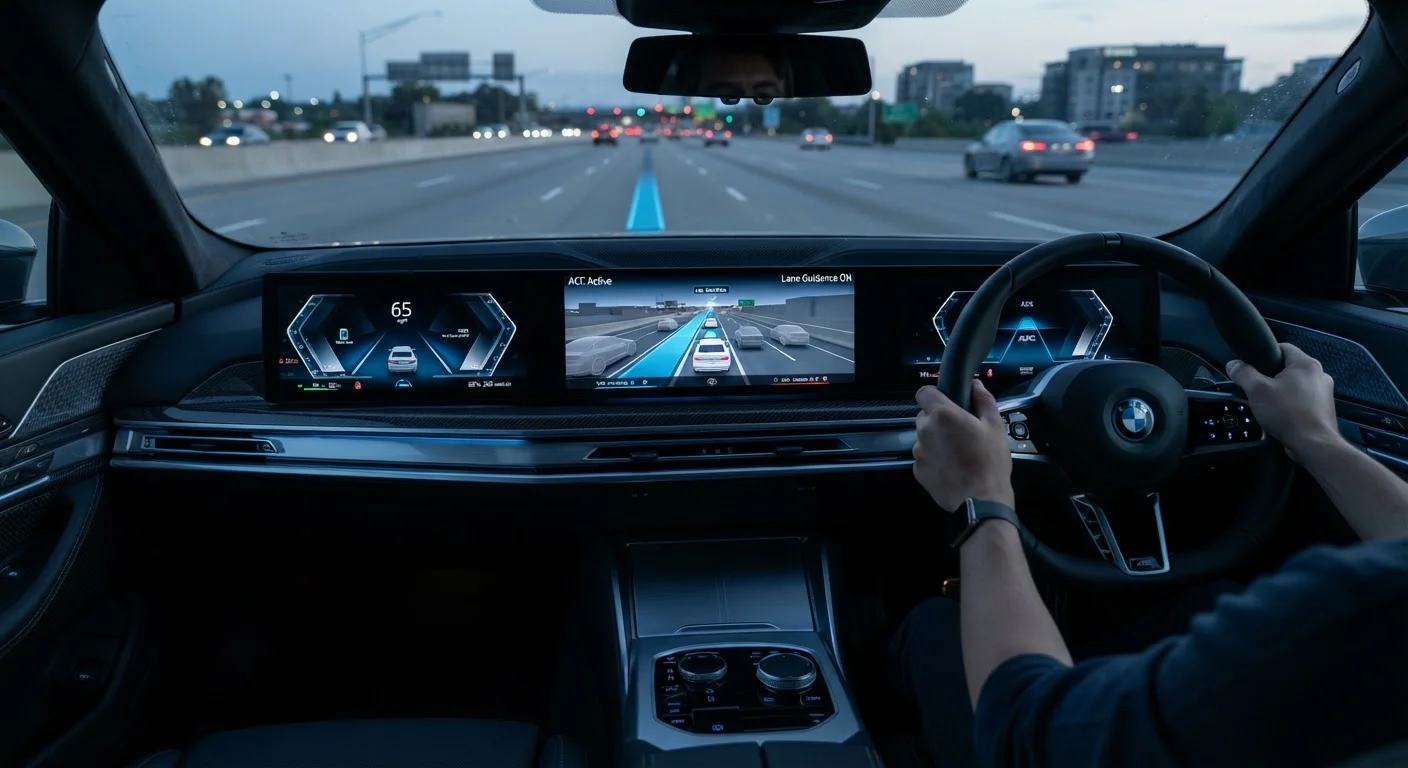
A Level 2 system combines at least two automated functions simultaneously - most commonly adaptive cruise control (speed management) and lane-centering (steering). The vehicle can accelerate, brake, and steer within its lane without direct driver input, but the driver must supervise every moment of operation.
Reduces driver fatigue on long highway stretches
Adaptive cruise control and lane-centering working together ease the physical and mental load of sustained highway driving, particularly in stop-and-go congestion.
Faster reaction to sudden speed changes ahead
Automated braking responses within Level 2 systems can act in milliseconds - significantly faster than the average human reaction time of around 1.5 seconds.
Maintains more consistent following distance
Adaptive cruise control holds a driver-set gap from the vehicle ahead, reducing the risk of rear-end collisions caused by distracted or inconsistent manual throttle control.
Level 3 permits genuine secondary task engagement
Within its certified operational conditions, a Level 3 system legally allows the driver to read, use a device, or otherwise disengage - a meaningful quality-of-life difference from Level 2.
Despite what the marketing language around some systems implies, Level 2 does not permit drivers to look away, check a phone, or mentally disengage. The system can fail without warning when it encounters unusual road markings, heavy precipitation, construction zones, or sensor interference. When it disengages - whether by design or due to system limits - the driver must be ready to assume full control instantly.
If your vehicle's lane-keeping feature frequently drops out, the lane-keeping system troubleshooting guide explains the common triggers and what to do about them.
Level 3: Eyes Off, But Not Hands Off the Situation
Level 3 represents a meaningful conceptual leap: the system, not the driver, monitors the driving environment during an active automation session. Drivers can legally disengage visual attention in the conditions the system defines - typically slow highway traffic below a set speed threshold.
Driver disengagement is a documented safety risk
Multiple studies and incident investigations have found that drivers using Level 2 systems often become less attentive over time - a phenomenon sometimes called automation complacency - despite the system requiring continuous supervision.
Systems disengage without guaranteed warning time
Environmental conditions such as faded lane markings, heavy rain, or sensor obstruction can cause Level 2 systems to hand control back abruptly, leaving little time for drivers to re-engage.
Level 3 takeover demands can be sudden and stressful
When a Level 3 system reaches its operational limit, it requires the driver to reassume control within a short window - a cognitively demanding transition, especially if the driver has been deeply engaged in another task.
Legal liability remains with the driver in most U.S. states
With narrow exceptions, U.S. law treats the licensed driver as responsible for the vehicle's operation regardless of what automation is active, meaning any collision is legally attributed to the human operator.
Performance degrades in adverse weather and complex environments
Rain, snow, glare, and unusual road markings can reduce sensor reliability significantly, and neither Level 2 nor Level 3 systems are designed to handle complex urban intersections or uncontrolled scenarios.
However, the transition demand is critical. When a Level 3 system reaches the boundary of its operational design domain (for example, approaching a construction zone or hitting rain), it issues a takeover request. The driver must respond - typically within several seconds - and assume full manual control. Failing to respond can result in the vehicle defaulting to a minimal-risk maneuver such as slowing to a stop.
Level 3 Is Not Yet Widely Available
As of now, only a small number of production vehicles sold in the U.S. include SAE Level 3 capability, and its use is subject to state-level regulations that vary significantly. Some automakers market systems with Level 3-like names that are technically classified as Level 2 under SAE definitions. Always cross-reference your owner's manual and your state's transportation authority for accurate classification and any applicable restrictions.
Level 3 availability in consumer vehicles remains limited as of this writing, and regulatory acceptance varies by U.S. state. Always verify what your specific vehicle's system is certified to do in your jurisdiction before treating any feature as a hands-free permission.
Advantages and Limitations in Practice
Both levels reduce certain driving burdens and can improve reaction times in specific scenarios - a key benefit when highway traffic suddenly slows. They also encourage more consistent following distances and can reduce stop-and-go fatigue on long commutes.
1.5 sec
Average human braking reaction time
Research commonly cited in traffic safety literature places the average driver reaction time at approximately 1.5 seconds - the gap automated emergency braking aims to close.
~94%
U.S. crashes involving human error as a factor
The National Highway Traffic Safety Administration (NHTSA) has estimated that human error contributes to approximately 94% of serious traffic crashes, underpinning the safety case for automation.
Yet their limitations are equally real. Neither system handles all weather conditions reliably. Neither can read the intent of other drivers, respond to an officer directing traffic, or navigate unpredictable urban environments with the judgment of an experienced human. Treating automation as infallible is the central documented risk. For practical guidance on using these tools appropriately, see getting the most from your car's safety systems.
It's also worth contrasting these active systems with the passive safety features - airbags, crumple zones - that operate independently of driver input. That distinction is covered in active vs. passive safety.